
|
| Xinjiang Today |
| Biography of a city | |
|
|
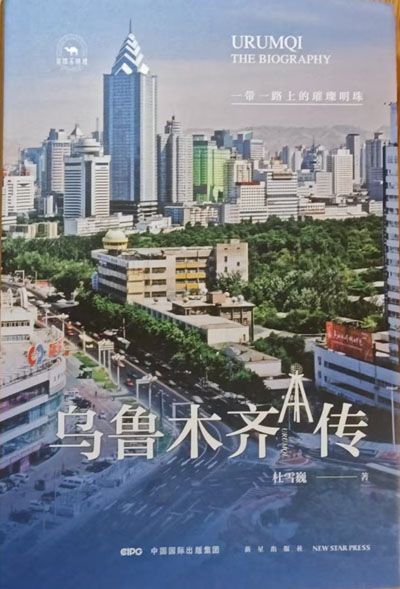 The publication of Urumqi: A Biography by cultural historian Du Xuewei in 2024 marked a seminal moment in the historical scholarship of China's northwestern frontiers. Published by the Beijing-based New Star Press as the first comprehensive biography of Xinjiang's regional capital and part of the Silk Road City Biography Series, the work traces the city's evolution from its origins to its present development—capturing, in effect, "half of Xinjiang's governance history through the story of a single city." Moving beyond earlier regional surveys or travelogues, Du provides a systematic and richly detailed narrative of Urumqi's transformation. He skillfully places the city's growth within wider currents of regional governance and national strategy, offering an insightful study that is meticulously researched. The story opens in the 18th century. Following the Qing Dynasty (1644-1911)'s campaign against the rebellious Junggar regime, a fortified town was established near the Urumqi River to secure imperial control. While defense was its initial purpose, trade arrived swiftly; by 1757, Kazak traders had been already bartering horses for silk and tea, turning the outpost into a vital node on the northern Silk Road. Thus, from its very foundation, security and commerce emerged as the twin engines of Urumqi's growth—a dynamic the author suggests continues to shape its political and economic role. Moving beyond local history, the study situates Urumqi within the broader framework of Qing frontier strategy. Du observes that north Xinjiang historically held greater strategic value than the southern oases, and control over Urumqi was significant for effective command over the region. Drawing on official archives and gazetteers, the author traces the settlement's foundation, the subsequent construction of forts, and the influx of migrants from nearby Gansu and Shaanxi provinces. By the late 18th century, this once remote garrison had grown into a regional hub supporting agriculture, crafts and trade. Du examines these developments primarily through policy decisions and demographic records, offering an analytical rather than anecdotal account of urban expansion. The book then pivots to the 20th century, where Du's expertise in regional history brings key figures to life. Considerable space is devoted to Yang Zengxin, who governed Xinjiang from 1911 to 1928. The narrative details his consolidation of power, support for abolishing unequal treaties, and advancements in industry, agriculture, education and finance. Notably, he maintained stability for 17 years without central funding, debt or tax increases—an achievement treated with evident respect. Regional military leader Sheng Shicai, who dominated Xinjiang during the 1930s and 1940s, is presented in a more complex light: opportunistic in politics yet associated with structural reforms that contributed to urban modernization. These sections are descriptive rather than judgmental, emphasizing the administrative approaches of different periods. Du has gone beyond extracting lessons from past governance, offering a historical lens for perceiving the region's enduring challenges. He masterfully interweaves grand history with intimate detail. The book anchors Urumqi's modern transformation within national and Silk Road history, while meticulously reconstructing its vanished everyday life. It has vividly recreated a lost cityscape: neighborhoods behind former city gates, artisan quarters like Jiangnan Alley and the Hetan Road, tamed from a flood-prone riverbed into a major artery. The narrative resurrects forgotten shops, beloved local foods and lively street festivals. From the late 19th century onward, Urumqi's modernization has moved forward through infrastructure projects: the introduction of the telegraph in the 1880s, the first paved roads in the 1930s, urban water supply in the 1950s, and railway and airport developments in the contemporary era. Du also looks beyond material progress to explore the city's spirit. He characterizes Urumqi as quintessentially a "city of immigrants, integration and hybrid identity." Here, regional cultures converge and blend; multiethnic neighbors once coexisted harmoniously in traditional compounds, generating countless ordinary yet moving stories. This portrait of a hybrid, open community is rooted in deep research. Du spent six years examining over 400 sources—from Qing archives to Russian expedition notes and local gazetteers—to construct this clear and compelling history. While the book focuses substantially on modern history up to the mid-20th century, its treatment of the era after the founding of the People's Republic of China in 1949 is comparatively concise, leaving room for future scholars to continue the city's story. Comments to yanwei@cicgamericas.com |
|
||||||||||||||||||||||||||||
|