|
| Xinjiang Today |
| From curiosity to connection: experiencing the real Xinjiang | |
|
|
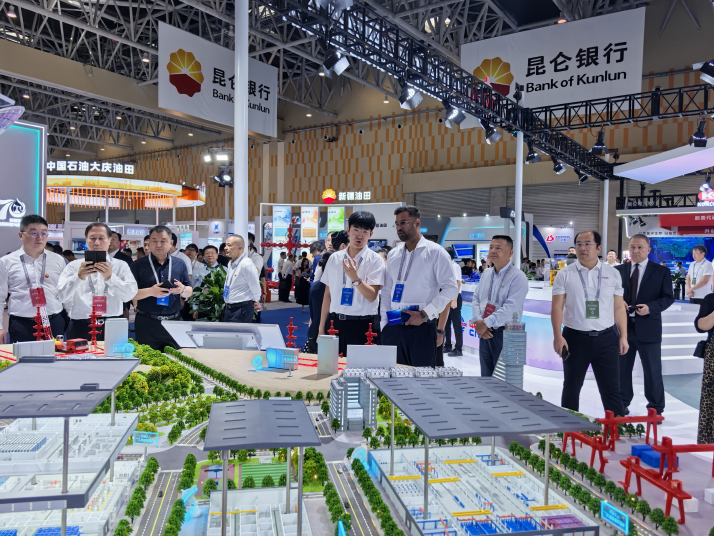 A booth at the Seventh China (Karamay) International Petroleum, Natural Gas and Petrochemical Technology and Equipment Exhibition in Karamay on August 13, 2025 (XINHUA)
In July and August 2025, international students at Peking University visited Xinjiang on a journey that blended economic observation, cultural immersion and personal discovery. Traveling from the oil city of Karamay to the border prefecture of Tacheng and the cosmopolitan capital of Urumqi, the students encountered a region shaped by both natural resources and human resilience, where ancient traditions coexist with modern development.
Through firsthand experiences such as standing in desert oilfields, visiting cultural parks and museums and engaging with local communities, these anecdotes offered diverse yet converging perspectives on Xinjiang as a place of openness, vitality and unity in diversity. Collectively, their accounts move beyond abstraction and headlines, revealing how understanding is forged not through distant study, but through lived experience. Alexander Wirch, from Ecuador, studying at Guanghua School of Management Before setting foot in Xinjiang, I thought I had a reasonable grasp on oil economies. After all, I come from Ecuador, where petroleum shapes much of our national narrative. Standing in the vast expanse of Karamay's desert oil fields, I realized I was only familiar with the theory. In Karamay, a city in north Xinjiang, in the blistering sun, with wind sweeping across the sand, I could almost feel the energy pulsing beneath the earth. It was no longer abstract; it was alive, real and transformative. Karamay is not just a hub of oil production; it's a symbol of what's possible when natural resources meet visionary planning. Once barren, it's now one of China's most affluent cities. According to official data, Karamay's per-capita GDP reached 271,400 yuan ($38,200) in 2024, ranking second among all prefecture-level administrative regions in China. Seeing this prosperity emerge from a desert landscape challenged my assumptions and underscored the impact of resource-driven development done right. But Xinjiang isn't just about economics. Our journey also led us deep into the region's cultural and environmental tapestry. In the desert, we encountered ancient architecture that seemed to rise organically from the sands, evidence of generations who thrived in harsh conditions by working with nature, not against it. Their resilience, etched into every curve of adobe and every shaded courtyard, was both humbling and inspiring. The human warmth we experienced in Tacheng, located in the far northwest of Xinjiang, was something I'll never forget. Strangers welcomed us with song, dance and joyful requests for photos. There was no pretense, no distance, only a genuine eagerness to connect, if only for a moment. It reminded me how quickly barriers fall when hearts are open. Our final stop, Urumqi, the capital city of Xinjiang, surprised me most. A cosmopolitan city pulsing with energy, it stands as a living bridge between China, Central Asia and Europe. Modern infrastructure and multicultural vibrancy intertwine in ways I didn't expect. It was here I felt the strongest shift, from outsider to participant, from observer to storyteller. This journey through Xinjiang reshaped more than my map of China; it reframed my understanding of unity in diversity, of development rooted in tradition, and of people who welcome the world with open arms. It reminded me that some truths can't be discovered through Google; They must be lived. 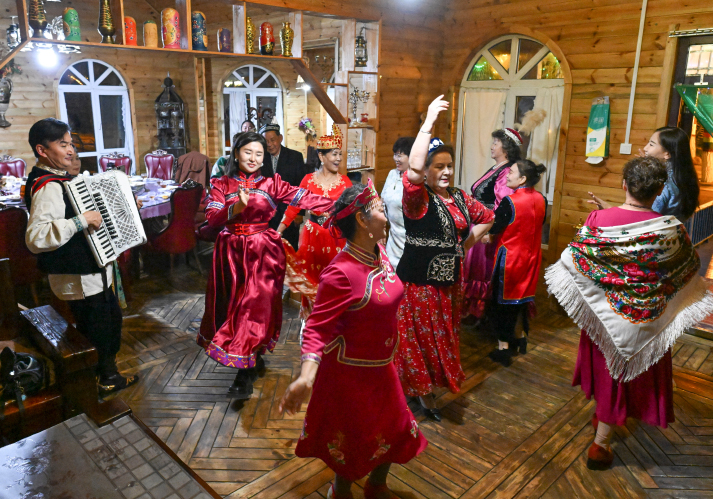 Visitors join a folk dance at a rural homestead in Tacheng on September 17, 2025 (XINHUA)
Akundi, from Angola, studying at Peking University School of Medicine Xinjiang, China's vast northwestern frontier, is a land of breathtaking contrasts, where desert meets development, and age-old traditions thrive alongside modern innovation. As a foreign visitor, I embarked on this journey with great curiosity, unsure of what to expect—yet returned with deep respect for a region that is as complex as it is captivating. Our trip began in Karamay, a city shaped, almost sculpted, by oil. Upon arrival, we visited Heiyou (Black Oil) Mountain, a geological wonder where natural asphalt seeps to the surface, forming pools so thick and pungent that the landscape feels more like science fiction than real life. Standing there, I could almost sense the pressure of the petroleum hidden beneath our feet. It was a powerful introduction to the raw natural resources that have powered the transformation of this once-remote area into one of China's wealthiest cities per capita. At the historic Karamay Oilfield No.1 Well, we learned how the discovery of oil here marked a turning point, not only for the city, but for the broader Xinjiang region. Nearby, "Devil City" offered another layer of drama, its surreal, wind-sculpted rock formations a stark reminder of the power of nature over millennia. However, the true impact of Karamay lies not in its landscapes, no matter how striking they may be, but in its story of economic renewal. It became clear to me that with vision and governance, even the harshest environments can be transformed into engines of prosperity. From Karamay, our journey continued to Tacheng. The scenery along the road shifted, revealing a quiet, majestic beauty, vast skies, undulating hills and glimpses of pastoral life. Tacheng is a border city with a rich history tied to the ancient Silk Road, and today, it stands as a bridge between China and Central Asia. In the Yemili Cultural Park of Emin County, we found ourselves immersed in the living heritage of the region's ethnic communities. Kazak, Mongolian and Uygur cultures were represented not as relics, but as vibrant, evolving traditions. The colors, the music, the craftsmanship and everything else spoke of pride and continuity. Tacheng also surprised us with its artistic soul. At the Accordion Museum, we discovered how this European instrument had become an unlikely cultural icon, deeply woven into local customs and celebrations. Meanwhile, the Honglou Museum offered deeper insight into the area's historical roots, displaying carefully preserved documents and artifacts that traced Tacheng's diverse past. These visits reminded me that culture here is not passive or preserved behind glass, it lives, breathes and adapts. Our final destination was Urumqi, the capital of Xinjiang and the symbolic heart of the region's diversity. The Xinjiang International Grand Bazaar was a feast for the senses, vivid textiles, the scent of spices and rhythmic street performances. It wasn't just a marketplace; it was a microcosm of Xinjiang itself: multicultural, energetic and open. Here, China meets Central Asia, not just geographically but emotionally, economically and culturally. What struck me most about Xinjiang was not just its physical beauty or economic achievements, but its people, their warmth, their pride in their heritage and their openness to outsiders. In every city, we were met with genuine hospitality. People sang, danced and invited us into their lives, even if only for a few minutes. These human moments were the most enduring part of the journey. Traveling through Xinjiang challenged my assumptions. I saw with my own eyes a region often reduced to headlines, and what I found was nuance, harmony and momentum. Development here is not only measured in infrastructure, but in opportunity. Diversity is not a challenge to be managed; it is a strength to be celebrated. This journey reminded me that real understanding doesn't come from reading about a place, but from being there. From walking its streets, listening to its people, and allowing yourself to be changed by what you find. Nguyen Thi Nhung, from Viet Nam, a doctoral student in the Department of Chinese Language and Literature As an international student, I felt deeply honored to take part in the Understanding Contemporary China and Perceiving Open Xinjiang program. Far beyond an academic field trip, this was an invitation into the heart of a region often misunderstood, yet filled with vitality, resilience and openness. Xinjiang has always held a kind of mystique in my mind. A place where ancient trade routes once linked civilizations, where cultures converged and mingled, this history came alive the moment I arrived. What I found wasn't a relic of the past, but a dynamic and modern region still rooted in tradition but also thriving on progress. My journey began with anticipation, and it quickly became an experience that reshaped my perspective. In Karamay, I saw more than oil rigs and industrial zones. At the Karamay Oilfield, I stood beside wells that have powered not only Xinjiang's economy but also symbolized the perseverance of its people. Generations of workers have toiled in this desert, not just extracting fuel but forging a future. There was something humbling about being there, seeing how human determination and innovation could transform arid land into a beacon of prosperity. In Tacheng, culture felt like a heartbeat that resonated through every corner of daily life. One afternoon, we were invited into the home of a local family. There, under the warm sunlight of their courtyard, we danced alongside residents in traditional dress. It was more than a performance; it was a shared celebration. The joy, the laughter, the effortless unity among people of different ethnicities, these moments spoke louder than any lecture or textbook ever could. Baktu Port of Tacheng, a key node in the Belt and Road Initiative, introduced by President Xi Jinping in 2013 to boost connectivity along and beyond the ancient Silk Road routes, illustrated Xinjiang's strategic role as a gateway connecting China to Central Asia and beyond. Commerce and culture move through this region hand in hand, creating a living echo of the ancient Silk Road. Seeing firsthand how Xinjiang is leveraging its location for international cooperation gave me new insight into China's global vision, and Xinjiang's vital role within it. But the most powerful lesson came from everyday people. In Yuliuxiang Alley of Tacheng, we met families composed of multiple ethnic backgrounds living together in harmony. It wasn't an overly formal or organized event, but simply how things are. Unity here isn't a political slogan; it's a reality felt in shared meals, interwoven traditions and the laughter of children playing together, unaware of difference. The people of Xinjiang welcomed us not as outsiders, but as friends. Their kindness left a lasting impression on me. I arrived with curiosity; I left with deep admiration, not just for the breathtaking landscapes or the impressive development, but for the spirit of openness and unity that defines this region. This journey reminded me that to truly understand a place, you have to walk its streets, share in its culture, and listen to its people. Xinjiang, in all its complexity and beauty, offered that in abundance. Comments to zhaowei@cicgamericas.com |
|
||||||||||||||||||||||||||||
|