
|
| Xinjiang Today |
| The Tang Dynasty's passport | |
|
|
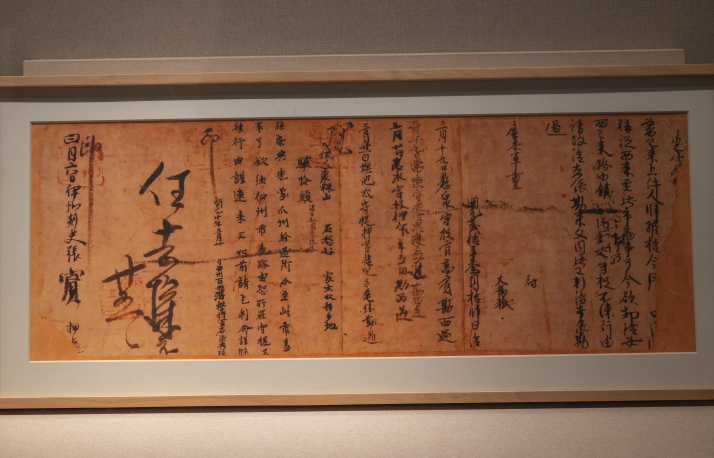 Photo taken on March 29, 2025 shows the Guosuo of Shi Randian, a valuable administrative document dating back to the Tang Dynasty (618-907), on display at the Kashgar Museum (VCG)
As modern visa policies and the unprecedented ease of global movement are increasingly defining international relations, it's easy to forget that travel permits have existed for more than a thousand years. Long before the simplicity of a stamped modern passport, the Tang Dynasty (618-907), often celebrated as China's golden age of international exchange, relied on a strict, centrally managed travel document known as the guosuo.
While ancient historical chronicles record the regulations, the true operational reality of the guosuo is revealed not by a historian, but through a physical artifact: the Guosuo of Shi Randian, an extraordinary document unearthed from the shifting sands of Turpan, Xinjiang. This single, brittle permit discovered in Astana Tomb No.509 offers a vivid lens through which to view both the administrative ingenuity and bureaucratic rigidity of the ancient Silk Road. Paperwork that defined mobility The Guosuo of Shi Randian is a remarkably vivid snapshot of Tang administrative practice. Originally a long strip of paper meticulously joined together and measuring more than half a meter, the document was issued to the merchant Shi Randian by the Household Departments of both Guazhou and Shazhou, two cities at the western end of the Hexi Corridor. Shi had first traveled from Anxi Frontier Command, the supreme military headquarters established by the Tang Dynasty in the Western Regions, to Guazhou for trade, carrying a guosuo issued by the Anxi Frontier Command General. The surviving document contains five vermilion seals: the first from the Guazhou Military Governor's Office, the following three from Shazhou Office, and the final one from Yizhou.After completing his trade, Shi applied to the Guazhou Military Governor's Office for a return guosuo to travel back to Anxi, which Guazhou duly issued. Because the route from Guazhou to Anxi required passing through the Tiemen Pass, which is located between modern Yanqi and Korla, this checkpoint was explicitly noted on the permit. This was no casual transit pass; it was a fully articulated government license, a reminder that the Tang Dynasty's cosmopolitanism was always, at its core, a form of regulated openness and underpinned by a strenuous bureaucratic infrastructure. By examining the details recorded on this permit, we can discern the state's key administrative priorities. First, it confirms identity and destination. The guosuo verifies the traveler's identity and clearly specifies the authorized destination, as well as the precise route to be followed. This level of detail left little room for deviation, effectively binding the traveler to a government-approved itinerary. Second, it indicates the purpose of travel. The document notes that Shi was traveling for trade, highlighting the system's primary function: to vet and legitimize commercial movement across the vast empire. Such oversight was crucial for regulating markets and preventing the movement of goods or people that could evade taxation or disrupt local economies. Third, it is a proof of authority. The presence of official seals and the signature of the issuing officer (likely the local Hucao Canjun, or Household Department Clerk) provided the necessary legitimacy for passage through every checkpoint and ferry along the route. This chain of authentication rendered the document valid across the entire imperial territory. For Shi, this permit was his golden ticket to legitimate commerce; without the guosuo, his journey would have immediately rendered him a fugitive, subject to arrest and penalties. Strictness of the system The system, which effectively combined the functions of a modern identification card and a travel visa, was designed not only to facilitate taxation and maintain public order but also to regulate the movement of a vast population spread across a geographically challenging empire. Tang Law was uncompromising regarding unauthorized travel. As recorded in the Six Codes of the Tang, anyone caught attempting to cross a pass "privately without official documents" was liable for a sentence of one year of penal servitude. This was not mere theory, as another famous Turpan discovery demonstrates: the Fragmentary File of the Investigation into Jiang Huaming's Loss of Guosuo, excavated in 1973 at the Astana site in Turpan. The document chronicles the misadventures of a porter named Jiang Huaming, who, after losing his permit, was arrested, interrogated across multiple bureaucratic offices, and detained solely for lacking the required paper. The administrative chaos and severe response underscore just how central, and non-negotiable, the document held by Shi was to daily life and commerce. The contrast is stark: one paper granted freedom; its absence guaranteed detention. The bureaucratic machine, while efficient, was utterly unforgiving of error or misfortune. Central hand in a local frontier Although Shi Randian's pass was physically issued by local authorities in a distant frontier prefecture, its rules originated from the central government's Department of State Affairs in the capital, Chang'an. This illustrates a key aspect of Tang governance: a highly coordinated, unified regulatory apparatus capable of dictating the precise standards of paperwork and procedure from the imperial center to the most remote Silk Road prefectures, such as Turpan. At the central level, the Department of Justice oversaw the administrative framework. On a local basis, the framework of the Household Department Clerk was responsible for reviewing applications and issuing permits. Applicants were required to submit detailed forms specifying their itineraries and purpose, often accompanied by supporting certificates. This process was both meticulous and, judging by other recovered documents, often completed with surprising efficiency. Shi's successful application exemplifies this sophisticated network in action, demonstrating how the long arm of the imperial bureaucracy extended across every major travel route. Echoes across continents The administrative uniformity seen in Shi Randian's permit extended to international exchange, demonstrating that the system was intended for global engagement. The same rigorous guosuo logic applied to passes issued to foreign dignitaries. For instance, the original passes of the Japanese monk Enchin (held at Japan's Mii-dera Temple) were designed by both central and local Tang authorities and exhibit the same bureaucratic rigor and required detail of Shi Randian's permit. These overseas artifacts confirm that the Tang state treated all travel—domestic or international—with equal administrative seriousness. The system ensured that foreign travelers were tracked, and Chinese citizens were strictly prohibited from leaving the country without explicit imperial consent. This is historically illustrated by the account of the famous pilgrim Xuanzang, who had to sneak out of Chang'an because Emperor Taizong (598-649) denied his guosuo application, effectively treating his journey as an illegal border crossing. The Guosuo of Shi Randian is far more than a historical curiosity. As a primary source artifact, it offers a rare, granular view into the operational efficiency, legal stringency and geographic reach of the Tang Dynasty's administrative apparatus. Behind the flourishing trade, the cultural exchange, global prominence and the celebrated openness lay a meticulously crafted and rigorously enforced administrative reality. The paper permit, whether held by a humble porter like Jiang or a merchant like Shi, was the ultimate symbol of imperial control. It confirmed that the right to travel, even for a short journey between regional hubs, was a privilege strictly licensed and managed by a vast, coordinated network that spanned the entirety of the magnificent Tang Empire. It is a striking reminder of how essential a single piece of government-stamped paper was to life and livelihood along the ancient Silk Road. Comments to maxiaowen@cicgamericas.com |
|
||||||||||||||||||||||||||||
|