
|
| Xinjiang Today |
| Changing a village in 10 years | |
|
|
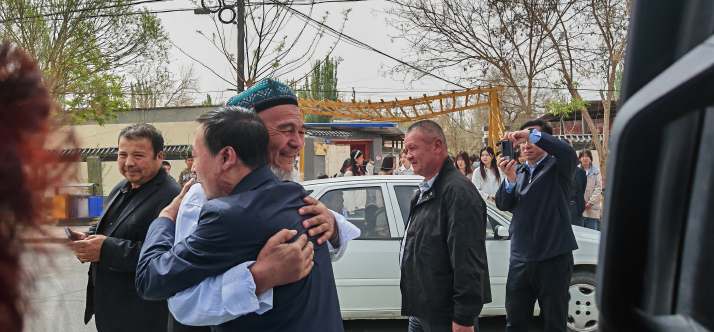 Before leaving Xinjiang, Zhou Aiwu says goodbye to villagers in Tongqike Village, Yuli County, in May 2023 (COURTESY PHOTO)
When Zhou Aiwu, a member of the Communist Party of China (CPC), was posted in Xinjiang, he first planned to stay there for three years. Then three years turned to six, and finally a decade. In 10 years, he has improved the lives of the people in the area he served and inspired a generation of young people to educate themselves and do something meaningful with their lives. Zhou's first destination was Yuli, a county lying on the border of the Taklimakan, the world's second largest shifting sand desert. Tongqike is a remote village in the county, with less than 2,000 people, mostly Uygurs. Zhou's first acquaintance in the village was Ainiwaer Tuohuti, a boiler operator with two children, and the two quickly formed a close bond. One day, Ainiwaer asked Zhou if he would teach the children standard Chinese and Zhou readily agreed. He started holding classes at Ainiwaer's home every Saturday afternoon. Word spread quickly, and soon, more children flocked to the class. Every new student was given a schoolbag, reading materials and stationery. Zhou was astonished by the children's hunger for knowledge. The class swelled rapidly, eventually reaching 68 students, some traveling from neighboring villages. Ainiwaer's home soon became too small, necessitating the class to move to the villagers' committee office. Dilixiati Abulimiti was one of the students. He was 13 at that time, the oldest child in the class. "Every Saturday, Zhou taught us for four hours," he said, talking of the classes. "He taught us Tang Dynasty (618-907) poetry, told us stories, and even sang and danced with us." Over three years, Zhou gave more than 100 lessons, frequently continuing them on Sundays as well. When required to travel for official business, he made sure to rush back before Saturday. In these years, he spent over 200,000 yuan ($28,651) of his salary for the children. When Zhou had first arrived in Xinjiang in 2013, he was deputy secretary of the CPC Yuli County Committee. Next spring, he was given the additional role of first secretary of the Tongqike Village Branch. 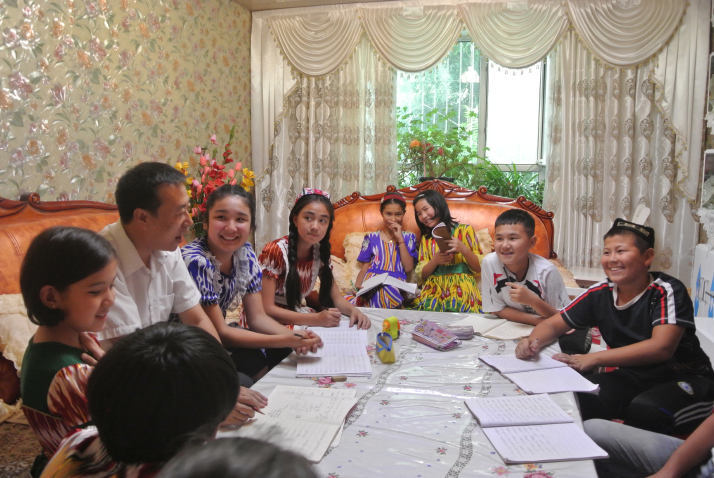 Zhou Aiwu (third left) learns Uygur and standard Chinese together with Uygur children in Yuli in July 2014 (COURTESY PHOTO)
Selected and dispatched to villages by CPC committees at higher levels, first secretaries are part of the village leadership together with members of the CPC village branch and the villagers' committee. They are tasked with helping devise village development plans, resolve transportation, power supply and other practical problems, and enhance villagers' capability of self-governance. Thanks to Zhou, the children in the village flourished academically. Dilixiati got admission in university to study computer information systems administration and upon graduation, secured a well-paying job at the Tarim Oilfield, China's largest ultra-deep oil and gas production base in the hinterland of the Taklimakan. He credits Zhou's support as the reason for his success. Zhou's remarkable ability to connect with the children was due to his fluency in the Uygur language. Upon arriving in Xinjiang, he deliberately sought out the most isolated post available: a village called Qiongmaili, the last location in the entire autonomous region to gain access to electricity. He lived and worked there alongside the villagers for four months, and it was there that he began learning Uygur. Progress was initially slow; it took him eight months just to master the 32 letters of the alphabet. He devoted over six hours daily to studying Uygur: listening to recordings in the morning, watching television in the evening, and memorizing words whenever possible during the day. Over the years, he filled more than 40 notebooks with his Uygur lessons. Colleagues, gatekeepers, sanitation workers and even the naan vendors became his impromptu tutors. Mastering the language greatly improved his work efficiency. Zhou spent two months visiting over 1,000 households without interpreters, armed with a Uygur-standard Chinese dictionary. He documented every difficulty and problem he encountered, compiling a list of more than 200 issues, most of which were eventually resolved. 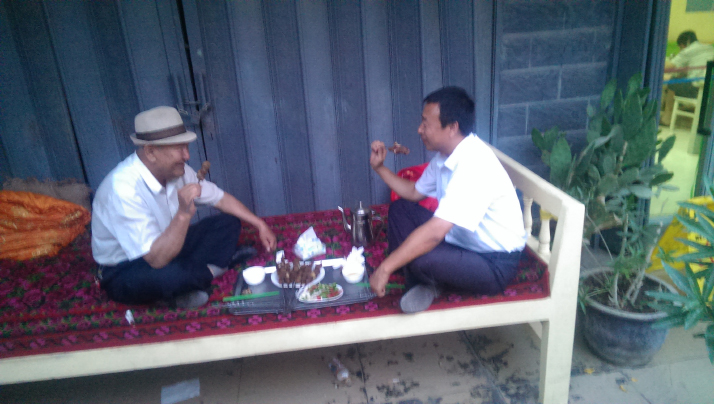 Zhou Aiwu (right) eats kebabs with a resident in Yuli in August 2015 (COURTESY PHOTO)
In Xinjiang, Zhou made many Uygur friends. He frequently visited them, shared meals, and attended their weddings. He devoted himself to community welfare, buying medicine for villagers and helping hundreds of ethnic minority families emerge from poverty. Throughout his 10 years in Xinjiang, he spent a significant amount of his own money supporting the local population and made substantial contributions to the development of local enterprises. A workaholic, his exceptional service led to repeated extensions of his term—from the planned three years to a full decade. In 2020, Zhou's dedication was tested severely. A natural gas explosion ripped through his residence, throwing him violently to the floor. He suffered extensive burns and the doctors at the hospital said the survival rate for such extreme trauma was only 7 percent. The hospital director became his chief physician, telling him, "You came from so far to support Xinjiang. I will move my office next to your ward, and I will personally take part in every one of your surgeries." The surgeries were fraught with life-threatening complications, but Zhou survived. The sheer scale of the procedure was staggering. Over 1,000 pins were required for the skin grafts and when they were removed, it was agonizing. Zhou had to bite his lips hard when the iron staples were pulled out from the flesh, one by one. 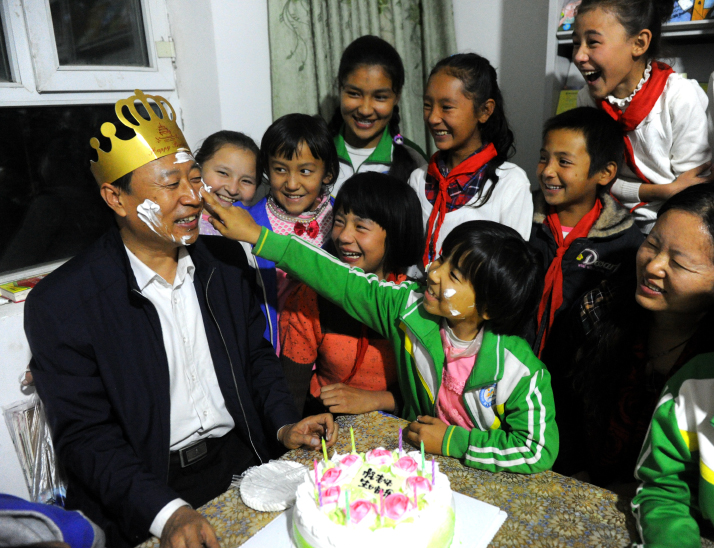 During a study trip to the Taklimakan Desert in 2015, the 68 Uygur children Zhou sponsored threw him an impromptu birthday party (COURTESY PHOTO)
On October 1, 2020—his 50th birthday—supported by his wife, son, and three caregivers, Zhou managed to sit up and finally get down from bed. For a patient suffering such severe burns, recovery and return to duty typically requires three to five years; Zhou accomplished this feat in just over seven months. During his decade of service in Xinjiang, Zhou received numerous honors, including being named a Moral Model and a National Advanced Individual in Aiding Xinjiang. Even after his return to Baoding in Hebei Province, north China, his bond with Yuli and his mentorship of the young people there continue. When Dilixiati and another young man from the village, Ailikaier Ainiwaer, wanted to broaden their horizons and work outside the region, Zhou helped them find jobs and arranged their flights and initial accommodation. When the two young men arrived in Baoding to start a new chapter in their lives, Zhou was waiting for them at the airport, having stood there for a full hour. Comments to yanwei@cicgamericas.com |
|
||||||||||||||||||||||||||||
|