
|
| Xinjiang Today |
| Traditional music revitalizes Xinjiang's villages | |
|
|
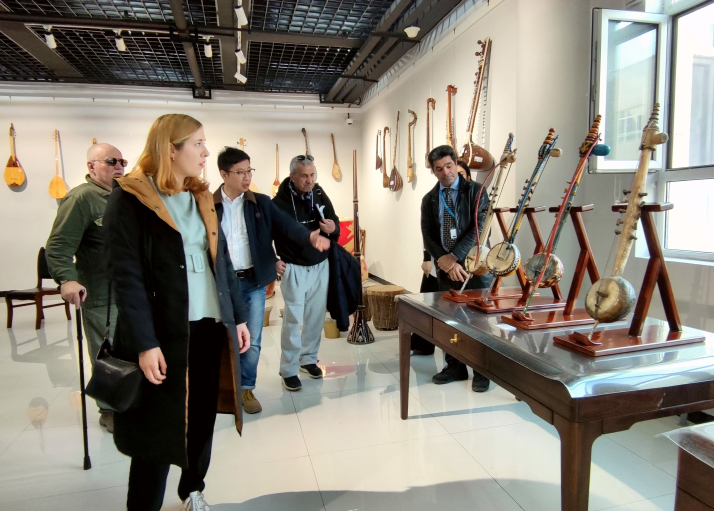 Visitors from different countries learn about Xinjiang's traditional ethnic music instruments at Xinjiang Arts University in Urumqi on November 4, 2025 (LU YAN)
With the rhythmic tapping of hammer on mulberry wood, master craftsman Yiming Wushouer shapes the body of a dutar, a traditional two-stringed Uygur musical instrument, in a workshop in Tuowankewukusake, a village in Kashi (Kashgar) Prefecture in south Xinjiang. "I was born and raised in a village of musical instruments. Our village has a history of over 150 years of instrument making, and almost every household knows how to craft them," the 77-year-old said, gently stroking the nearly finished dutar in his hands. "In the past, we made instruments by hand at home and sold them in small quantities in the bazaar. Now, we work in a traditional instrument workshop. Some are bought directly by tourists, while others are ordered online. Our instruments are in high demand all across the country." The craft has transformed from a fading family tradition into a vibrant and sustainable industry that not only supports local livelihoods but also preserves and promotes the rich cultural heritage of Xinjiang's different ethnic groups. Through instruments like the dutar, melodies that once echoed in family courtyards now reach broader audiences at national exhibitions and global markets, fostering cultural exchange and ensuring that these timeless traditions continue to resonate with future generations. 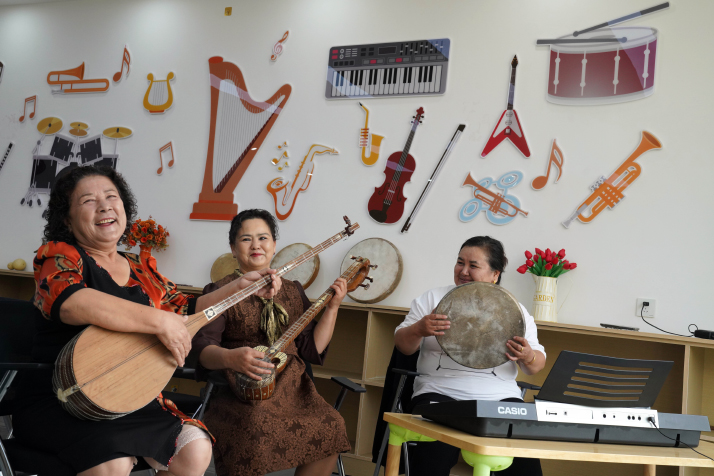 A rehearsal in a community activity center in Kashi City, Kashi Prefecture, in September 2024 (XINHUA)
A living workshop For more than five decades, Yiming has been following the rhythm of his craft—hollowing mulberry wood, fire-shaping the curves, assembling parts with intricate carvings, setting the bridges and frets, polishing, and applying lacquer. His tools—planes, chisels, files and sandpaper—are extensions of his hands. Among his creations is a 5.7-meter-long five-stringed tanbur, a plucked string instrument recognized by the Shanghai-headquartered China Records as the longest of its kind in the country. Today, Yiming has been designated a national representative inheritor of the intangible cultural heritage craft of ethnic musical instrument making, specializing in Uygur traditions. Skilled in making eight traditional instruments, he has passed on his knowledge to dozens of apprentices. As local official Rezeye Aierken said, the village now produces instruments in 27 categories and over 50 varieties. In 2011, it was named a National Intangible Cultural Heritage Productive Protection Demonstration Base—a living workshop where tradition sustains community and culture resonates into the future. Thanks to the paired assistance program in Xinjiang, in which more economically and technologically developed cities and provinces partner with less developed ones to boost their growth, Guangdong Province in the south provided over 42 million yuan ($6 million) in funding since 2024 to revitalize this village. Combining instrument-making, intangible cultural heritage demonstrations and hands-on immersive folk experiences, the project aims to establish a new landmark for cultural and tourism integration. Huang Tao, a housing and urban-rural development bureau official from Guangdong, told Xinjiang Daily there are welcome dance performances daily for visitors while Xinjiang song and dance shows are held on the folk culture stage, "bringing local traditions to life." The story of Tuowankewukusake is not an isolated one. Its transformation has been replicated in other communities across Xinjiang. Jiayi, a village in Aksu Prefecture, has a 300-year legacy as one of Xinjiang's leading villages producing handmade folk instruments. Once made in scattered family workshops, it is now a well-organized industry that is directly boosting local prosperity. "In the past, villagers worked in scattered, small workshops. The sales were unstable, and the quality varied," village head Baihetiyaer Amuti said. A pivotal change came in 2020 with the establishment of the Jiayin Handmade Musical Instrument Intangible Cultural Heritage Workshop. This initiative built a synergistic model linking households, cooperatives, the workshop and the villagers' committee. "The heritage workshop has conducted several training sessions, instructing hundreds of individuals and effectively filling the talent gap in the inheritance of craftsmanship," said Li Wenbing, head of the cultural heritage department of the Bureau of Culture, Sports, Radio, Television and Tourism in Aksu. The results are tangible: The workshop provides stable employment for over 160 people with an average monthly income exceeding 3,500 yuan ($500). This is a notable contrast to the 2024 national average disposable income of rural residents, approximately 1,927 yuan ($276) per month. The annual output value of the village cooperative is 18 million yuan ($2.57 million), commanding an impressive 70 percent of Xinjiang's handmade instrument market. It produces over 40,000 instruments annually, underscoring the successful transformation of intangible cultural resources into a powerful economic engine. At the same time, the village is also developing tourism, creating new agritainment businesses to revitalize the local economy. 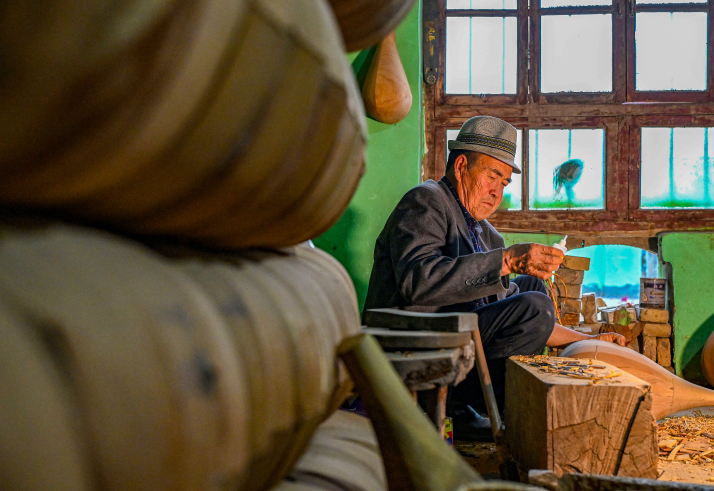 A craftsman glues the soundboard of a dutar at home in Jiayi Village in Aksu in October 2024 (XINHUA)
Policies empower tradition There is a comprehensive, government-led campaign to preserve, revitalize and promote Xinjiang's ethnic musical instruments and traditional music heritage. For example, since 2021, cumulative financial investments have been made by the central and regional governments for the protection of Xinjiang's intangible cultural heritage protection. The funds, exceeding 164 million yuan ($23.5 million), have facilitated extensive fieldwork, documenting knowledge from over 10,000 inheritors of the craft, the construction of heritage-experiencing facilities, such as the Xinjiang Intangible Cultural Heritage Museum, and support for artistic creation. Moreover, in recent years, Xinjiang has implemented systematic projects to preserve endangered instruments, establish digital audio-visual archives and promote the inclusion of their craftsmanship in the intangible cultural heritage list. 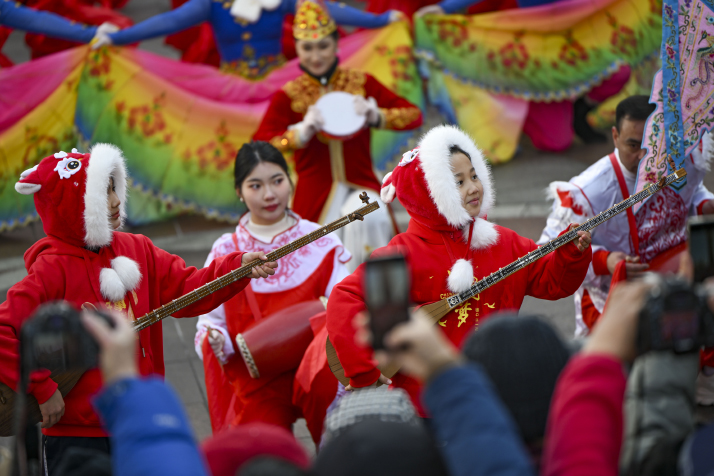 Children perform with the dutar, a traditional two-stringed Uygur musical instrument, at a Chinese New Year gala in Urumqi in January 2025 (XINHUA)
In many rural areas and communities, government-funded cultural activity courtyards have become gathering places for local musicians. These venues host spontaneous events where musicians of all ages perform together, and folk songs are sung. Courses in traditional music have been introduced in primary and secondary schools as well as universities, heritage transmission bases have been set up, and the master-apprentice system is encouraged to complement traditional education models. Communities and schools are encouraged to invite inheritors to teach. The Twelve Muqam is a noteworthy example. It is a Uygur performance art that blends singing, dancing, and music and is protected by legal and institutional frameworks. In 2010, the regional legislature enacted the Regulations of the Xinjiang Uygur Autonomous Region on the Protection of Uygur Muqam Arts. This landmark law clearly defines the rights of inheritors, while outlining the responsibilities of government bodies and society at large. It ensures the allocation of essential resources, including funding and dedicated spaces, for preservation work. In 1996, Xinjiang Arts University pioneered a dedicated Muqam major, a significant step. The program has had over 250 graduates so far who now form the backbone of Muqam's continuity, working as performers in professional troupes or as researchers engaged in documentation—securing the art's vitality for generations to come. (Print Edition Title: Rural Resonance) Comments to luyan@cicgamericas.com |
|
||||||||||||||||||||||||||||
|