
|
| Xinjiang Today |
| From tuntian to the XPCC | |
|
|
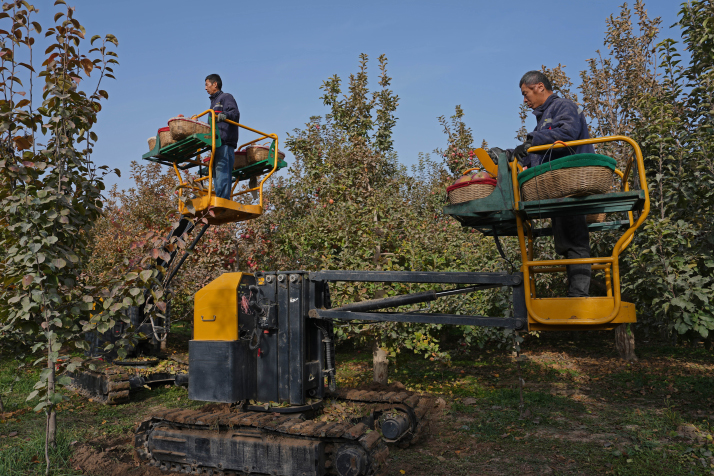 Workers pick apples in an orchard of the Xinjiang Production and Construction Corps (XPCC) First Division on October 23, 2025 (XINHUA)
When discussing the tuntian system in the Western Regions—the practice of stationing troops to reclaim wasteland for cultivation, two historical figures deserve special attention. The first is Zhang Qian, an official of the Han Dynasty (206 B.C.-A.D. 220), who was sent with over 100 men to forge an alliance with the Rouzhi, one of the earliest inhabitants of the region, and coordinate an attack on the Xiongnu, a nomadic tribe feared for their mounted archers, who frequently raided Han territory. Although they failed to secure an alliance, they brought the Han court detailed and systematic knowledge of the Western Regions. The second figure is Zheng Ji. After Zhang opened the route to the Western Regions, exchanges between the Han court and the various states of the region strengthened. Envoys traveled back and forth, and merchants from many ethnic groups increasingly used the corridor that later came to be known as the Silk Road. To protect this route across sparsely populated terrain and difficult passes, Han Emperor Wudi, who reigned from 141 B.C. to 87 B.C., created a new post, stationing an official with several hundred troops near present-day Luntai in Bayingolin Mongolian Autonomous Prefecture, who both provided security and carried out garrison farming. After Emperor Xuandi came to the throne in 74 B.C., he promoted Zheng and dispatched him to Jushi (present-day Turpan Basin) to lead troops in garrison farming, with authority over territories south of the Tianshan Mountains. Zheng also campaigned vigorously against the Xiongnu, driving them to withdraw from the Western Regions. In 60 B.C., the Han court established the Western Regions Frontier Command, headquartered in present-day Luntai, and appointed Zheng as its first head. He formalized administrative offices, stationed troops and implemented state directives across the Western Regions, marking the beginning of sustained Han governance there. 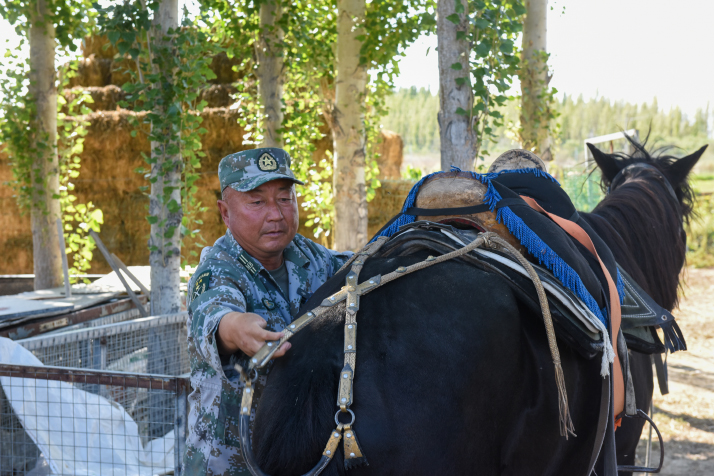 An XPCC Fourth Division militia member tacks up his horse before a border patrol on September 5, 2024 (XINHUA)
Tuntian and frontier governance Upon taking office, Zheng expanded the tuntian system, and administering the garrison-farming organizations became a central part of his duties. The primary purpose of tuntian was to secure reliable grain supplies for the garrisons; it also provided essential necessities for envoys and merchants, helping keep trade along the Silk Road moving. The large-scale expansion of the tuntian system produced tangible results. Backed by the Han Dynasty's advanced agriculture, crafts and commerce, the garrison-farming program had a lasting impact on the economy and society of the Western Regions. Tuntian troops brought production skills, including knowledge of cultivation, irrigation and ironworking. They also brought equipment. Iron tools and farm implements consequently became more common in the region, including chisels, axes, saws, iron plowshares and tongs. The use of draft oxen further increased agricultural efficiency. These changes not only eased supply pressures on the garrisons, but also encouraged broader land reclamation across the Western Regions, supported the diffusion of new techniques, and contributed to local economic growth. They also helped sustain the Silk Road as an active corridor of exchange. Crops such as sesame, broad beans, cucumbers and carrots moved from the Western Regions into the Central Plains, while silk textiles, ironware, and other manufactured goods traveled westward. As commercial ties deepened, exchanges between the Central Plains and the Western Regions became increasingly extensive and institutionalized. The practice of anchoring governance in the Western Regions through the tuntian system became a model for later imperial dynasties. Successive central governments continued to employ tuntian in one form or another. The system served several practical purposes: It reduced reliance on long-distance grain transport, secured provisions for frontier garrisons, eased pressure on local communities and supported broader socioeconomic development. It also reinforced defense, advanced frontier settlement and cultivation and encouraged cultural contact among different ethnic groups. In this sense, the principle of "sustaining the army through agriculture" persisted for more than a millennium. Late Qing Dynasty (1644-1911) scholar Wei Yuan summarized three benefits of the system: First, it secures the frontier while lowering transport costs; second, it reclaims wasteland while increasing resources; third, it dispenses with grain shipments while replenishing granaries. 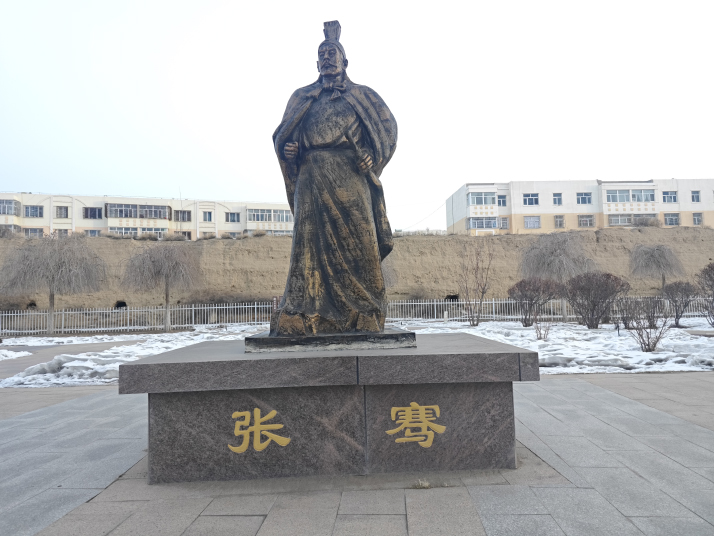 A statue of Zhang Qian (ca. 164-114 B.C.) in Hami (XINHUA)
The XPCC in contemporary Xinjiang When Xinjiang was peacefully liberated in 1949, farming and animal husbandry were the main pillars of the economy. The region lacked development and the population were impoverished. In January 1950, the People's Liberation Army (PLA) units stationed in Xinjiang started focusing their efforts on production and construction to consolidate border defense, speed up Xinjiang's development and reduce the economic burden on the local government and local residents. When the year ended, they were self-sufficient in edible oil and vegetables and mostly self-sufficient in grains. In 1953, the Xinjiang Military District reorganized its troops into two divisions: defense and production troops. The latter had regimental agricultural and stock raising farms. The production troops set up industrial, transport, construction and commercial enterprises, as well as public institutions of science and technology, education, health, and culture. In October 1954, the Production and Construction Corps of the Xinjiang Military District of the PLA was formed, which was renamed the Xinjiang Production and Construction Corps (XPCC) in December 1981. According to the white paper The History and Development of the XPCC issued by the State Council Information Office in 2014, the practice of stationing garrison troops to cultivate and guard its border areas is a legacy of China's history of developing and safeguarding its frontiers for millennia. In Xinjiang, it represented a continuation and development of historical experience under new conditions. Xinjiang has a long border, and the XPCC has been given the responsibility of safeguarding it. A highly organized paramilitary force, the XPCC has for many years shouldered both production and military duties, every member assuming the dual role of soldier and worker. Together with the army groups, police force and local residents, it has built a strong border joint defense system. The XPCC has played a crucial role in fighting terrorism and maintaining stability. Since the 1980s, the threat to Xinjiang's social stability from the "three forces"—separatists, religious extremists and terrorists—has grown. To confront it, the XPCC has established emergency militias to respond to violent terrorist activities rapidly. The XPCC has always followed the principle of "not competing for benefits with the local people." It has reclaimed farmland and built regimental agricultural and stock raising farms in the Gobi Desert and in the harsh natural environment of the desolate border areas. It has also gradually established a multi-sector industrial system encompassing food processing, light industry, textiles, iron and steel, coal, building materials, electricity, chemicals and machinery. Additionally, the XPCC has achieved significant progress in education, science and technology, culture, health and other public sectors. In comparison with the Han Dynasty's tuntian system, the XPCC has carried forward and modernized garrison-farming practices in tandem with border defense. Operating on a much larger scale and with broader influence than its historical antecedents, it has become an important force in strengthening border security and maintaining stability in Xinjiang. At the same time, it promotes local economic development, ethnic unity and social stability, thereby contributing to the implementation of the China-proposed Belt and Road Initiative that aims to boost connectivity along and beyond the ancient Silk Road routes. Drawing on the tradition of "supporting the military through farming and safeguarding farming through a military presence," and applying contemporary management approaches, the XPCC has developed a frontier governance and development model suited to the new era. Through economic development and cultural exchange, it also aligns with the goal of building a community with a shared future for humanity while helping safeguard national sovereignty and territorial integrity. Comments to lanxinzhen@cicgamericas.com |
|
||||||||||||||||||||||||||||
|