
|
| Xinjiang Today |
| Homegrown healthcare | |
|
|
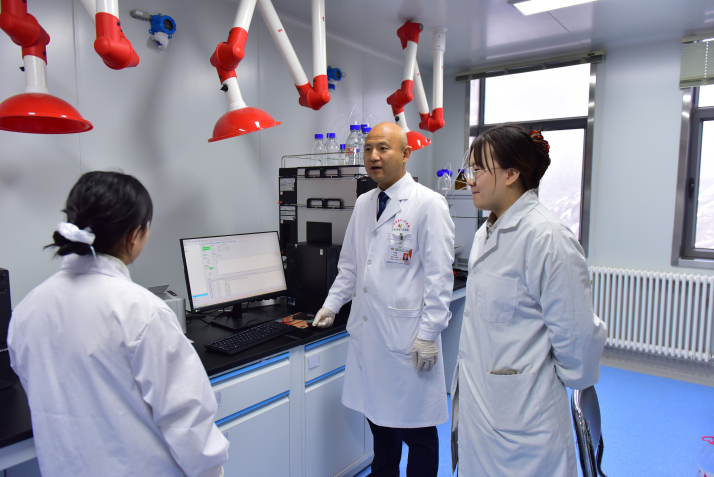 Li Zhijian (center), Vice President of Xinjiang Uygur Autonomous Region Uygur Medicine Hospital, at Xinjiang's Key Laboratory of Evidence-based Research and Transformation of Hospital Preparations of TCM in Urumqi on December 12, 2025 (COURTESY PHOTO)
If you are a local in Xinjiang and catch a cold, your first-choice medicine is likely Zukamu Granules—a traditional herbal medicine that has been a household antidote for cold for generations. Zukamu Granules is the preferred drug for treating colds in Uygur medical theory, and has been in use for 1,500 years. In recent years, medical researchers have been striving to modernize traditional Uygur medicine, an integral part of traditional Chinese medicine (TCM). They are leveraging modern science and technology to preserve and innovate Uygur therapeutic techniques, breathing new life into this time-honored medical heritage. Milestone in research Some exciting news emerged from a session of the China Ethnic Medicine Association last December. A project led by a team from the Xinjiang Uygur Autonomous Region Uygur Medicine Hospital won the top 2025 China Ethnic Medicine Association Science and Technology Award. The project developed evidence-based transformation technologies for Xinjiang's traditional ethnic medicine preparations, focusing on clinical value. Approved by the Ministry of Science and Technology, the award honors outstanding contributions to the inheritance and innovation of ethnic medicine. The team, led by Li Zhijian—researcher, doctoral supervisor, and vice president of the hospital—spent over a decade tackling the technical bottlenecks hindering the development of Xinjiang's ethnic medicine. Xinjiang's ethnic medicine, a vital component of TCM, boasts profound cultural connotations and has proven clinical value. However, its industrialization and sustainable development are hampered by four core challenges: inadequate systematic inheritance, lack of scientific validation, underdeveloped quality control, and disjointed industrial transformation. To break these bottlenecks, Li and his team focused on resolving issues including the difficulty in transforming classic prescriptions into today's medicines, and outdated standards. A critical challenge in ethnic medicine inheritance is that the theories and classic prescriptions are mostly passed down orally, lacking systematic documentation. This also puts some traditional processing techniques at risk of being lost. To address this, the team established a "trinity" model integrating literature research, clinical verification, and standard formulation. Li told Xinjiang Today they sorted out 1,200 ethnic medicine prescriptions, condensed 200 representative ones, and conducted in-depth research on 38 time-honored prescriptions predating the Qing Dynasty (1644-1911). A national disease-prescription-medicine database was established, enabling qualified classic prescriptions to be exempt from efficacy and clinical trials. This greatly streamlined new drug research and development. Additionally, the team collected nearly 100 ethnic medical classics and over 100,000 medical records, laying a solid literary foundation for inheritance. Many ethnic medicinal materials and preparations suffer from vague clinical positioning, often labeled misleadingly as "treating all diseases," with unclear action mechanisms, which hinders verification by modern medical standards. To tackle this, the team built a paradigm combining evidence-based evaluation and mechanism elucidation. Using real-world research, they established a dedicated database to collect the clinical data of 60 to 70 preparations, completing safety and pharmacodynamic research on 33 characteristic ones. An evidence-based medicine center was set up to decipher the scientific mechanisms underlying ethnic medicines, enhancing their credibility in modern medical practice. Traditional ethnic medicine is made in small workshops. The processes are crude and the dosages imprecise. Backward endpoint testing fails to ensure stable product quality. The team focused on modernizing traditional dosage forms, redesigned packaging and solved engineering bottlenecks to enable large-scale production. They also shifted to sterilizing equipment and medicines with electron beam technology instead of the traditional cobalt-60 sterilization, which can cause severe health hazards of high-energy gamma radiation, and needs stringent security, handling, and transport protocols. Besides, they established a full-process quality control system, measures that significantly improved the stability and safety of ethnic medicine products. The disconnect between scientific research and industrial demands had for long blocked the transformation of high-quality preparations into marketed drugs, due to insufficient market evaluation and technical support. To bridge this gap, the team is constructing a collaborative innovation chain linking research institutions with enterprises, focusing on both clinical value and market demand. Currently, the researchers have collaborated with over 10 local pharmaceutical enterprises, transforming eight research results into marketable products, including improved Zukamu Granules and other herbal preparations. These products have achieved annual sales of over 50 million yuan ($7.17 million), driving the development of Xinjiang's ethnic medicine industry, according to Xinjiang Daily. 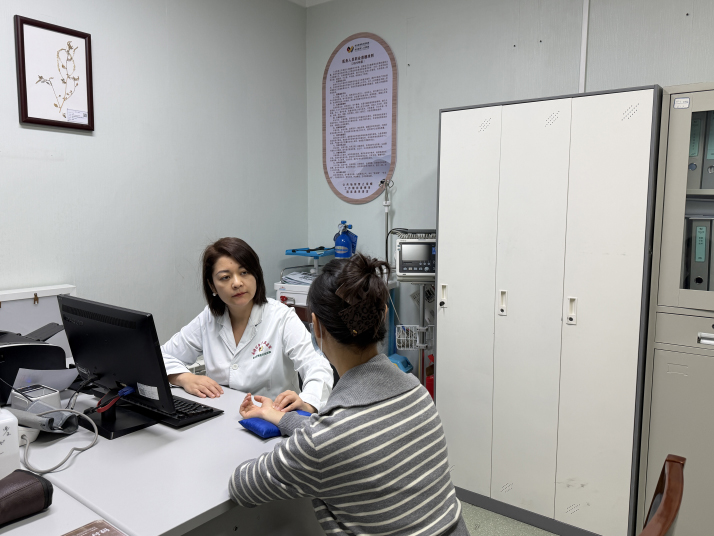 Mubarak Maimaiti, Director of the Department of Preventive Treatment of Diseases and Mizaji, Xinjiang Uygur Autonomous Region Uygur Medicine Hospital, takes a patient's pulse, on January 19 (COURTESY PHOTO)
Innovating therapeutic techniques Inheriting and modernizing ethnic therapeutic techniques is crucial for the development of ethnic medicine. Mubarak Maimaiti is a doctor of Xinjiang Uygur Autonomous Region Uygur Medicine Hospital. She majored in acupuncture and tuina, Chinese therapeutic massage, and is dedicated to integrating traditional Uygur medicine with modern clinical practice. Mubarak's team integrates TCM therapies—such as acupuncture, tuina, moxibustion and cupping—with traditional Uygur external therapies, including manual therapy, medicinal fumigation, topical application, and hot compress. These integrated techniques, characterized by simplicity, low cost, efficacy, and minimal side effects, were initially used for musculoskeletal pain. Now they have been extended to systemic regulation, addressing postpartum weakness, insomnia, and other conditions. Mubarak says standardization is key to the sustainable development of Uygur medicine. Since 2008, institutions including Mubarak's hospital have made significant progress: sorting out 19 Uygur medical external therapies, formulating strict standardized operating procedures specifying dosage, water temperature, and manipulation steps, and verifying their safety through 1,500 clinical cases across 49 primary hospitals. Thirteen Uygur techniques were incorporated into national TCM operation standards in 2024. These steps have standardized clinical practice and popularized Uygur medicine nationwide. Grassroots medical assistance is a vital link in popularizing Uygur medicine. From 2018 to 2019, Mubarak supported Shufu County Hospital, a general hospital located in Kashgar Prefecture, in building a standardized rehabilitation department and trained local doctors. In 2024, she participated in a grassroots preventive treatment service program initiated by the regional Department of Human Resources and Social Security, promoting pediatric massage techniques and providing guidance to address gaps in primary hospitals—such as part-time staffing and unclear development plans. To adapt to Xinjiang's dietary characteristics—high meat consumption and low vegetable intake, which contribute to a high prevalence of hypertension, diabetes, and other chronic diseases—her hospital has promoted customized herbal teas over the past four years. Available in convenient granule form, these teas are covered by medical insurance, affordable, and effective in reducing liver and kidney problems. These efforts have enhanced the clinical capabilities of grassroots medical staff and raised public health awareness. In November 2025, the Xinjiang Uygur Autonomous Region Health Commission announced that "15-minute urban and 30-minute rural TCM health service circles" have been established in Xinjiang, so that patients can access such services conveniently. Despite these achievements, Uygur medicine still faces inherent bottlenecks. Current technical standards lack refinement, with general guidelines failing to provide differentiated protocols for disease subtypes. Additionally, Uygur external therapies are labor-intensive and time-consuming, resulting in lower efficiency than Western medicine. To address these challenges, Mubarak proposes targeted strategies. Technological innovation—such as converting manual external therapies into automated instrument operations—can reduce labor input and improve efficiency. Introducing advanced devices like AI diagnosis instruments, infrared imagers, and meridian detectors will enable quantitative efficacy assessment through data comparison, solving the long-standing issue of unquantifiable results in Uygur medicine. Furthermore, popularizing health concepts from childhood through family guidance and school education can curb disease incidence at the source. At the core of Uygur medicine is Mizaji (literally meaning physical constitution), the philosophy of "preventing disease before onset, halting disease progression, and preventing recurrence after recovery." A well-known Uygur medical proverb summarizes this: "Those who does not know their Mizaji at 40 live in vain," reflecting the emphasis on understanding one's physical constitution. The establishment of specialized departments is a step forward. Since August 2023, the Preventive Treatment of Diseases and Mizaji Department at Mubarak's hospital undertakes outpatient services, chronic disease follow-up, grassroots support, and research projects. The eight-member team led by Mubarak have TCM and Western general practice backgrounds. "We aim to popularize preventive health concepts, optimize chronic disease management protocols, and build an informatized follow-up system," Mubarak told Xinjiang Today. "We will also integrate weight management, preventive treatment, and chronic disease management into a diversified, standardized health management system." Policy guarantees The progress of Xinjiang's ethnic medicine is supported by strong policies. In recent years, the region issued a series of policies, including the "14th Five-Year Plan for the Development of Traditional Chinese and Ethnic Medicine in Xinjiang," which allocated special funds for ethnic medicine research, talent training, and industrial development. During the 14th Five-Year Plan (2021-25) period, Xinjiang invested heavily in TCM projects, supporting the construction of multiple key laboratories and inheritance studios for renowned ethnic medicine experts. According to Xinjiang's health authority, in 2024 alone, the regional financial department arranged 6.55 billion yuan ($939 million) in various subsidy funds for TCM (including ethnic medicine) undertakings, a year-on-year increase of 150.96 percent. This investment has supported the construction of three autonomous region-level key TCM laboratories, two specialized laboratories for ethnic medicine pharmacy technology, 18 national grassroots renowned old Chinese medicine expert inheritance studios, and 31 autonomous region-level renowned old Chinese medicine inheritance studios. Talent cultivation is another focus. The region has established a training system combining academic education, apprenticeship, and continuing education, cooperating with eight medical colleges and universities to enroll over 500 ethnic medicine students annually. Currently, Xinjiang has more than 3,000 practicing ethnic medicine doctors, forming a professional team that supports the inheritance and innovation of ethnic medicine. In addition, the research and development of new ethnic medicines has also trained a group of professional talents, promoting the upgrading of the industry's talent echelon, according to Xinjiang's Health Commission. Comment to maxiaowen@cicgamericas.com |
|
||||||||||||||||||||||||||||
|