
|
| Xinjiang Today |
| Ruins and records | |
|
|
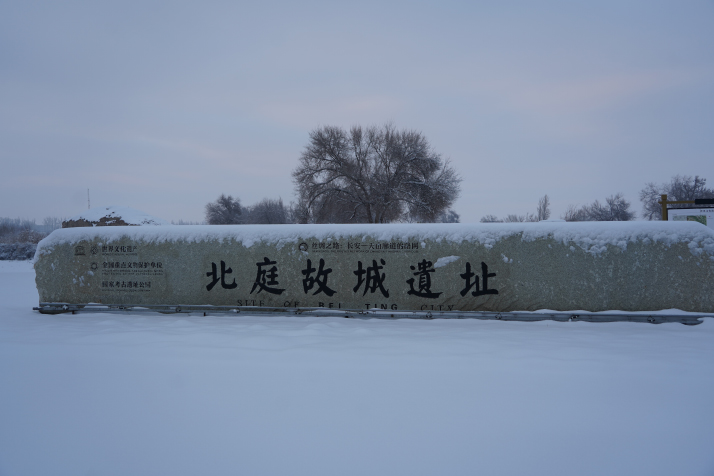 Entrance to the Beiting City ruins (MA XIAOWEN)
Standing amid the rammed earth ruins of Beiting City in Jimusaer (Jimsar) County, with the wind carrying the chill of the Tianshan Mountains, the name of Cen Shen (715-770), one of the preeminent poets in the Tang Dynasty (618-907), immediately sprang to my mind.
The ancient city was where the Grand Beiting Frontier Command of the Tang Dynasty was located. The Tang court established the Grand Beiting Frontier Command and the Grand Anxi Frontier Command to administer the Western Regions, the name Xinjiang was known by then. As a staff officer stationed successively in both commands, Cen experienced the harsh winters, long marches and multicultural life of the borderlands. Here, he wrote his masterpiece Song of White Snow in Farewell to Secretary Wu Going Back to the Capital. The north wind rolls the white grasses and breaks them; And the eighth-month snow across the frontier sky Is like a spring gale come up in the night, Blowing open the petals of ten thousand pear trees. These opening lines of the poem vividly capture the frontierscape: its severe snowstorms, stark landscapes and raw beauty, while also eulogizing the loyalty and perseverance of the Tang soldiers stationed there. Beyond scenery and valor, Cen's poetry records the local customs of the Western Regions, and the rich cultural exchanges between the Han and other ethnic groups, offering a poetic window into Beiting's past. 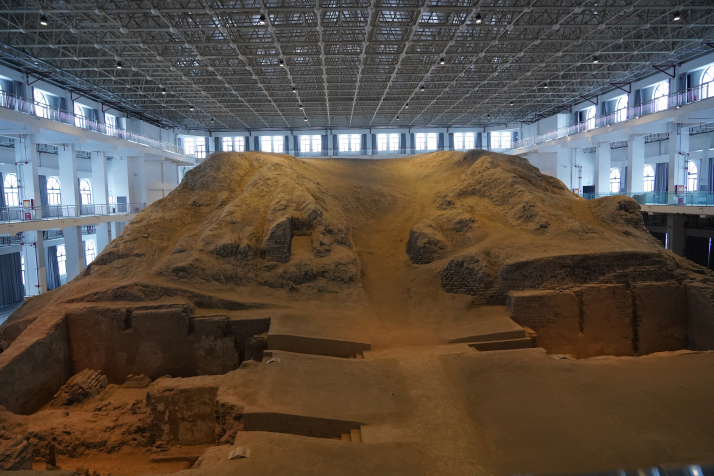 The ruins of a Buddhist temple in the ancient city of Beiting (MA XIAOWEN)
Historical evolution During the Eastern Han Dynasty (25-220), the renowned general Geng Gong stationed 300 troops in Beiting, then known as Jinman, to defend the frontier, achieving legendary feats like repelling thousands of nomadic troops despite scarcity of supplies when the soldiers had to boil snow for water. This solidified its status as a frontier stronghold. In 702, Wu Zetian (624-705), the only empress in China's history, ordered the establishment of the Grand Beiting Frontier Command, ushering the city into its most glorious era. As the military and political center in the northwest of the Tang Dynasty, the command administered a vast area extending from modern-day Hami in Xinjiang in the east to the Chu River Valley in present-day Kyrgyzstan in the west. Caravans streamed along the postal roads, where the camel bells of foreign merchants mingled with the bugles of Tang soldiers. Cen wrote of the bitter cold here in winter in Song of White Snow in Farewell to Secretary Wu Going Back to the Capital: The general cannot draw his rigid bow with ease; E'en the commissioner in coat of mail would freeze. These lines immortalize the pride and hardships of the frontier soldiers. Empress Wu Zetian authorized a standing army of 20,000 troops, which combined Han infantry with ethnic minority cavalry, creating a formidable army capable of countering nomadic warfare tactics. Besides military defense, the command managed trade routes and supervised oasis agriculture. After the ninth century, the Gaochang Uygur Kingdom (840-1209), one of the local regimes of the Western Regions that paid tribute to the central authorities, designated Beiting as its summer capital. Buddhism flourished here. According to historical records, in the royal temple of the kingdom, located west of the city, painters used mineral pigments to depict the Buddhas and apsaras, celestial beings in Oriental culture regarded as excelling in music and dance, in murals. After the Yuan Dynasty (1271-1368)'s conquest of the Gaochang Uygur Kingdom in 1209, Beiting retained its status as an administrative center. Finally, it fell in the wars during the Ming Dynasty (1368-1644), with only its rammed earth walls and scattered tiles left today, telling the vicissitudes of "ten thousand palaces turning to dust." 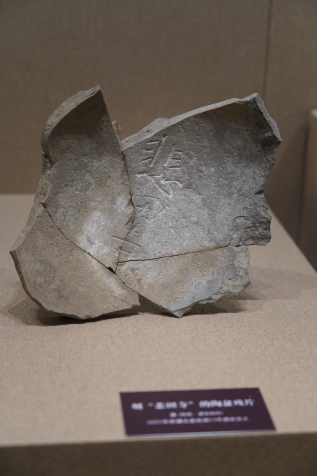 A fragment of a pottery vessel unearthed from the ruins of Beiting City, inscribed with the Chinese characters for Beitian Temple, on November 28 (MA XIAOWEN)
Architecture and legacy The ruins of Beiting feature a double-layered, nested square layout, with the inner and outer city walls forming an enclosed structure. The inner city still retains the remains of its northern gate and barbican, along with other defensive facilities including a moat, watchtowers and corner towers. The highest section of the existing city wall is 11.5 meters tall. Standing at the highest point of the ruins, the layout of the city is clearly visible. The outer city had a circumference of about 4.5 km. Fragments of Tang Dynasty bricks and tiles are still embedded in its rammed earth layers. The inner city was the core area where the ruins of palaces, government offices and Buddhist temples are faintly distinguishable. The lotus-patterned roof tiles scattered on the ground testify to the architectural grandeur of the past. The ruins of the royal temple are remarkable. In the extant halls, the murals retain their bright colors, depicting scenes of Uygur nobles worshiping the Buddha, and Western Regions-style apsaras, demonstrating the details of multiethnic cultural integration. The relics unearthed from the ruins offer concrete proof of the Tang Dynasty's governance over the Western Regions. The finds include Kaiyuan Tongbao coins, round copper coins with a square hole in the center introduced by Tang Emperor Gaozu—evidence of the region's integration into the empire's monetary system; lotus-patterned floor tiles signal the spread of Buddhist culture and advancing ceramic techniques; and a bronze official seal for Pulei Prefecture, an administrative division under the Grand Beiting Frontier Command, confirms formal imperial rule in the area. Pottery shards inscribed with the Chinese characters for Beitian Temple also reveal that the Tang court extended its state-run charity system to the region. The Beitian sanatoriums in Buddhist temples, first created during the reign of Empress Wu Zetian, provided relief to the poor and vulnerable. Archaeologists believe the fragments demonstrate the dynasty's holistic administrative reach going beyond political control. 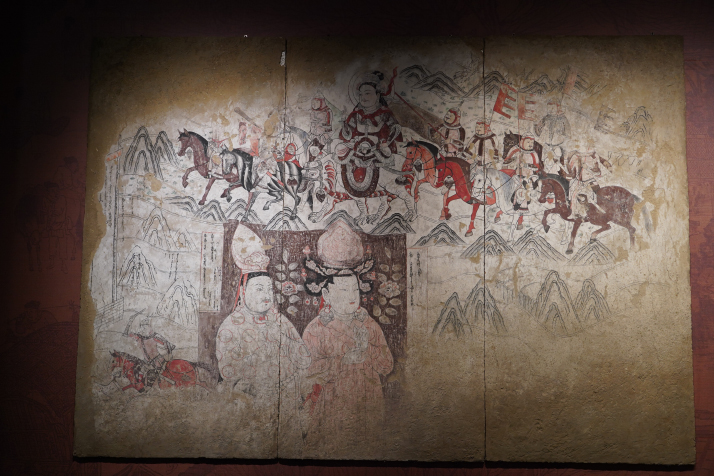 A partial replica of the Royal Procession Mura at the Museum of the Beiting Gaochang Uygur Buddhist Temple, located at the ruins of Beiting city in Jimsar County, on display on November 28 (MA XIAOWEN)
A civilizational landmark In 2014, the ruins of Beiting were inscribed on the UNESCO World Heritage List as a core component of Silk Roads: The Routes Network of Chang'an-Tianshan Corridor. It is more than an ancient city—it is tangible evidence of the Central Plains dynasties' governance of the frontier, cultural exchange along the ancient Silk Road and contributions to the Chinese civilization by multiple ethnic groups. Today, trails in the Beiting City Ruins National Archaeological Site Park connect the various heritage sites for visitors to explore, and digital preservation technologies enable the broken city walls to "speak." As the setting sun gilds the rammed earth walls, the wind seems to still carry the echoes of camel bells, soldiers' shouts and monks' chants. The ruins are not static relics of the past but a three-dimensional history book where visitors can decipher its thousand-year-old civilization. Comments to maxiaowen@cicgamericas.com |
|
||||||||||||||||||||||||||||
|