
|
| Xinjiang Today |
| Football fever | |
|
|
 The Hetian (Hotan) and Bortala teams compete during the 2025 Atushi Cup Football Invitational Tournament in Atushi, Kezilesu (Kizilsu) Kirgiz Autonomous Prefecture, on November 27 (VCG)
Hetian (Hotan) Prefecture clinched a stunning 2-1 victory over Bortala Mongolian Autonomous Prefecture in the final of the 2025 Atushi Cup Football Invitational Tournament, held on November 27 in Atushi (Artux), Kezilesu (Kizilsu) Kirgiz Autonomous Prefecture. As the championship trophy was lifted, the roar of the crowd echoed through the stadium, capturing the remarkable rise of football across Xinjiang in recent years.
From Kezilesu Kirgiz Autonomous Prefecture to Kashi (Kashgar) Prefecture, and the Xinjiang Production and Construction Corps (XPCC) city of Wujiaqu, football tournaments have flourished throughout Xinjiang. Flagship events such as the Atushi Cup, the Kashi Cup, the XPCC Football Super League, and various international youth invitationals have become annual highlights on the regional sporting calendar. More than athletic competitions, these tournaments have evolved into vibrant festivals of shared passion, forging deep emotional bonds that unite communities. Highlights Now in its third edition, the Atushi Cup has become a cornerstone of Xinjiang's football scene. This year's tournament attracted 16 teams and 408 players from 10 prefectures and cities across the region. Over 13 action-packed days, 32 fiercely contested matches were played. On the night of the final, Artux City Football Park was brilliantly illuminated and filled with the energy of passionate supporters. After 101 gripping minutes, the Hetian team emerged victorious, their triumph met with sustained applause from the stands. The tournament also featured exceptional public engagement. Average attendance surpassed 8,000 per match, while online interest surged, with videos and trending topics related to the event amassing an impressive 1.59 billion views. Similarly, the Kashi Cup International Youth Football Invitational Tournament highlighted Xinjiang's growing global football connections. Expanding on its inaugural edition, the second tournament featured 12 teams, including participants from Russia. Among the six Chinese teams were the U-16 (under 16 years old) youth squads of four Chinese Super League clubs. After a series of compelling matches, Guangdong Meizhou Hakka Football Club defeated the Tajikistan Football Academy in the final to claim the championship. Meanwhile, the XPCC Football Super League continued to gain momentum. Concluding on August 17, the competition saw the Xinjiang Xinjindun Technical School team secure the title with a 8-0 victory over the Urumqi Petrochemical Football Team. The league has become a lively platform for community engagement and a spirited expression of the Corps' athletic ethos. Social impact These football events extend beyond sports, serving as dynamic hubs for cultural exchange. At the Atushi Cup, fans from Hetian brought traditional naghra drums and suona horns, seamlessly blending the deep, resonant sounds of these historic instruments with the modern rhythm of the stadium. The result was an atmosphere that felt both deeply rooted and vibrantly contemporary. The economic impact was equally striking. During the tournament, hotel bookings in Atushi City jumped 280 percent year on year, with downtown accommodation fully booked a week in advance. Total food and beverage spending increased by 210 percent compared with normal levels. Restaurants and eateries near the arena, particularly those serving local Xinjiang flavors, recorded peak annual sales. The grins on vendors' faces reflected the economic energy generated by the sports plus development model. Community solidarity was also on display. A volunteer fleet of around 100 ride-hailing drivers traversed Atushi throughout the tournament, offering free and convenient rides to visiting fans. 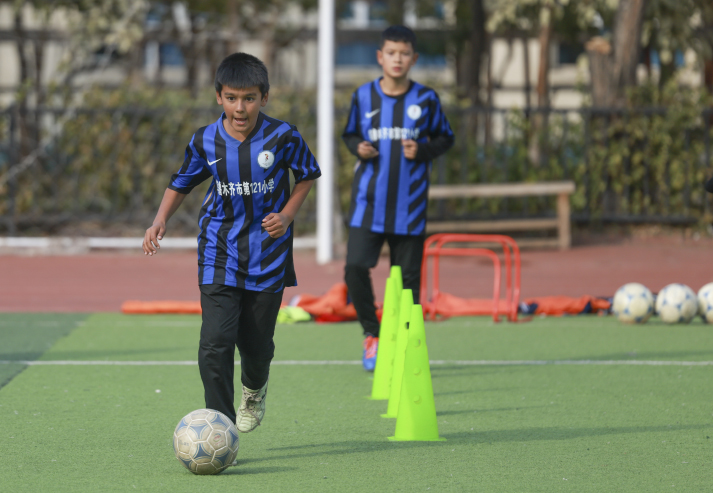 Members of a Urumqi primary school football team train on October 17 (XINHUA)
Future development Football in Xinjiang, and especially in Atushi, boasts a rich heritage. The sport took root more than a century ago in Yikesake Village in Atushi, where the first football pitch was built in 1908, earning the area a reputation as a "century-old football town." This enduring passion is supported by robust infrastructure. Kezilesu has built 377 football fields, achieving a density of more than six pitches per 10,000 residents. Five schools have been selected as pilot sites for football education, integrating the sport into core curricula. In addition, 27 schools have been designated as National Campus Football schools, supported by 172 school-based football pitches. Across Kezilesu, football has become a powerful social magnet, attracting students after class, local shopkeepers during breaks, and herders on their way home, all united by a shared love of the game. This model ensures that football remains a lasting symbol of vitality and togetherness in the region. In Xinjiang, football has grown from a simple game into a bridge linking heritage with hope. As Chen Kehua, a commentator from Guizhou's famed Village Super League, noted: "Here, football has truly become a bridge connecting people of different ethnicities and from different places." Comments to zhangxinyang@cicgamericas.com |
|
||||||||||||||||||||||||||||
|