
|
| Xinjiang Today |
| The Xinjiang FTZ turns 2 | |
|
|
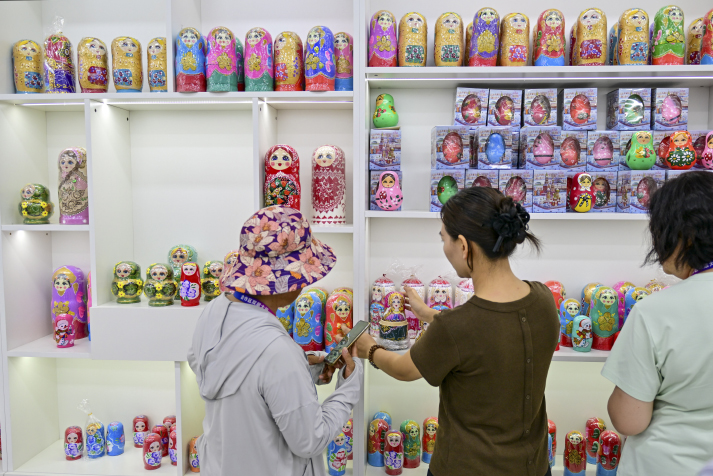 Tourists visit a duty-free shop at the Horgos International Border Cooperation Center on the China-Kazakhstan border in Huoerguosi on July 26, 2024 (XINHUA)
For Yu Huan, a fresh produce trader in China's far west, the past two years have brought, in his words, "earth-shaking changes."
The time taken to send a truckload of grapes from Huoerguosi (Khorgas or Horgos) in Ili Kazak Autonomous Prefecture to Almaty in Kazakhstan has been slashed from days to just six hours, thanks to the China (Xinjiang) Pilot Free Trade Zone (FTZ) that has eased restrictions on the passage of goods and boosted trade and investment with supportive policies. "This is no longer about waiting. No matter when we arrive at the port, we pass through [customs] immediately," said Yu, whose company, Jinyi International Trade (Group) Co. Ltd., saw its trade volume jump by 50 percent, from $1.53 billion in 2023 to $2.3 billion in 2024. In 2025, it has grown further, reaching $1.4 billion in just six months. Yu's experience is a microcosm of the tangible impact of the FTZ, which marks its second anniversary this year. The first of its kind in northwest China, the FTZ spans three strategic hubs: regional capital Urumqi, western border port Huoerguosi, and southern city Kashi (Kashgar). In just 24 months, it has become an engine of growth, hosting over 18,000 new businesses and accounting for 40 percent of Xinjiang's foreign trade in the first three quarters of this year. 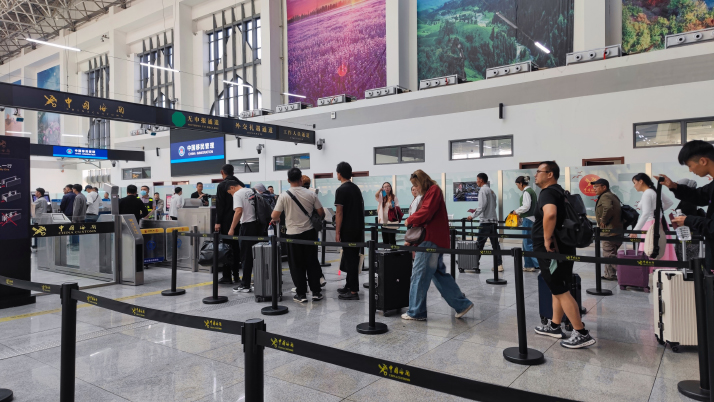 Travelers go through the exit-entry point of Horgos Port in Huoerguosi in Ili Kazak Autonomous Prefecture on September 9 (LU YAN)
Witnessing changes The transformation Yu has witnessed is rooted in systemic innovation. Gone are the lengthy custom clearing processes that caused spoilage and delays. A new regime of 24/7 customs service, fast-track lanes for perishables and pre-clearance procedures allows goods to be inspected and released upon arrival. This has slashed logistics costs by over 20 percent, saving companies like Yu's approximately $100 per truckload. Thanks to the FTZ, Huoerguosi, located on the border between China and Kazakhstan, a vital stop along the ancient Silk Road, is reprising its old role. Cross-border e-commerce trade there increased by 889 percent year on year during the first half of 2025. At the Huoerguosi land port, streams of heavy trucks loaded with a dazzling variety of high-quality Chinese goods—cross-border parcels, domestically produced new-energy vehicles and agricultural machinery, and wind turbine blades stretching dozens of meters long—flow out of the country round the clock. Hutebeke Asihati has been driving trucks on the Huoerguosi-Almaty route for over a decade. "Back then, there wasn't nearly as much cargo—making one round trip every 10 days or two weeks was considered decent [profit]. Now, there's no stopping at all. I'm making the round trip every three days," he said. Yang Qiang, head of Huoerguosi Customs, said that in 2012, fewer than 400 vehicles passed through daily, and the then newly opened railway port operated only one freight train a day. Today, 27 China-Europe freight trains and over 1,800 vehicles of various kinds shuttle through every day, with the annual cargo throughput reaching 45.566 million tons—nearly three times the volume in 2012. While cargo volumes have surged, customs clearance time has been considerably reduced. "The number of clearance procedures has been streamlined from 12 to just four, and clearance time has been cut from over 30 hours to less than five hours, improving efficiency by 80 percent," Yang added. Wang Tianzhu, who operates an aviation logistics business in Urumqi, told China National Radio the turning point for his business came in June 2024 with the launch of bonded aviation fuel services in the FTZ. This market-opening measure has reduced fuel costs for each international flight by approximately $10,000, lowering transportation expenses and attracting enterprises from across the country to ship goods via Xinjiang. In less than a year, his company's chartered flight routes to Europe have expanded from just one to 22, with flight frequency increasing from once a week to three times daily, and shipment volume growing tenfold. "In the past, our worry was not having enough cargo—every day we were concerned that flights wouldn't be fully loaded. Now, the challenge is insufficient land transport capacity and not enough planes. For our company, this is an excellent development opportunity," Wang said. 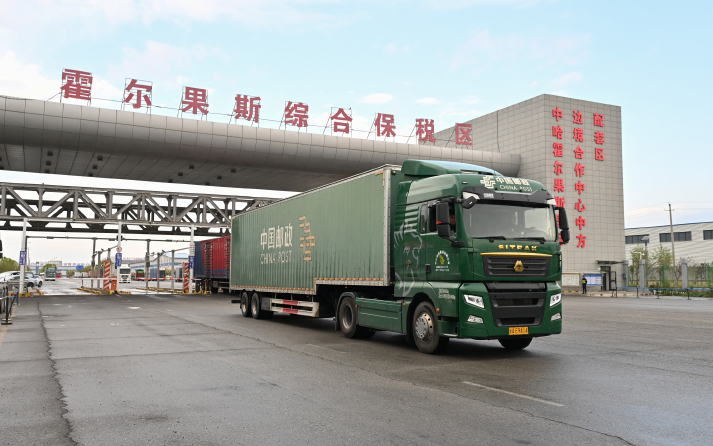 A postal truck leaves the comprehensive bonded zone in Huoerguosi (Khorgas or Horgos) on September 11 (XINHUA)
New business models "The pilot FTZ's leading role is to test high-standard reforms that remove barriers to the flow of goods and capital," Li Xuan, director of the Xinjiang pilot FTZ work office, told Xinhua News Agency. In Huoerguosi, the cross-border flows of people, goods and capital have been enhanced by institutional innovations. The China-Kazakhstan Huoerguosi International Border Cooperation Center is the first cross-border economic cooperation zone jointly established by China and Kazakhstan. Following the establishment of the Xinjiang pilot FTZ, the cooperation center has welcomed the entry of multiple Kazakh banks and enterprises. Concurrently, Chinese banks have also enhanced their service there, making currency exchange and payment settlements more convenient for tourists and businesses during shopping and procurement. Beyond traditional merchandise sales, the center has cultivated new business models such as cross-border e-commerce. Supporting facilities have also been increasingly enhanced. The center now houses star-rated hotels, and dining and entertainment venues, and has established a dispute resolution platform. This platform provides comprehensive legal services, including mediation, consultation, notarization and litigation support, for both domestic and international market participants. Official data from Huoerguosi's commerce authorities show that cross-border e-commerce trade volume from January to July this year amounted to 29.14 billion yuan ($4 billion), a staggering year-on-year increase of 814.2 percent. Cross-border e-commerce now spans over 20 countries and regions, and the product range has expanded from initial categories such as daily necessities and clothing to industrial goods, including new-energy products and mechanical parts. The China-Asia Europe Investment and Trade Hub was established in the pilot FTZ's Urumqi area in April to accelerate economic and trade exchanges between China and Eurasia. The center brings together more than 80 professional institutions from China and abroad, covering critical fields such as law, finance and taxation, logistics, human resources and intellectual property. It provides investment and trade services not only for local Xinjiang enterprises but also for companies across the country. To expand its international services, the center has set up overseas branches in Kazakhstan, Tajikistan and Uzbekistan. Kashi is also breaking new ground in cross-border collaboration by aligning its economic development zone with Kyrgyzstan's free economic zone under a joint working mechanism. It enables warehouse-to-warehouse deliveries between the two countries in 48 to 72 hours, doubling efficiency. "Since establishing our presence in the Kashi area of the pilot FTZ last August, our trade volume has surged," said Zhao Zhijiang, head of a foreign trade company in the comprehensive bonded zone in Kashi. "Products like building materials, power equipment and electrical appliances are highly popular in Central Asia." He added that this year, the company secured a 300-million-yuan ($42 million) export order from the government of Kyrgyzstan. In just two years, the pilot FTZ has boosted Xinjiang's foreign trade, turning the region into a key logistics and trade hub, driving high-quality development through high-standard opening up. In the first three quarters of this year, Xinjiang's total import and export value was 393.14 billion yuan ($55 billion), marking a year-on-year increase of 22.1 percent. This growth rate outpaced the national average by 18.1 percentage points, setting a new record. (Print Edition Title: A Prodigious Start) Comments to luyan@cicgamericas.com |
|
||||||||||||||||||||||||||||
|