|
| Xinjiang Today |
| Multilingual artifacts: tracing a history of multiethnic development | |
|
|
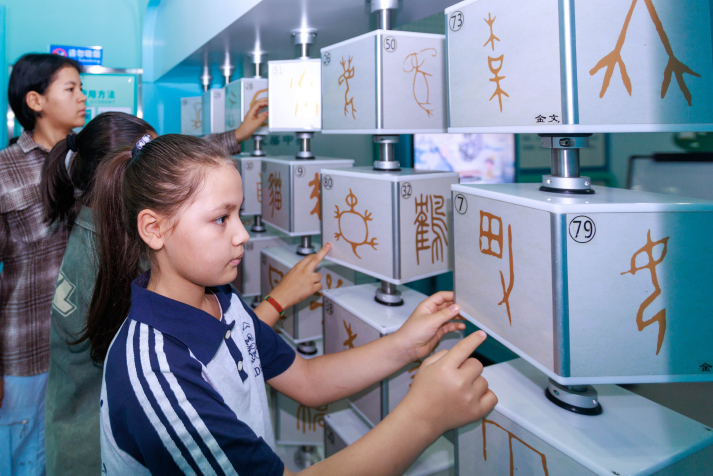 Children learn about the oracle bone script, the earliest form of writing in China, at a museum in Urumqi in August (VCG)
In August 2023, the Xinjiang Museum in Urumqi hosted an archaeological exhibition titled Chinese Historical Records: Exhibition of Documents Unearthed in Xinjiang. Organized into four thematic sections—bamboo and silk manuscripts, paper documents, stele inscriptions and epitaphs, and research and conservation—the exhibition brought together 150 artifacts or artifact sets. These materials included legal codes from ancient oasis kingdoms, economic contracts, personal correspondence and Buddhist manuscripts, most unearthed from the ruins of Loulan in Ruoqiang County, Hetian (Hotan) Prefecture and Turpan City. Xinjiang's arid climate and protective desert environment enabled these fragile documents to survive in exceptional condition for more than 1,000 years. Spanning from the Han Dynasty (206 B.C.-A.D. 220) to the Ming Dynasty (1368-1644), the artifacts vividly illustrate the long-standing coexistence of multiple languages and writing systems. Today, these materials are preserved at the Xinjiang Museum, where they serve as invaluable primary sources for understanding Xinjiang's history and cultural development. Archaeological research indicates that at least 25 languages and 18 ancient scripts were used throughout the region's history—a diversity closely linked to population movements, trade and the spread of religions along the Silk Road. Xinjiang served as a meeting point for Eastern and Western civilizations as well as a site where multiple Chinese linguistic and cultural traditions converged, reflecting the region's enduring history of multiethnic integration and development. 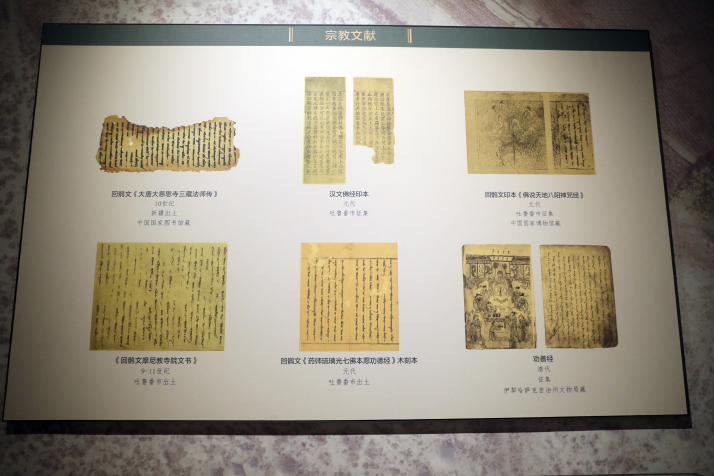 Ancient religious documents written in different languages on display at the Chinese Historical Records: Exhibition of Documents Unearthed in Xinjiang exhibition at the Xinjiang Museum in Urumqi in August 2023 (VCG)
Extensive diversity Since 2010, archaeologists from the Institute of Archaeology of the Chinese Academy of Social Sciences (CASS), Academia Turfanica in Turpan and other institutions have carried out multiple systematic excavations at the Tuyoq Buddhist Grottoes in Shanshan County, covering roughly 6,000 square meters. In addition to working within the cave chambers, they also excavated outer structures, including antechambers, floors, passageways and staircases. Their discoveries have been remarkably rich, including approximately 200 square meters of newly discovered murals, more than 15,000 fragments of documents, and a wealth of silk paintings, wooden artifacts, stone implements, pottery wares, sculptures, writing instruments and everyday objects. The paper documents unearthed during the excavations include texts in several scripts: Chinese, Huihu, Sogdian, Tibetan and others. They encompass Buddhist manuscripts, documents and annotated editions of classical texts. Some are relatively well-preserved, complete with dated colophons and a small number remain attached to their original scrolls. Comparable archaeological excavations have been undertaken across Xinjiang. According to data compiled by the CASS Institute of Archaeology, Xinjiang's six UNESCO World Heritage Sites, 9,545 immovable cultural relics and more than 450,000 movable artifacts collectively trace its evolution over the centuries. Archaeological evidence indicates that the earliest widely used script in the region was Chinese, a position it has held from the first century B.C. to the present day. Prior to that, none of the major local languages had a written form. The broad use of written and spoken Chinese in Xinjiang followed the Han Dynasty's establishment of the Western Regions Frontier Command in 60 B.C., which was confirmed by textual evidence. Xinjiang was known as the Western Regions in ancient times. Most Chinese language documents from that period pertain to central government decrees, household registers, contracts, Confucian classics and Buddhist manuscripts, indicating that Chinese served as the dominant language in both official and cultural spheres. Household registers and wills document intermarriage between Han and non-Han peoples, with children of mixed heritage often carrying dual names—one Chinese, one non-Han. Naming patterns included Han surname paired with non-Han given name or vice versa. Even documents written in indigenous scripts frequently adopted the reign titles and official designations of Central Plains dynasties. The unearthed materials reveal true multilingual coexistence. For example, Chinese, Sanskrit, Kharosthi and other scripts circulated simultaneously in the second century. Some of the following centuries even saw greater linguistic diversity. 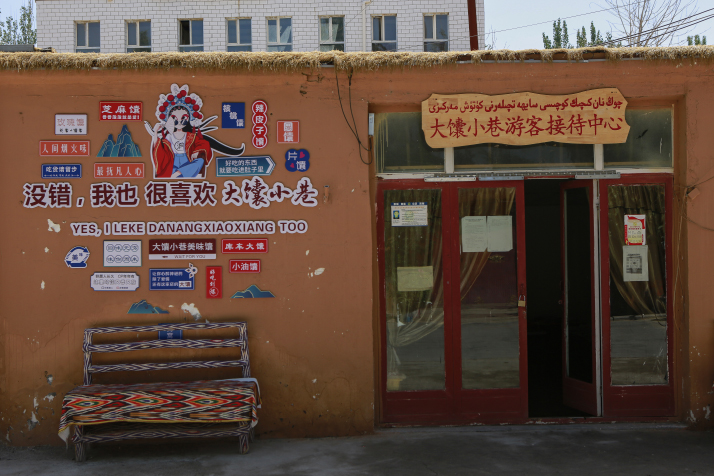 A tourist service center in Kuche (Kuqa), Aksu Prefecture, features signboards in standard Chinese, Uygur and English (VCG)
Deep integration The Great Tang Records on the Western Regions, written by Chinese Buddhist monk Xuanzang in 646, a narrative of his 19-year journey through China and neighboring areas, provides valuable accounts of scripts used by the ancient states in the Western Regions. For example, it notes that in the state of Qiuci, what is today Kuche, also spelt Kucha and Kuqa, "the script was modeled on that of India, with minor modifications." Because scripts serve as the carriers of civilization, the book clearly reveals the profound cultural interconnection found across Xinjiang in ancient times. The linguistic diversity is also reflected in historical place names, which even occasionally necessitated explanatory notes in documents of the same era. The multilingualism went far beyond simple coexistence. It represented a fusion of languages and functional integration that spanned administrative, economic and social life. Archaeological evidence reveals that during the Tang Dynasty (618-907), household registers and population declaration forms in the Western Regions were primarily written in Chinese, often accompanied by annotations, signatures or seals in Huihu or other scripts. This indicates that primary-level administration relied on bilingual officials or interpreters, requiring cross-ethnic cooperation. Documents from the period of the Tubo Kingdom (618-842) frequently feature Chinese-Tibetan bilingual texts or mixed vocabulary, reflecting the multiethnic makeup of local governance. The Tubo regime established in today's Xizang Autonomous Region was a local government of ancient China. Economic life shows similar integration. Slave trade and land contracts unearthed at the ruins of Loulan and Niya were often written in parallel Chinese and Kharosthi, not for official submission but to ensure full mutual understanding between Han merchants and local residents. Chinese signatures or seals on contracts written in Huihu scripts show that Han merchants recognized the legal validity of these documents. Meanwhile, Sogdian merchants' correspondence includes Chinese vocabulary (such as units of weight and commodity names), while Chinese account books suddenly feature lines of Sogdian notation. Such fluid code-switching reflects prolonged cohabitation and barrier-free communication. Some documents even display multiple calendrical systems. Often, the Chinese zodiac calendar, Syriac calendar and Sogdian calendar appear concurrently, which reflects the application of multiple calendrical systems in daily life. The multilingual phenomenon offers tangible evidence of cultural exchange and mutual learning in Xinjiang, while also exemplifying the characteristics of Chinese civilization: unity in diversity and inclusiveness. Today, standard Chinese as well as Uygur, Kazak, Mongolian, Kirgiz and other ethnic languages are widely used in Xinjiang. This linguistic landscape continues the deep-rooted patterns of integration and interaction that have characterized Xinjiang for millennia. Comments to lanxinzhen@cicgamericas.com |
|
||||||||||||||||||||||||||||
|