
|
| Xinjiang Today |
| Westward Ho! | |
|
|
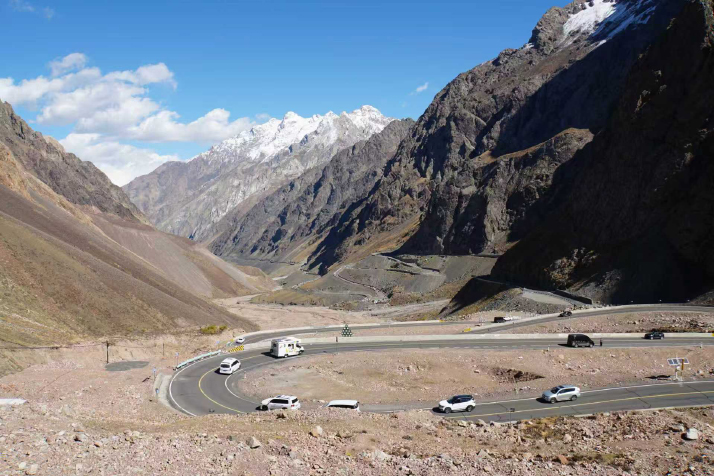 Vehicles on the Duku Highway on September 21 (WANG YAJUAN)
Xinjiang's rich history is being unearthed with significant archaeological finds. The Mo'er Temple ruins in Kashi (Kashgar), the westernmost and oldest well-preserved large earthen Buddhist temple site in China testifying to centuries of Buddhist history, were listed among China's top 10 archaeological discoveries in 2024. They offer crucial insights into early Buddhist architecture and sinicization of Buddhism.
Four years before that, another archaeological find also made it to the top 10 archaeological discoveries of the year. The Kiyakkuduk beacon tower ruins in Yuli County, used by the troops stationed there in the past to transmit military signals by smoke and fire, throw light on garrison life and the military management system at the border through the documents excavated at the site. They also prove Tang Dynasty (618-907) governance of the region. Moreover, Xinjiang's ancient heritage and traditions are powerful drivers for tourism growth and economic development. 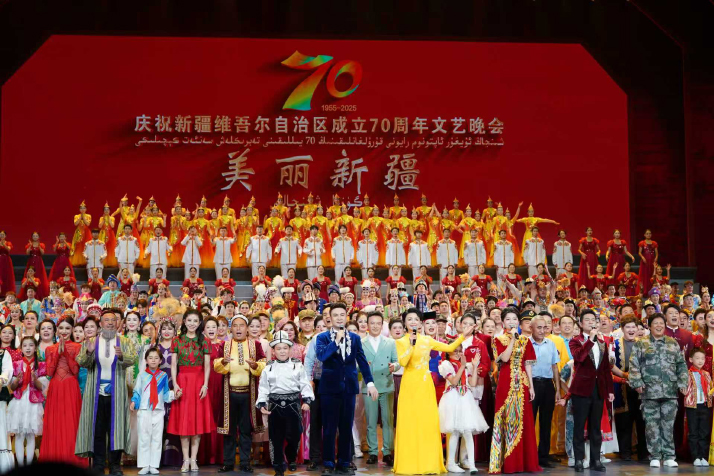 Actors perform at a gala marking the 70th founding anniversary of Xinjiang Uygur Autonomous Region in Urumqi on September 24 (WANG YAJUAN)
Role of museums The rich cultural heritage is meticulously preserved and presented across the region's museums. The region boasts 150 museums and memorial halls with more than 30 new ones established since the start of the 14th Five-Year Plan (2021-25) period. Last year, these venues hosted over 2,500 exhibitions and educational events, attracting more than 8 million visitors. The Xinjiang Museum adds to the cultural landscape by featuring special collections from the Palace Museum in Beijing and the National Museum of China, also in the capital. The museum's innovative Mobile Museum program, launched in 2010, takes artifacts to rural and urban communities through approximately 3,000 touring exhibitions annually. Intangible cultural heritage is being woven into contemporary life. Over 380 bazaars, exhibition halls and workshops are reviving ancient crafts. Time-honored traditions such as the bright colored Atlas silk with a wide variety of patterns, exquisite pottery and the production of mulberry bark paper—renowned for its softness, durability and unique properties for calligraphy and painting—are experiencing a renaissance. Artistic works are also proving to be powerful catalysts for tourism growth. The television series To the Wonder, an authentic portrayal of the life of the Kazak ethnic community in Xinjiang, became a nationwide hit, resulting in a surge in visitors to its filming locations in Altay Prefecture. Other acclaimed productions, such as the stage drama Zhang Qian by the Xinjiang Art Theater, which portrays the eponymous Han Dynasty (206 B.C.-A.D. 220) diplomat's journey to the Western Regions that subsequently led to the formation of the Silk Road, are also whetting people's curiosity in Xinjiang. This integration of cultural intellectual property with tourism experiences is transforming visits into immersive cultural explorations. The result is evident from the numbers. In 2012, Xinjiang welcomed 48.6 million tourist visits. That figure jumped to 302 million last year. This year from January to October, the region received 299 million tourist visits, which generated 343.28 billion yuan ($48.7 billion) in spending, reflecting a year-on-year growth of 8.47 percent and 8.78 percent respectively. This success is underpinned by strategic policies and master plans, including a five-year tourism development plan released in May to integrate its culture, tourism and sports sectors, aiming to host more than 400 million annual visits and generate 1 trillion yuan ($140 billion) in revenue by 2030. The plan, unveiled at an annual tourism development conference in Kuche (Kuqa), Aksu Prefecture, outlines strategies to leverage Xinjiang's unique strengths and expand its "culture plus" industries, including cultural and creative sectors, cultural trade and the digital culture industry. It also calls for strengthening sightseeing and vacation tourism, while fostering growth in winter sports, outdoor recreation and related equipment manufacturing. 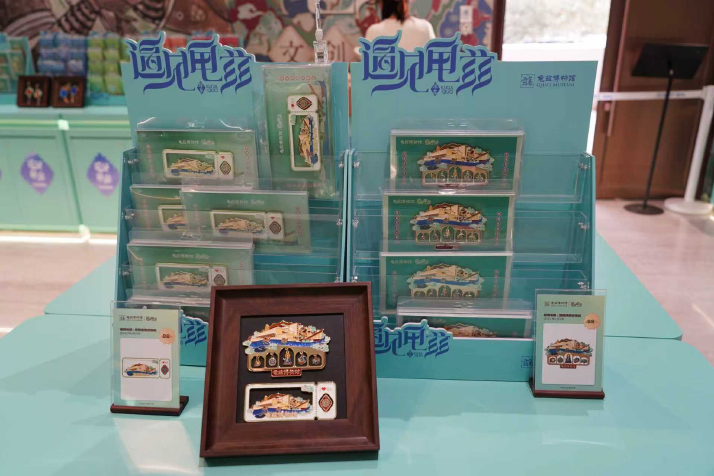 Cultural creative products in the Qiuci Museum, Aksu Prefecture, on October 22 (WANG YAJUAN)
Infrastructure upgrade The region's tourism infrastructure is rapidly strengthening. Xinjiang now boasts 18 5A-level scenic spots, the highest level in China's tourist sites rating system, ranking third nationally. Self-driving tourism is flourishing along renowned routes like the Panlong Ancient Trail, a stretch of winding mountain road with over 600 hairpin turns, dramatic elevation changes, and stunning views of snow-capped peaks, lakes and grasslands, as well as the Duku Highway connecting north and south Xinjiang and renowned as one of the most scenic roads in China. Rural tourism is another significant driver of prosperity. In south Xinjiang alone during 2024, rural areas received over 49 million tourist visits, generating 23.8 billion yuan ($3.4 billion) in revenue and creating 250,000 jobs. Across the region, over 510,000 business entities operate within the culture and tourism sectors, directly or indirectly employing more than 1 million people. A comprehensive transportation network is now in place. Expressways connect all prefectures and cities, reaching 95 percent of 3A-level and above scenic areas. Railways link every prefecture and city, serving over 82 percent of county-level administrative regions. More than 50 direct flight routes provide air access to 5A-level scenic spots. Essential supporting infrastructure—including restrooms, visitor service centers and parking lots—has been upgraded. Xinjiang offers diverse types of accommodation, from five-star hotels to numerous homestays. To stimulate tourist spending, the regional commerce department is collaborating with culture, tourism and sports authorities to develop popular landmark destinations and commercial hubs. The department also promotes Xinjiang brands to wider audiences through events like the Online Chinese New Year Goods Festival and the Xinjiang E-commerce Livestreaming Festival. Major national brands such as Luckin Coffee and the Haidilao hotpot chain have expanded into prefectures and cities, enhancing high-quality retail options. In collaboration with the culture, tourism and railway authorities, 70 dedicated tourist trains for senior citizens have been introduced, offering tailored, high-quality consumption experiences for the elderly. Sports plus tourism Xinjiang is also using sports to establish distinctive, recognizable brand events and boost tourism. It hosts premium international events, such as the Taklimakan Rally, a cross-country off-road motor rally through the vast Taklimakan Desert that is crisscrossed by sand dunes and mountains, and the high-altitude Tour of Sayram Lake Road Cycling Race, to widen its tourist base. Since the beginning of the year, 26,000 sports events have been held, stimulating spending across the transportation, food and beverage, accommodation and entertainment sectors. As of the end of 2024, Xinjiang had 88,800 sports venues, including 118 ice and snow facilities. Premier ski destinations like Jikepulin in north Xinjiang are now magnets for ski enthusiasts nationwide. With 103 ski resorts, including five national-level facilities, Xinjiang's winter sports tourism capability is among the nation's best. Since 2022, Xinjiang has staged two winter games of the autonomous region, accompanied by extensive cultural and tourism programs, such as the Ice and Snow Carnival. Over 3,000 grassroots ice and snow activities have been launched across the region, engaging more than 3 million participants. This demonstrates how the region's "cold resources" are creating a significant "hot effect" on the economy. Comments to wangyajuan@cicgamericas.com |
|
||||||||||||||||||||||||||||
|