
|
| Xinjiang Today |
| A herder family welcomes a new future | |
|
|
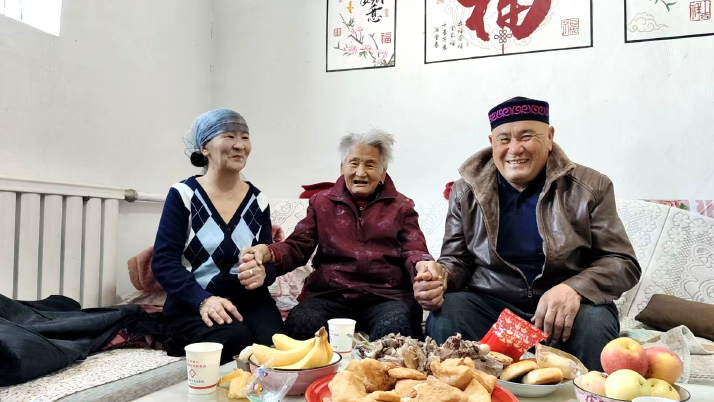 Senbati Shayilawu's mother (left) and father with a neighbor at their home in Halahumu Village in Tacheng Prefecture on October 25 (COURTESY PHOTO)
For as long as I can remember, the wind defined my life. The "old wind" of Tuoli County in Tacheng Prefecture frequently screamed around our felt yurt, a constant presence in my nomadic Kazak childhood. It dictated where we would move, when we would leave, and brought with it a deep-seated anxiety—of winter storms, lost lambs and a life without an anchor. Today, I stand at the window of my family's brick house, listening to that same wind. But its meaning has changed. It's no longer a force to be endured, but a sound I now associate with coming home—a home that was given to us, and one that has propelled me on a journey I could never have imagined as a child shivering in a yurt. My story, from herder's daughter to a postgraduate student of education, is the story of a new Xinjiang, built on a stable foundation. 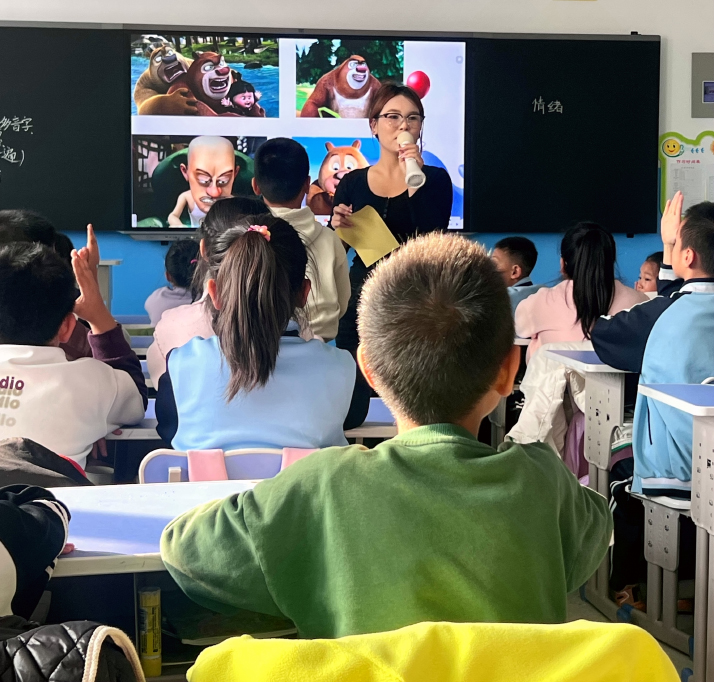 Senbati Shayilawu teaches psychology at a primary school in Changji Hui Autonomous Prefecture on November 4 (COURTESY PHOTO)
When home stopped moving My earliest concept of home was seasonal and temporary. We followed the grass, our yurt was packed and rebuilt with the cycles of the year. Winter was a test of survival. I recall one blizzard so fierce that snow sealed our door. My father dug his way out to search for the missing lambs, and my mother and I waited for hours, the howling wind filling the silence with fear. In that moment, home felt fragile. The change began with an announcement. I was 8 when my father came back from the village, his face alight with disbelief. "They are going to build us a house," he said. "A real, brick house. For us." The "they" was the government. I didn't fully understand the scale of it, but I understood my parents' hope. The relocation in 2010 is etched in my memory. We loaded our few possessions—the handmade felt rugs, the iron kettle, our clothes and other daily necessities—onto a cart. I looked back at our empty yurt site, a patch of flattened grass, and felt a pang. But it was quickly swallowed by anticipation. Nothing had prepared me for the solidity of that new door. My father's hand trembled as he turned the knob and pushed it open. Inside was a revelation: smooth cement floors, walls painted white, a television and an electric bulb hanging from the ceiling. The kitchen was a separate room. It was silent, still and utterly permanent. That first night, as we drank tea under the electric light, my father said, "This is more than a house. This is a future." For me, it was the first page of a new book. With school now just minutes away, my world, once bound by grazing lands, suddenly expanded into the world of books and ideas. 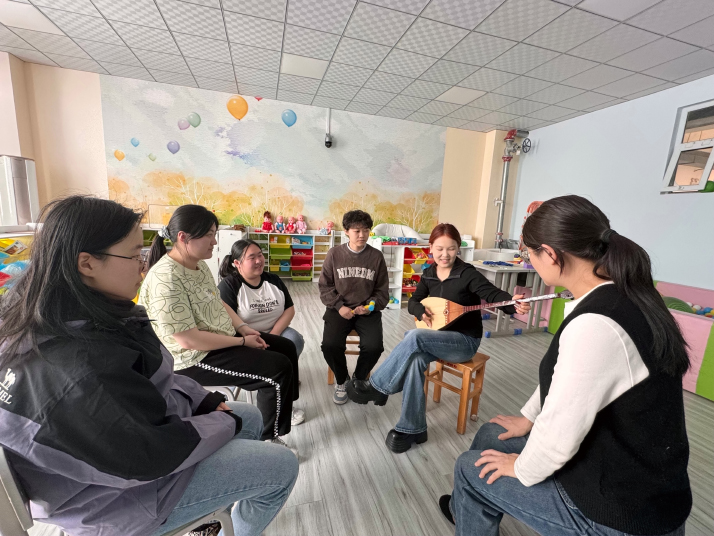 Senbati Shayilawu plays the dombra, a plucked string musical instrument of the Kazak ethnic group, for her classmates at Changji University in Changji Hui Autonomous Prefecture on February 27 (COURTESY PHOTO)
The road leads back That solid new home didn't just house us; it changed our life. It carried me through a local school where bilingual education in Kazak and standard Chinese opened a wider window to the world. It steadied my hand through the intense preparation for the national college entrance exam, the gaokao. And in 2019, it propelled me farther than any of my ancestors had ever dreamed—onto a plane to Jilin Engineering Normal University in Changchun, Jilin Province in northeast China, over 4,000 km away, to study the Internet and new media. In the lecture halls of the university, I became an accidental ambassador. For many of my classmates, Xinjiang was an abstract place in the northwest, often reduced to headlines or scenery postcards. I showed them the reality on my phone: a photo of my father, smiling proudly before our brick house; a panorama of the summer pasture, an ocean of green under an endless blue sky. I was proud of my heritage, but also purposeful: I was learning the tools to tell our own stories, with our own nuance. On the third floor of our school building, there was a special dining hall serving ethnic minority cuisines. During festivals like the Spring Festival, which all Chinese celebrate, and the traditional festivals of Xinjiang's ethnic minority groups, such as the Corban Festival, it offered us free meals with a wide variety of delicious dishes. The ladies serving the food were always warm and cheerful, greeting us with "Happy holiday!" It really made us feel at home even when we were far away. Yet, the pull of home was a constant tide beneath the exciting currents of university life. Upon graduation, my talented classmates scattered to glittering opportunities at media giants in Shanghai or innovative start-ups in Beijing. I faced a clear, daunting choice: to lose myself in the exhilarating rush of a mega-city, or return to the windswept, still-developing region that had made my journey possible? The decision, after months of introspection, was simple. My skills had a different, perhaps deeper, value in Xinjiang. The most important story I could help tell was not from a high-paying media job in a big city, but from the very ground where my own story had taken root. Today, I am back. But I have not returned to the pasture. I am pursuing a master's degree in primary education at Changji University in Changji Hui Autonomous Prefecture. It is a conscious and heartfelt pivot—from telling stories to shaping the minds that will write the next chapter. The ongoing government investment in our future is palpable everywhere I look: interactive whiteboards, projectors, computers and science lab equipment at my university. There are also dedicated spaces such as music rooms, art classrooms and sports equipment rooms. Additionally, spacious and well-lit teaching buildings and libraries have been constructed. The libraries boast extensive collections, ranging from fairy tales and popular science books to literary classics, catering to the reading needs of children across all grades. I am studying to become a teacher because I have experienced the transformative power of a stable start. I had to walk miles through biting cold to school; my students will board warm, yellow buses to modern, well-equipped campuses. I did my homework by the flickering, dim light of an oil lamp; they will learn with digital tablets, accessing libraries of knowledge at their fingertips. My mission is to help them harness these unprecedented opportunities—to be deeply, authentically proud of their ethnic heritage, with its rich poetry and nomadic wisdom, while becoming effortlessly fluent in the languages and skills of the wider world. I want them to be the next generation of builders, engineers, artists, and yes, teachers, right here. The government has also introduced a range of preferential policies to encourage outstanding talents to pursue careers in education. These measures include improving teachers' salaries and benefits, providing professional training opportunities, and addressing teachers' housing needs. As a result, a growing number of university graduates are choosing to return to Xinjiang to become teachers, injecting new vitality into the region's educational development. 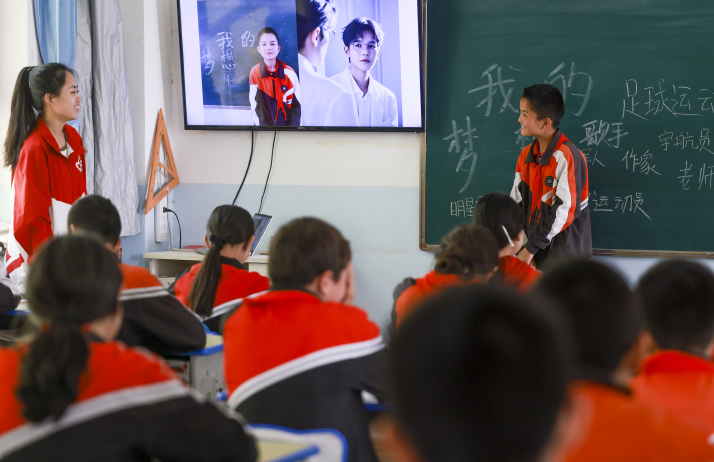 At a primary school in Kezilesu (Kizilsu) Kirgiz Autonomous Prefecture, a teacher (left) shows her students the dream career photos she created for them with AI on April 23 (XINHUA)
During one of my teaching practicums at a primary school, I met a teacher who had moved to Xinjiang from neighboring Gansu Province. She told me, "Education in Xinjiang needs more people. The children here are wonderful, and I want to settle down here to contribute to their growth." Hearing her words, I was deeply moved, realizing that I was not alone in this endeavor—many others, just like me, are working to advance education in my hometown. The old wind still blows past my family's house, a familiar song from my childhood. But now, its sound is no longer solitary or frightening. It is layered with the distant, dependable hum of a school bus climbing the hill, the cheerful chatter of construction crews laying fiber-optic cables along the roadside, and the quiet, determined turning of pages in my pedagogy textbooks. The wind once scattered us across the landscape. Now, we are rooted. Deeply, firmly rooted. And from this unshakable foundation, we are not standing still—we are growing upward, reaching for the sun, together. (Print Edition Title: Wind of Change) The author is a master's degree candidate at Changji University in Xinjiang Comments to luyan@cicgamericas.com |
|
||||||||||||||||||||||||||||
|