
|
| Xinjiang Today |
| Revamping the education system for quality and equity | |
|
|
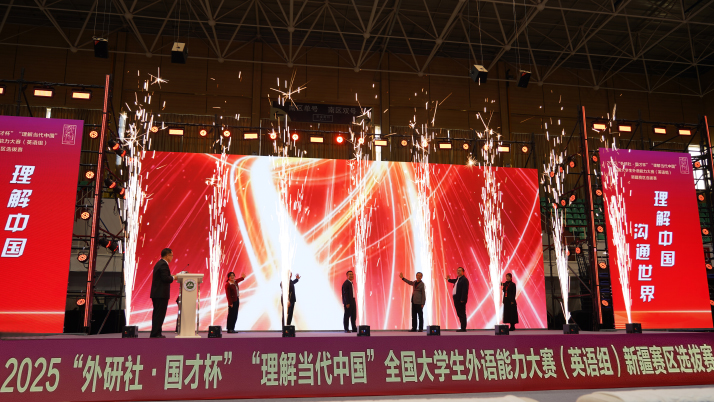 The opening ceremony of a college students' English contest takes place in Shihezi University in Shihezi City on November 1 (WANG YAJUAN)
Prioritizing educational advancement, Xinjiang has accelerated the establishment of a high-quality education system that will benefit all ethnic groups.
In 2024, Xinjiang boasted gross enrollment of 102.72 percent for preschool education and 97.74 percent for senior high schools. Gross enrollment counts everyone enrolled in preschool education regardless of age, while the denominator is only the population in the official preschool age range. The ratio can exceed 100 percent if many children younger or older than that range are enrolled. Its completion rate of nine-year compulsory education was over 99 percent, above the national average. A white paper titled CPC (Communist Party of China) Guidelines for Governing Xinjiang in the New Era: Practice and Achievements released by the State Council Information Office in this September provides a glimpse into the new development, including educational progress in Xinjiang. Investment in education has expanded. Since 2012, the Central Government has spent over 1.1 trillion yuan ($154.4 billion) on education in Xinjiang, improving the conditions of elementary and secondary schools, and establishing a financial assistance system for students from disadvantaged families. The funding to assist these students increased from 2 billion yuan ($286.3 million) in 2012 to 9.3 billion yuan ($1.3 billion) in 2024. Students in some prefectures, such as Aksu, Kashi (Kashgar) and Hetian (Hotan), receive free education for 15 years. 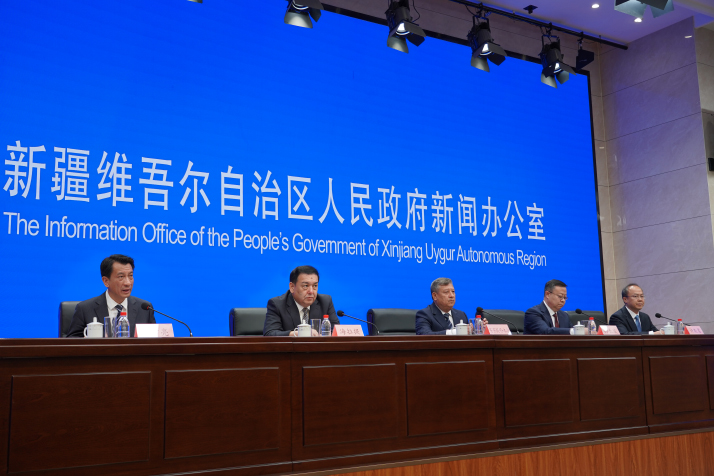 A press conference on the development of education in Xinjiang is held in Urumqi on September 30 (WANG YAJUAN)
Empowering education Xinjiang encourages students to learn more about the motherland and deepen their understanding of the Chinese culture. Under the Foundation Project, students are offered study tours to other parts of the country, such as Beijing. In the recent two years, over 210,000 teenagers have benefited from these tours. In terms of the curriculum, Xinjiang's education emphasizes teaching the national common language, traditional culture and ethnic unity. Standard Chinese is taught in primary and secondary schools. In Aksu, initiatives such as "Recitation of Classic Works" have led to notable improvements in students' proficiency in standard Chinese. In addition, students are also taught both national and Xinjiang's local history and culture so that they will gain a better knowledge about both the country and the region. Higher education has been given a boost. As of 2024, the region had 63 institutions of higher learning, 24 more than in 2012. All five prefectures and autonomous prefectures in south Xinjiang have universities offering undergraduate programs. This September, construction of the Kashi campus of Xinjiang University began, with enrollments slated for 2026. It will be the first Double First-Class university (those selected to cultivate world-class institutions and disciplines) in south Xinjiang, filling a long-standing gap. In addition, projects to enhance the quality and capacity of Kashi University, Kashi Vocational and Technical College, and Kashi Polytechnic Vocational and Technical College are progressing smoothly. The programs offered in Xinjiang's vocational institutions are aligned well with the needs of local specialty industries. A large number of students have been trained in fields such as tourism services, e-commerce, equipment manufacturing and textile and apparel, contributing to local development. Over the past five years, vocational institutions across Xinjiang have produced more than 700,000 graduates, nearly half of whom, originally from outside Xinjiang, have chosen to remain in the region, becoming a driving force behind industrial upgrading. 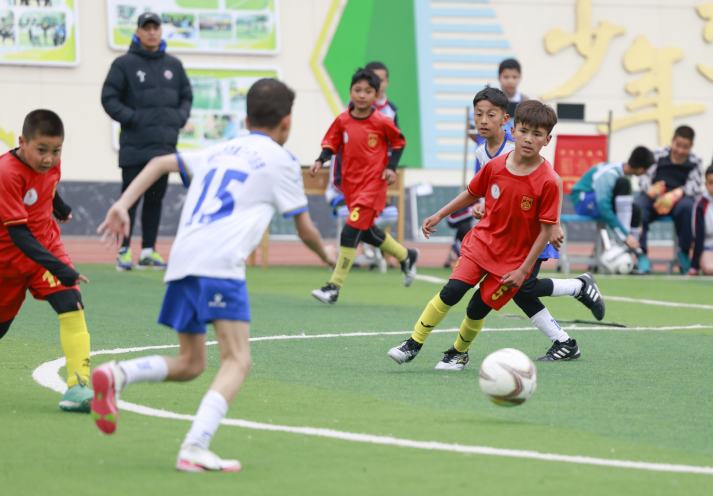 Students compete in the fifth Primary and Secondary School Football League of Shuimogou District, Urumqi City, on April 16 (XINHUA)
Nurturing better teachers To recruit teachers, Xinjiang has diversified recruitment channels, attracting educators from across the nation. In the recent five years, some 39,500 primary, secondary and kindergarten teachers have been recruited. Volunteer teachers have also been brought in through programs such as the National Silver Age Teacher Action Plan, an initiative that introduces experienced retired educators to underserved areas. In addition, there is mutual secondment of teachers between north and south Xinjiang. This is crucial for achieving full coverage of national common language instruction throughout the region, with a particular focus on rural and south Xinjiang schools. The skills of the teachers have also significantly improved. Teachers' training programs have benefited 153,000 teachers, with 6,000-plus educators supported to pursue higher academic degrees annually. Over 80 teachers have won national-level honors, and more than 400 have received Xinjiang's regional-level accolades. Teachers' remuneration and benefits are being enhanced, complemented by preferential policies in such aspects as housing and healthcare. 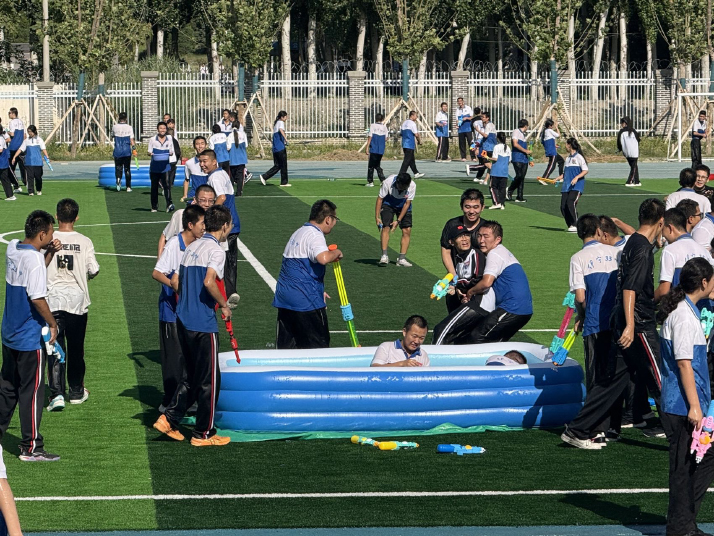 Students take part in a water gun fight at the No.1 Middle School of Ili Kazak Autonomous Prefecture on July 8 (NAFEIXIA NABI)
The role of AI Xinjiang is harnessing the power of AI to drive transformative educational reform. A focus is co-development and sharing of high-quality resources. Students in Xinjiang's remote and border areas can now access premium educational materials from the developed eastern regions via the Smart Education of China platform. Rolled out in 2022, the national education platform offers high-quality, accessible digital learning resources and services for all levels of education, including materials for primary and secondary schools, vocational training and higher education. Complementing this, the regional education department is promoting information technology courses and the creation of AI-themed curricula in local schools. The regional education department is embracing new technological trends through regular training and practical activities that elevate the digital literacy of teachers and students. Xinjiang's teachers and students are among the most active in the nation in using the Smart Education of China platform. The regional education department is also securing financial and social investments to enhance vital digital education infrastructure, such as information networks and teaching equipment. International partnerships A key region in the Belt and Road Initiative, Xinjiang has expanded its international education cooperation with partner countries along and beyond the ancient Silk Road routes. Fifteen of its institutions are authorized to host international students, with a focus on attracting students from Central Asian countries. As of 2024, Xinjiang was home to 3,200 international students from countries including Kazakhstan and Uzbekistan. The China-Central Asia Education Cooperation Action Plan (2025-30), released at the first China-Central Asia Education Ministers' Meeting in Urumqi in May, details joint training programs in areas such as agricultural technology, traditional Chinese medicine, and language and culture. A Luban Workshop, jointly run by Urumqi Vocational University and the ALT University in Almaty, Kazakhstan, was inaugurated on November 1. The Luban Workshops, named after legendary Chinese carpenter Lu Ban, share Chinese vocational technology and culture globally to cultivate highly skilled talents for the host countries across Asia, Africa and Europe. The workshop in Almaty will help nurture high-skilled talents in the field of intelligent manufacturing. Comments to wangyajuan@cicgamericas.com |
|
||||||||||||||||||||||||||||
|