
|
| Xinjiang Today |
| Apples and crabs are changing the economy | |
|
|
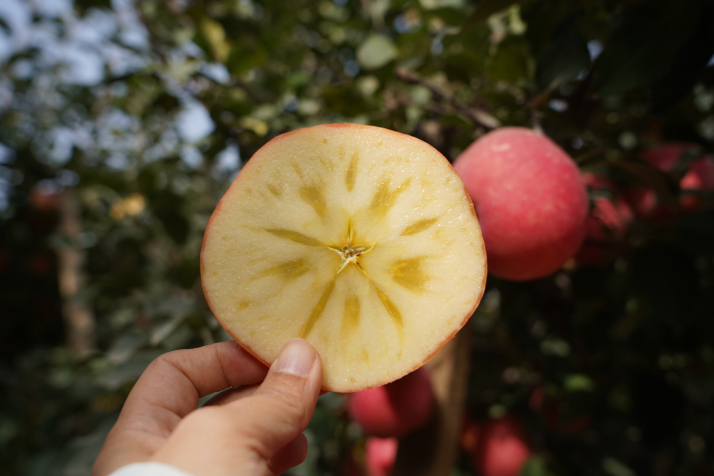 The crystal sugar heart of an Aksu apple, hailed as among Xinjiang's, and arguably China's, finest (WANG YAJUAN)
Wang Yunzhi would be amazed to hear of the apple of discord. To this apple grower from Aksu Prefecture, far from being an agent of strife, it is the golden fruit behind her family's enviable transformation. A few years ago, the Wang family used to fret about unstable crops and low profits. But last year, their net income surpassed 1 million yuan ($140,700)—all grown on trees, thanks to a bountiful harvest of apples, hailed as being among Xinjiang's, and arguably China's, finest. That figure becomes even more striking when considered against the national backdrop. With the average per-capita disposable income reported to be 41,314 yuan ($5,812) in 2024 by the National Bureau of Statistics, Wang's success story is testament to how a single fruit variety can change a family's destiny. The secret of their success is the "crystal sugar heart" of the famed Aksu apples, a translucent core resulting from high sugar content. High-quality apples thrive in Aksu thanks to its dry, temperate continental climate and long hours of sunshine in all four seasons. The local water is also a key reason for the apples' excellent flavor, as the water used for irrigation is the snow and glacier meltwater from the nearby Tianshan Mountains, one of the largest mountain ranges in the world. Yet nature's gift alone does not fully explain Aksu's agricultural progress. In recent years, the prefecture has combined its natural advantages with technological innovation, scientific management and digital transformation to elevate not only apples but its entire agricultural sector to new heights. 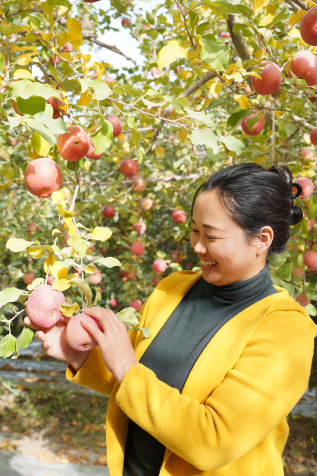 Wang Yunzhi, an apple grower in Aksu Prefecture, checks her apples at her orchard in Hongqipo--the heartland of the famed crystal sugar heart apple, on October 18 (WANG YAJUAN)
From seed to success Wang has been an apple grower for more than two decades, but her road from seed to success was anything but smooth. Starting with less than a hectare, she initially followed conventional methods, emulating her neighbors' pruning and fertilizing, yet struggled to turn a profit. "The money from selling apples one year would all be reinvested in seedlings and fertilizer the next. By the year's end, our pockets were still empty," she recalled. Nature too dealt brutal blows. A devastating hailstorm in 2015 left her orchards in ruins. Then another struck in 2018, smashing the fruits to pulp. However, the turning point came in 2019 when she joined the Fengqingyuan Fruit Farmers Cooperative in Hongqipo—the heartland of the crystal sugar heart apple. The cooperative collaborates with Xinjiang Hongqipo Agriculture and Animal Husbandry Investment and Development Co. Ltd., a large local agriculture enterprise, to help farmers grow and sell better produce. The company, the orchestrator of a modern agricultural value chain, invests in farmers through the cooperative to secure premium, standardized products, which it can then brand and sell. 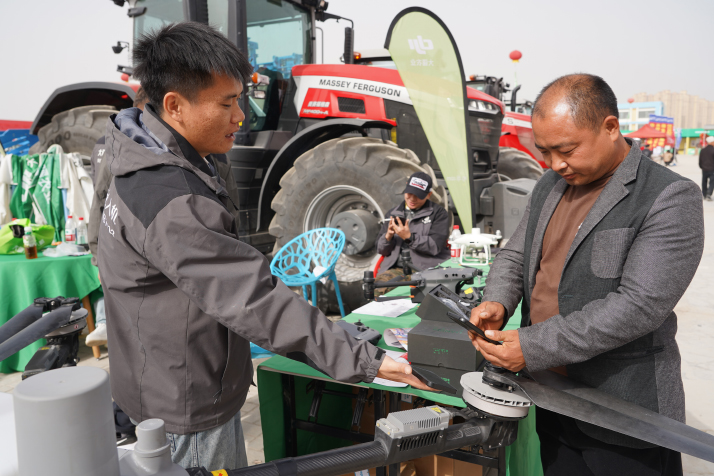 A farmer exchanges contact information with an intelligent agricultural machinery salesperson at the 11th Xinjiang Characteristic Fruit (Aksu) Trade Fair on October 17 (WANG YAJUAN)
"Through the cooperative, experienced farmers and technicians taught me proper irrigation, scientific pruning, biocontrols and how to apply organic fertilizer," Wang explained. The technical guidance caused the marketability of her apples to soar and she gradually expanded her farming area. "Before, for example, if I grew 100 tons of apples, I could only sell 40 tons. Now, I can sell 80 to 90 tons. The income per hectare has been increasing as well." In 2019, she also began building her online sales network. Through Douyin, the Chinese version of TikTok, she shared snippets of orchard life, such as pruning techniques, harvest scenes and images of the glistening crystal sugar heart inside each apple. These authentic glimpses into the farming process resonated deeply with consumers nationwide. Today, she sells over 300 tons of fresh apples and 50 tons of other dry and fresh fruits online annually. "This year, with more than 10 hectares of apple orchards, I have every confidence in both growing and selling my apples well," Wang told Xinjiang Today. Wang's story is one example of the digital shift in farming. Her digital success mirrors the broader regional transformation. In recent years, Aksu has fervently embraced e-commerce trends, utilizing livestreamed sales of agricultural products as a sustainable new business model. A growing number of farmers are following in Wang's footsteps, becoming online influencers who directly connect consumers with the region's specialties, including apples, walnuts and red dates. 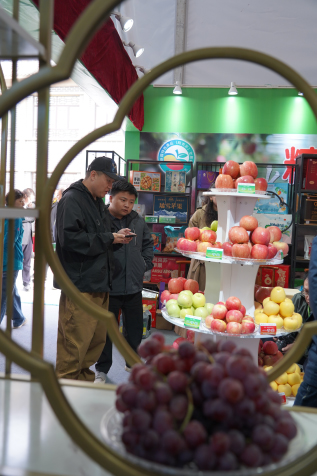 Visitors at the 11th Xinjiang Characteristic Fruit (Aksu) Trade Fair, which ran from October 17 to 19, in Aksu City, Aksu Prefecture (WANG YAJUAN)
Official data reflected this boom: From January to September this year, online retail sales of agricultural products in the prefecture exceeded 2 billion yuan ($281 million), a growth of 14.94 percent year on year. Moreover, the local government hosts an annual fruit fair to create sales channels for local businesses and farmers across and beyond the region. The 11th Xinjiang Specialty Fruit (Aksu) Trade Fair, held in October, featured over 450 enterprises and cooperatives from the grain, fruit, vegetable, livestock and food sectors, displaying a wide array of over 1,800 products from fresh specialties to processed goods. During the event, deals worth nearly 5 billion yuan ($702 million) were signed for 130,300 tons of goods. 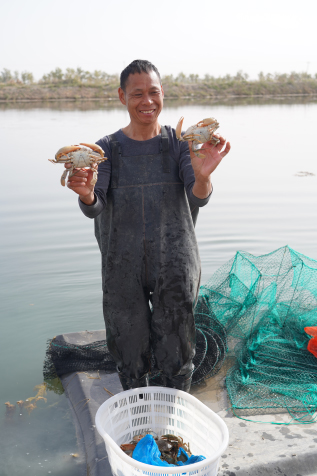 An aquaculture farmer displays his farmed crabs in Alaer City, Aksu, on October 20 (WANG YAJUAN)
Crabs from barren waters Imagine savoring fresh, high-quality mud crabs, a delicacy usually found in coastal waters, in arid, landlocked Xinjiang, thousands of kilometers from the nearest ocean. This is no longer a fantasy but an agricultural breakthrough unfolding in Aksu, where salt-alkali land has been transformed into an unlikely home for seawater crabs. Aksu, like much of Xinjiang, contains vast stretches of salt-alkali soil—land traditionally seen as infertile and difficult to farm. In fact, Xinjiang accounts for about one third of China's total salt-alkali land area, with over 7.7 million hectares classified as lightly or moderately saline. But instead of treating this as a setback, innovators recognized an opportunity. Could carefully managed salt-alkali water simulate the natural marine habitat of crabs? The question was answered thanks to the paired assistance program in Xinjiang, launched in 1997. Under the program, some Central Government departments, central state-owned enterprises, as well as 14 provinces and municipalities in China's more developed regions have been paired with Xinjiang. Through personnel exchanges and assistance programs in areas such as science and technology, education and healthcare, the program channels expertise and resources to Xinjiang to help narrow regional disparity in development. Zhejiang Province—a coastal region in the east renowned for its seafood expertise—was paired with Aksu. In 2024, this partnership enabled the introduction of tens of thousands of juvenile mud crabs from Sanmen County, a famous crab-breeding region in Zhejiang, into experimental ponds in Alaer City, Aksu. This venture was far more than a simple transplant. It was a massive effort involving governments, research institutions and crab farming experts from both Zhejiang and Alaer. Together, they recreated a marine-like environment by balancing water chemistry, temperature and feed. The results exceeded expectations: The crabs not only survived—they thrived. The first harvest proved a resounding success, selling out rapidly despite the premium price. Customers praised their quality, and the crabs became an instant sensation. For Xinjiang locals, the crabs offer a rare chance to enjoy fresh, locally sourced seafood. For the Zhejiang community living in Xinjiang, the taste creates an edible link to their coastal roots. "Cross-regional cooperation can channel expertise and resources to foster sustainable development," said Chen Wuqun, General Manager of Xinjiang San'a Agricultural Development Co. Ltd., which has successfully cultivated saltwater mud crabs in Alaer's inland salt-alkali water. Chen has brought a wealth of expertise from his background in the aquaculture industry in Zhejiang. Through the paired assistance program and hands-on experience, he identified a unique business opportunity for Xinjiang fishery. Now looking ahead, he plans to expand the farming area and involve more local farmers who are interested in mud crab cultivation. "Hopefully, by sharing our knowledge and creating sustainable market opportunities, we're helping turn local potential into tangible economic benefits for the local community," he concluded. (Print Edition Title: Flavors of Success) Comments to luyan@cicgamericas.com |
|
||||||||||||||||||||||||||||||
|