|
| World |
| At the CIIE, coffee tells a story of how China is deeply integrated into the global supply chain | |
|
|
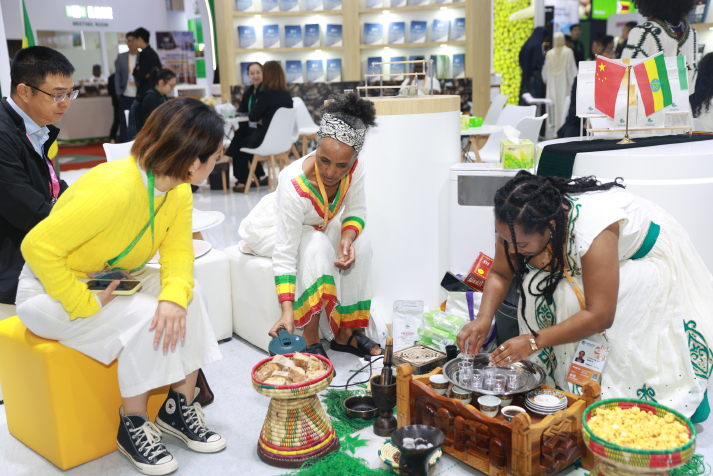 Ethiopian exhibitors prepare traditional coffee at the Ninth CIIE on November 8 (YIN KANG)
The China International Import Expo (CIIE) is regarded as a showcase for international businesses seeking a foothold in the Chinese market. Yet at its ninth edition, held in Shanghai on November 5-10, a curious phenomenon occurred: It was often hard to tell whether a product was Chinese or foreign. Nowhere was this more apparent than in coffee. There was a time when China barely featured on the global coffee map, which had long been shaped by tropical growers and Western consumers. This year's CIIE, however, told a different story. Luckin Coffee, China's largest coffee chain by store count, made an unlikely appearance in the national pavilions of both Brazil and Indonesia. In 2024, it signed a 10-billion-yuan ($1.4-billion) deal to source 240,000 tons of Brazilian coffee beans over five years. At the Indonesian country pavilion, the centerpiece was Luckin's signature Coconut Latte, whose runaway popularity prompted Luckin to sign an agreement for exclusive rights to secure coconuts from Indonesia's Banggai Islands. The flow was not all one-way. Sumseron Coffee, a Kenyan exporter returning to the CIIE this year, had used contacts made at the expo last year to sell 6 tons of coffee beans to Viet Nam. Elsewhere, Kunshan, an industrial hub near Shanghai that grows not a single coffee bean yet accounts for roughly two thirds of China's roasting capacity, organized a coffee event where visitors sampled beans from across the globe. These stories point to a broader shift in China's place in global trade, where it is emerging as a major buyer, processor and trading hub connecting businesses and consumers across continents. The result is a global supply network in which it is getting harder to tell where the Chinese part ends and the international part begins. 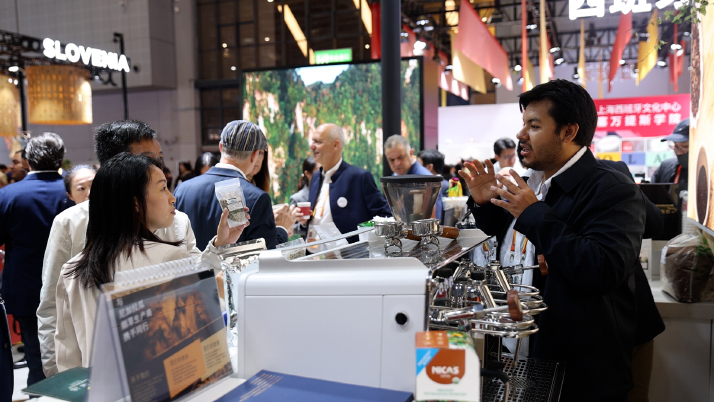 A barista showcases Nicaraguan green coffee beans at the country's national pavilion during the Ninth China International Import Expo in Shanghai on November 6 (YIN KANG)
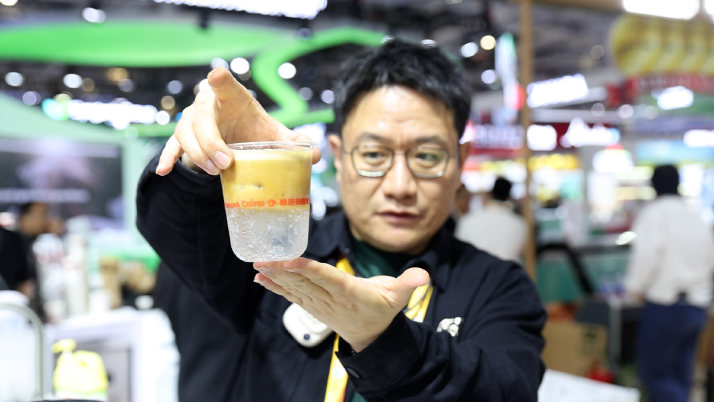
Two worlds in one cup For Nicholas Hoskyns, Managing Director of Ético, a Nicaraguan association of small farmers and businesses, this was his second time participating in the CIIE. For more than three decades, he has worked with small farming cooperatives to bring local produce such as coffee, sesame and peanuts to Europe, the United States and Japan. Yet despite his extensive experience in the field, entering the Chinese market had long seemed a daunting prospect. "China is such a vast and competitive market," he told Beijing Review. "Nicaragua is a small country, so you feel like you haven't got enough volume." His first visit to the CIIE last year, however, began to change that perception. Beyond its enormous scale and fierce price competition, he discovered a market with a growing appetite for high-quality beans and distinctive flavors beyond the standard offerings of mass-market chains. What gave Hoskyns an added measure of confidence is the deepening of trade ties between China and Nicaragua. Since restoring diplomatic relations in December 2021, the two countries have signed a free trade agreement, which took effect in January 2024, and seen bilateral trade climb nearly 90 percent to $1.42 billion in 2025, compared with 2022. Nicaragua has also participated in four editions of the CIIE since the country's ties with China were restored in 2021. "We will keep coming back," Erwin Ramírez, Nicaragua's Minister of Development, Industry and Commerce, told Beijing Review. The CIIE, he said, provides a valuable platform for bringing Nicaraguan exporters closer to Chinese businesses and consumers, while deepening trade ties between the two countries. For Hoskyns and the small farmers he represents, this year's CIIE brought those growing ties closer to home—and to Baoshan, a city thousands of kilometers away in southwest China's Yunnan Province. On November 6, representatives from Nicaragua and Baoshan signed an agreement at Nicaragua's national pavilion to open new sales channels for Nicaraguan coffee in the Chinese market. "This will allow Baoshan to source coffee directly from Nicaragua, which will greatly cut import costs," Zhao Jihui, the Baoshan government official who signed the agreement, said. Baoshan is no stranger to coffee. As one of the birthplaces of China's commercial coffee industry, the city has been growing beans since 1952. Today, besides accounting for a substantial share of Yunnan's coffee output, it now imports beans from 27 countries and regions, processing them for a market that stretches well beyond China. According to Zhao, Baoshan began importing Nicaraguan coffee last year and has since purchased some 60 tons. Shipments have been hampered by rising freight costs linked to conflicts in the Middle East, but he expects imports to grow as the new agreement takes effect. The story, however, does not end there. "The next step is to build processing facilities and invest in coffee plantations overseas, so that we can become even more deeply integrated into the global supply chain," Zhao said. Roots and routes Another unlikely glimpse into China's coffee history could be found at the pavilion of Charoen Pokphand Group (CP Group), an agro-industrial and food conglomerate headquartered in Thailand. On offer was Xinglong coffee, a traditional brew from Xinglong, a small town near the beach resorts of Wanning in Hainan, China's southernmost island province. Dark, thick and intense, Xinglong coffee is made by roasting robusta beans over charcoal with butter, sugar and a pinch of salt, then brewing them in a metal kettle and straining the liquid through gauze into sweetened condensed milk. To many visitors, it was a novelty. To Liang Dongru, it was a taste passed down through generations. More than half a century ago, her grandparents, ethnic Chinese from Malaysia, settled in Xinglong, which was established in the 1950s as a farm to accommodate Chinese returning from overseas. They were among waves of returnees from 21 countries and regions, who brought with them not just coffee-growing techniques, but a taste for the drink itself. In 1952, the same year Baoshan began growing coffee, Xinglong saw the establishment of the first coffee factory in China after 1949. By the 2010s, its brand, Sun River Mark, had become a household name. For Liang, who took immense pride in her hometown's coffee heritage, joining the business seemed only natural. The following decades saw China's coffee scene profoundly transformed, with homegrown chains such as Luckin and Cotti expanding at breakneck speed, coffeehouses rising even in the countryside, and creative flavors constantly emerging. Amid the rush for novelty, an old name like Sun River Mark seems to have faded from public view. A new chapter began in 2022, when Sun River Mark joined forces with CP Group. "It was a partnership that worked both ways," Ye Jian, General Manager of CP (Hainan) Xinglong Coffee Industry Development Co. Ltd., told Beijing Review. For the food conglomerate, the partnership offered a foothold in China's increasingly crowded coffee market. Apart from Xinglong's long coffee-making tradition, another major draw, Ye noted, was Hainan's development as a free trade port. On December 18, 2025, the island began operating under a special customs regime designed to facilitate trade through looser trade controls, lower taxes and streamlined investment rules. CP Group has been quick to seize the opportunity. Just three months after the launch date was announced, the company completed a pioneering transaction in October 2025, importing coffee beans from overseas, roasting them in Xinglong, then exporting the finished products to Australia. In another first, it shipped coffee made with Colombian beans to Beijing, taking advantage of a policy that exempts goods from import tariffs if their value increases by at least 30 percent through processing in Hainan. For Xinglong Coffee, the partnership offers a way to modernize and tap into CP Group's global sourcing and distribution networks. "We want to use our scale and resources to bring Chinese heritage brands like Sun River Mark to a wider audience," Ye said, adding that the company has retained all employees of the original factory. Liang is one of them. "In the past, our little factory would never have had the chance to exhibit its products in Shanghai, let alone at an exhibition like this," she said. At Xinglong Coffee's CIIE debut this year, she served some 500 cups a day. It was exhausting, but she could not have been happier. Mixing it up At this year's CIIE, the increasingly tangled global coffee trade was producing more than new business deals. It also brought forth new ideas about how coffee could be made and consumed. A few steps away from the Xinglong Coffee stand was an espresso bar run by Dashang Group, a Chinese retail conglomerate based in Dalian, Liaoning Province. Behind the counter, Zuo Jiayi, a champion coffee roaster from New Zealand, was experimenting with new recipes using an instant coffee product of his own invention. With a combination of precision extraction, liquid nitrogen and freeze-drying, he has devised a way to better capture the flavor of freshly brewed coffee in instant granules that dissolve with a quick stir. The idea came to him after he bought a rare Panamanian coffee at auction for more than $10,000 a kilogram. Customers who purchased the costly beans, however, struggled to brew them properly. Even Zuo found it difficult to produce two identical cups. "That's how I came up with this idea of freezing coffee in time at its best," Zuo told Beijing Review.
For Zuo, innovation often begins when people, ingredients and ideas from different parts of the world come together. A chance conversation with an exhibitor at the New Zealand pavilion, for instance, had prompted him to experiment with mixing his coffee granules with apple cider. Such encounters, he believes, are what make the CIIE particularly valuable. "It's hard to say whether the result is Latin American, Chinese or New Zealand. It has a bit of everything," he said. To Zuo and his fellow exhibitors, the expo is something of a global laboratory, where ideas collide, unexpected combinations take shape and new possibilities emerge. The beans may have a country of origin. The finished cup is becoming harder to pin down. (Print edition title: A Global Blend) (Zhang Shasha contributed to this story) Copyedited by Elsbeth van Paridon Comments to pengjiawei@cicgamericas.com |
|
||||||||||||||||||||||||||||
|