|
| World |
| What did Ningbo offer the world's mayors? | |
|
|
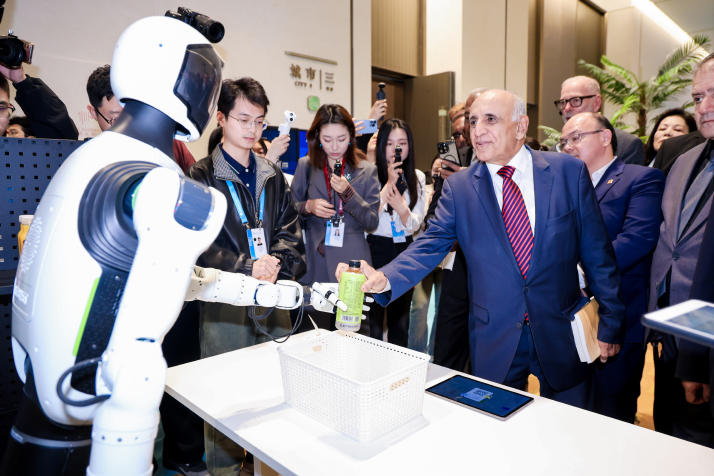 A participant interacts with an embodied AI robot during the 2026 Global Mayors Dialogue in Ningbo, Zhejiang Province, on November 3 (COURTESY PHOTO)
Romulus Agbedjekou stood on a viewing platform of the Ningbo-Zhoushan Port's Meishan terminal in Ningbo, Zhejiang Province, on November 3, watching driverless trucks glide along preset routes beneath gantry cranes stacking containers with mechanical precision. "This is one of the most modern ports in the world," Agbedjekou, special representative of the mayor of Cotonou, Benin, and chair of the city's economic affairs commission, told Beijing Review. "We hope to replicate these practices at the Autonomous Port of Cotonou." That impulse to look at Ningbo and see home ran through the 2026 Global Mayors Dialogue, held in this eastern Chinese port city on November 2-5. Mayors and representatives from 20 cities in 15 countries gathered under the theme Openness and Connectivity for Shared Opportunities. They signed 14 cooperation agreements during the event, covering trade, technology, education, tourism and exchange between local governments. The Ningbo Consensus on Cooperative Development was also issued, calling for open trade, industrial cooperation and closer people-to-people exchange. But the substance of the gathering lay less in the documents than in the specific things each delegate came looking for. Port-side dialogue Ningbo-Zhoushan Port handled 1.432 billion tons of cargo in 2025, ranking first globally for the 17th consecutive year and becoming the world's only port to surpass 1.4 billion tons annually. Its container throughput reached 43 million 20-foot equivalent units (TEUs), the standard unit of measurement used in the shipping industry, in 2025, ranking third globally for the ninth consecutive year, and its 309 container routes connect to more than 700 ports in over 200 countries and regions. Asked what keeps the port running, Yu Fengqing, Vice Mayor of Ningbo, mentioned three things during a port-side dialogue on November 3. China's steadfast commitment to continuous opening up, backed by its manufacturing bases, has created opportunities for port development. The port holds a unique role as a golden hub of the Yangtze River Delta and a vital link connecting China with the Middle East, Africa and Europe under the Belt and Road Initiative (BRI), which has more than 200 deep-water berths across 20 port areas stretching 220 kilometers of coastline. The BRI is a China-proposed framework that boosts connectivity along and beyond the ancient Silk Road routes. Decades of development has produced unmanned trucks, remote-controlled cranes and digital-twin systems, what Yu called "certainty systems that do not depend on people," keeping the port up and running even in typhoons and heavy fog. For cities like Cotonou, the lesson is the modularity. At Meishan, the automation is visible and, more importantly, described by Ningbo officials as adaptable. Hu Linjie, an operations manager at Ningbo Meidong Container Terminal, told Beijing Review that the port hopes its green practices can offer "a transition plan that can be borrowed and replicated" by ports worldwide. Lee Fu Haw, a councilor with Malaysia's Royal Klang City Council, was explicit about the practical value, "Malaysia's Port Klang is undergoing expansion and digital transformation and Ningbo is a good reference for us." Ningbo is offering technical interfaces, including automated terminal management, green energy integration and driverless transportation that smaller or less-developed ports can adopt in stages. As Yu said, Ningbo offers standardized solutions that different ports can plug into, rather than a model to be "copied wholesale." Zhou Qiangwu, former Vice President and Chief Administrative Officer of the New Development Bank, offered a pathway for smaller ports during the same dialogue. Developing countries with smaller ports can cooperate with regional or near-regional ports, unify green standards, jointly procure green equipment, share maintenance technology and build green corridors together. Such coordination, he argued, attracts more ocean-going shipping and improves facility utilization. 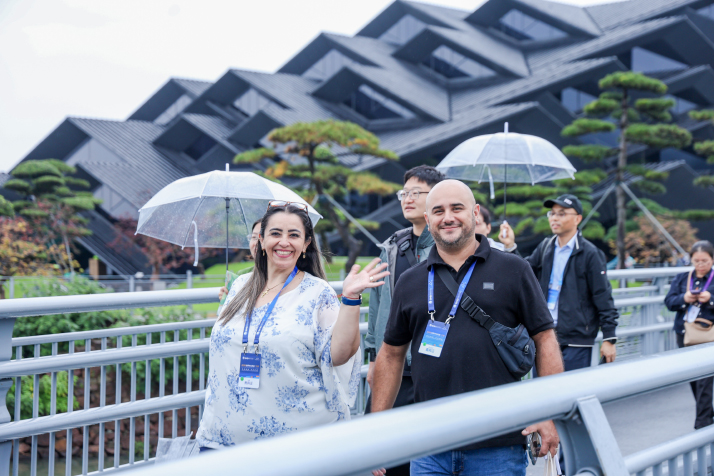 Participants visit Dongqian Lake during the 2026 Global Mayors Dialogue in Ningbo on November 4 (COURTESY PHOTO)
The green corridor If the port represents Ningbo's hard connectivity, the city's network of sister-city relationships supplies the soft infrastructure. Ningbo maintains friendly ties with 124 cities worldwide, according to Wang Cheng, Secretary of the Communist Party of China Ningbo Municipal Committee, at the event's main session on November 3. One of the oldest is with Rouen, France, a relationship now in its fourth decade. At the China-France Friendship Garden in Ningbo, a climbing rose variety called Angela, planted in honor of the 30th anniversary of the Ningbo-Rouen bond, bloomed out of season. Joachim Moyse, Vice President of Métropole de Rouen and Mayor of Saint-Étienne-du-Rouvray in the Rouen metropolitan area, visited the garden during the event and said its counterpart in Rouen is nearing completion. The dialogue platform, he said, "builds bridges between peoples" and allows city administrators to exchange governance experience and inspire one another. That sentiment was echoed in the maritime sphere. In May, Ningbo-Zhoushan Port signed green shipping corridor initiatives with five international ports, including France's HAROPA Port alliance, which encompasses Le Havre, Rouen and Paris. The partnership, first cemented in 2025, had moved from intent to implementation within a year, with French container shipping and logistics giant CMA CGM joining as a second shipping partner to complete a French "port-shipping-classification" chain. At that same event, Ningbo-Zhoushan Port released China's first systematic operational handbook for international green shipping corridors, detailing over 30 actionable measures across port decarbonization, organizational optimization and smart empowerment. What cities want Not every delegation arrived with ports on its mind. At the Ningbo-based PIA Automation smart factory on November 4, Enrico Ricci, President of the Economic Development Commission of the City Council of Florence, Italy, watched an embodied AI robot write steadily on paper. Florence, he said, is looking for ways to connect advanced digital technologies with small businesses and start-ups, and hopes to exchange more ideas with Ningbo. Ahmed Wazeery, Secretary General of Egypt's Suez Governorate, pointed to the China-Egypt TEDA Suez Economic and Trade Cooperation Zone, where investment has exceeded $6.7 billion, as well as the Suez Canal Economic Zone's six ports and four industrial areas, citing them as evidence of the two sides' existing cooperation. His interest in Ningbo, however, extended beyond manufacturing to education, cultural industries and hi-tech industrial parks. 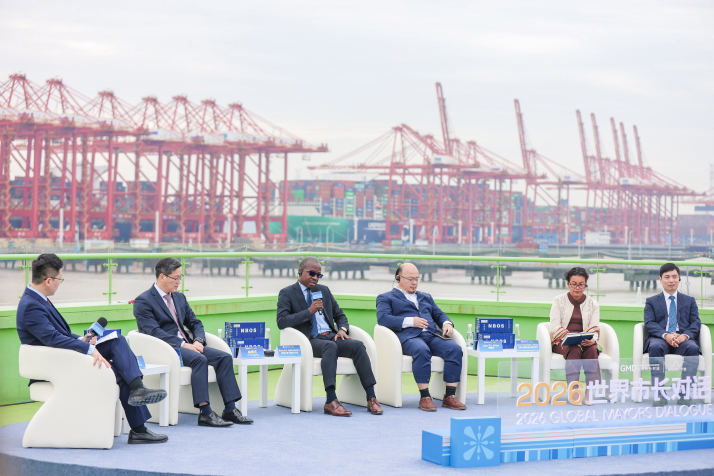 Participants attend a port-side dialogue during the 2026 Global Mayors Dialogue at Ningbo-Zhoushan Port's Meishan terminal in Ningbo on November 3 (COURTESY PHOTO)
The Suez connection is not new. In 2024, a Ningbo delegation visited the Suez Canal authorities, and Ningbo-based Dashun Fur, specializing in microfiber cleaning textiles, invested $40 million in the economic zone, expanding from textiles into modern logistics. Wazeery's visit was an effort to deepen a relationship that already has a track record. Madagascar's Toamasina, which handles 80 percent of the country's maritime cargo, sent a special representative of the mayor, Lao Harivelo Alexa, who said the port looks to connect closely with a port like Ningbo-Zhoushan, with direct shipping routes as a key guarantee. Mayor of Ningbo Shen Mingquan framed the city's openness not as a one-way projection but a two-way embedding into global industrial and innovation chains. Ningbo already has extensive international business links, Shen said, adding that the eastern Chinese city trades with more than 220 countries and regions. More than 5,000 Ningbo-based enterprises have invested overseas, while nearly 10,000 foreign-invested firms operate in the city. Wayne Brown, Mayor of Auckland, New Zealand, whose city's relationship with Ningbo predates its formal sister-city agreement, put forward the case for more in-person contact. Trade today, he said, is increasingly city-to-city, but it is people-to-people connections that contribute to it. Ningbo, Yu said, does not seek to be the protagonist of global shipping but a connector within the world's shipping network, linking China's hinterland on one end and global partners on the other. According to him, Ningbo will continue to add routes and deepen sister-port ties, so that ports can complement each other's routes, share container slots and exchange information. "Our simple understanding is to turn the port's connectivity into mutual commonality, and Ningbo's port into everyone's bridge," Yu concluded. (Print Edition Title: The Connector) (Reporting from Ningbo, Zhejiang Province) Copyedited by Elsbeth van Paridon Comments to mamm@cicgamericas.com |
|
||
|
||||||||||||||||||||||||||||
|