|
| World |
| China and Switzerland deepen trade ties as barriers rise across the global economy | |
|
|
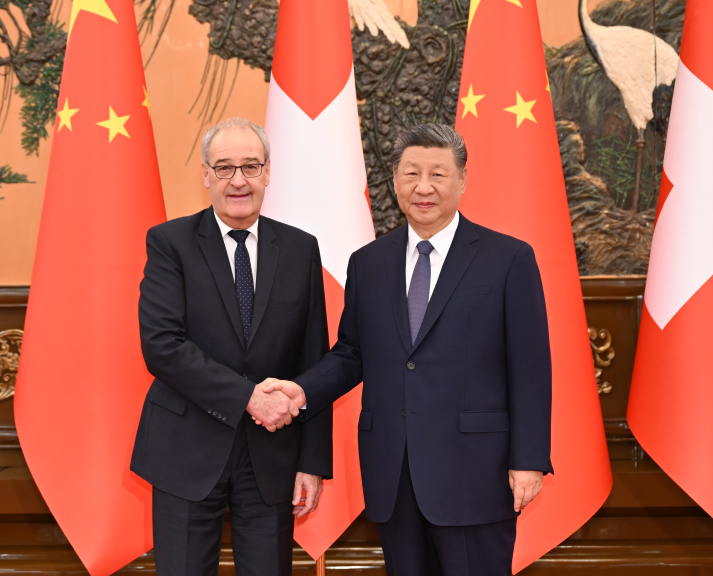 Chinese President Xi Jinping meets with President of the Swiss Confederation Guy Parmelin at the Great Hall of the People in Beijing on October 30 (XINHUA)
As China and Switzerland mark the 10th anniversary of their innovative strategic partnership, established in 2016, they have expanded their economic ties. On October 30, witnessed by Chinese President Xi Jinping and President of the Swiss Confederation Guy Parmelin, the two countries signed a protocol to upgrade their free trade agreement (FTA) in Beijing. The original FTA took effect in 2014. Before the signing, Xi met with Parmelin, who was on a working visit to China from October 30 to November 1. During the meeting, Xi called on both countries to inject confidence and more certainty into China-Europe economic and trade cooperation as well as into the global economic development. Noting Switzerland is an important partner of China in Europe, Xi said Swiss cooperation with China has always been at the forefront among European countries. He added that free trade cooperation has become the brightest highlight of China-Switzerland relations, which demonstrates the political courage and responsibility of the two countries in adhering to open cooperation, and highlights the unique leading role of both sides in promoting the building of an open world economy. "It's a new step in our relations," Parmelin told Reuters on October 30, adding that the negotiations to upgrade the FTA had addressed the practical expectations of companies and other stakeholders. Switzerland is China's seventh largest trading partner in Europe, while China is Switzerland's largest trading partner in Asia. Bilateral trade reached $49.04 billion in 2025. Following the signing of the protocol, both sides will complete their respective domestic legal approval procedures and work to bring the upgraded agreement into force as soon as possible, China's Ministry of Commerce (MOFCOM) said. Upgraded trade agreement The original China-Switzerland FTA was signed in 2013, making Switzerland the first country in continental Europe to conclude such an agreement with China. Upgrade negotiations were formally launched in September 2024 and concluded in August 2026 after five rounds of talks. Under the protocol signed on October 30, the two sides will make high-standard commitments to further opening up trade in goods, services and investment, while upgrading rules covering rules of origin, trade facilitation, technical barriers to trade, digital trade, competition, and trade and sustainable development. The upgrade is expected to provide stronger institutional support for bilateral trade and investment liberalization and facilitation, MOFCOM said, adding that it underscores both countries' clear stance in support of free trade, open cooperation and a rules-based multilateral trading system amid global uncertainty. According to the ministry, the two sides will further reduce tariffs on nearly 300 product categories each, with goods ultimately eligible for zero tariffs accounting for more than 99 percent of bilateral trade by value. Swiss coffee, machine tools and watches are among the products that will benefit from additional Chinese tariff reductions, some immediately and others after five- or 10-year transition periods. Switzerland will further open its agricultural market, offering more favorable treatment to selected Chinese products, including vegetable oils and pet food. The Swiss Government said the upgraded FTA will eventually allow 99.8 percent of Switzerland's current exports to enter China duty-free. On investment, the two countries agreed on rules concerning market access, transparency and the treatment of foreign investors. The revised framework includes commitments addressing discriminatory treatment and certain requirements imposed on foreign businesses. It also introduces provisions on not imposing customs duties on electronic transmissions (relating to e-commerce) and on strengthening cooperation on personal information protection and digital customs procedures. The newly added chapter on trade and sustainable development addresses issues including environmental goods and services, responsible business conduct, climate change, biodiversity, sustainable agriculture and the transition toward cleaner energy. The upgraded FTA also includes provisions concerning AI, electronic trade documents and source-code protection. This is the first time China has included a dedicated source-code protection provision in a bilateral FTA, MOFCOM said. High expectations On October 30, Parmelin and the Swiss business delegation accompanying him on his visit to China held talks with Chinese Minister of Commerce Wang Wentao. According to MOFCOM, Swiss business representatives expressed interest in expanding production and research and development investment in China and reaffirmed their confidence in the country's market potential. They identified pharmaceuticals, machinery, finance, watches and green transformation as priority areas for broader cooperation. Beyond trade, both countries are also seeking closer ties in science and emerging industries. During his meeting with Parmelin on October 30, Xi highlighted digital technologies, green energy storage and AI as areas with strong potential for further collaboration. On October 31, Parmelin visited the Ministry of Science and Technology and discussed research and innovation partnerships with Minister Yin Hejun. The two sides signed an agreement on the cross-border management of scientific data for joint research activities, which is expected to facilitate cooperation among researchers by establishing clearer procedures for handling scientific data. Parmelin also expressed interest in exchanges between young scientists and in preparations for the 10th meeting of the bilateral science and technology cooperation committee. The business opportunities arising from the upgraded FTA, together with the changing needs of Swiss companies operating in China, were the focus of the Ninth Sino-Swiss Economic Forum held in Beijing on October 31. A dedicated session brought together business executives and policy specialists from both countries to examine the economic outlook and the implications of the agreement's revision. The forum, jointly organized by the Swiss Chamber of Commerce in China, the Embassy of Switzerland in China and export and investment promotion organization Switzerland Global Enterprise, also featured sessions on AI, advanced engineering and manufacturing, and life sciences. Parmelin and Wang addressed the forum's evening banquet, joining participants from both countries to celebrate the new chapter in bilateral free trade ties. In an interview with Swiss public broadcaster SRF following the signing of the protocol, Parmelin said growing protectionism in international trade had helped move the negotiations with China forward. He expressed confidence that the new FTA would help both sides address practical trade concerns and further improve conditions for bilateral business cooperation. At a time of growing uncertainty in the global economy, it also reflects the two countries' shared commitment to openness and free trade, Parmelin noted. (Print Edition Title: Lower Fences, Wider Gates) Copyedited by G.P. Wilson Comments to liwenhan@cicgamericas.com |
|
||
|
||||||||||||||||||||||||||||
|