
|
| World |
| Pickleball emerges as a new bridge for youth exchange between China and the United States | |
|
|
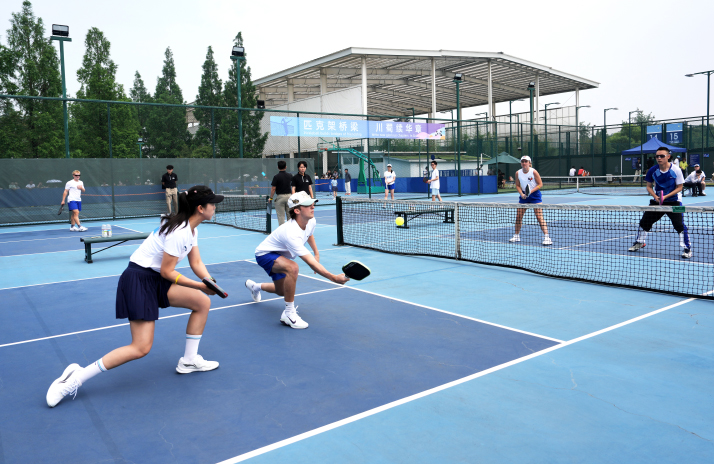 Players from China and the United States during a friendly pickleball match in Chengdu, Sichuan Province, on May 17 (VCG)
At Peking University's Khoo Teck Puat Gymnasium in mid-October, Chinese and American university students were grouped into mixed doubles pairs, many meeting for the first time. Yosef Volkowitz, an undergraduate from the University of Illinois in the United States, and his Chinese partner Jin Chuyi of Beijing Union University won every match they played. It all came down to chemistry. "You take this ball, I will get that one—you just know without saying anything," Volkowitz told state broadcaster China Central Television, adding, "When we played together, we became friends." Or as Jin summed it up, "The more we talked, the more common ground we found." "Through several rounds of matches, our coordination has grown more and more in sync. None of us knew each other before we came here, but sports is the best language. With pickleball as the medium, we are friends now," Yang Linfeng, a master's student at Peking University, said. That scene unfolded during the Beijing leg of the 2026 China-U.S. Elite University Student Pickleball Friendship Tournament, held on October 11-19 in Beijing and Guangzhou in Guangdong Province. It brought together more than 60 students from five Chinese universities and 11 U.S. institutions, including the University of Illinois, University of Washington and Columbia University. This was the first major activity after Peking University became one of China's first youth pickleball international cultural exchange bases under the Center for Language Exchange and Cooperation of the Chinese Ministry of Education. The event was also among the first concrete follow-ups of an updated initiative announced by Chinese President Xi Jinping during his state visit to the U.S. in late September: 100,000 young Americans will be invited to visit China for exchange and study over the next five years. More than five decades after a few friendly ping-pong matches helped re-open the door to bilateral exchange between China and the U.S. in the early 1970s, pickleball is carrying forward the tradition of sports diplomacy, bringing hundreds of young Chinese and Americans face-to-face, on and off the court. A sport for all Pickleball was invented in 1965 on Bainbridge Island, Washington State, the U.S., by three families looking for a casual game their children could play. It blends elements of tennis, badminton and table tennis, played on a court roughly the size of a badminton court, with a low net and lightweight composite paddles. Its signature rule is the "kitchen," a seven-foot (2.13 meters in metric terms) no-volley zone near the net, designed to limit overpowering smashes and reward soft touch, placement and patience. Matches are typically played to 11 points, with a two-point lead required to win. What makes it ideal for youth (diplomacy) is its accessibility: Beginners can learn basic strokes within minutes; players of different ages and skill levels can compete side by side. Unlike many competitive sports that reward raw athleticism, pickleball prioritizes collaboration and respect, making it a natural vehicle for cross-cultural conversation. In the U.S., it has become one of the fastest growing recreational sports. In China, it has spread rapidly in schools and communities in recent years, with more than 2 million enthusiasts nationwide. "We don't even need to speak the same language. Paddle tapping is a universal sign in pickleball," Ella Boydston from Utah Tech University said while attending the 2026 China-U.S. Friendship Pickleball Event held in Ganzhou, Jiangxi Province, in May. Paddle tapping, a quick touch of paddles between partners or opponents, is pickleball's signature gesture of teamwork and respect, though the exact etiquette of when to tap varies by player. The scene echoed a well-known story from 55 years ago. Judy Hoarfrost joined a U.S. table tennis delegation to China in 1971 at the age of 15. That trip was the beginning of what later became known as Ping-Pong Diplomacy and helped lay the groundwork for the establishment of official diplomatic relations between China and the U.S. "It's wonderful to be here and to bring a group of young people. Most of them have never been to China, and just to see their eyes be so curious and light up," Hoarfrost, now head of the Oregon Friendship Pickleball Delegation, told Xinhua. During their 13-day trip, the delegation traveled to Beijing, as well as Jiangxi, Guizhou and Sichuan provinces. A two-way journey The current wave of China-U.S. youth pickleball exchanges began in 2025, when a delegation of 44 teachers and students from 13 schools in Montgomery County in Maryland, the U.S., visited China that April. Hosted under China's initiative announced in November 2023 to invite 50,000 young Americans to visit the country for exchange and educational purposes over a five-year period, the group visited Shanghai, Shenzhen in Guangdong and Beijing. They played friendly mixed-team matches with local students and visited cultural landmarks. The American teenagers wrote a letter sharing their experiences, saying they had forged unforgettable friendships with their Chinese counterparts during the trip. They received a reply from President Xi, encouraging them to serve as new-generation ambassadors of China-U.S. friendship and to contribute to stronger ties between the two peoples. The dialogue quickly became two-way. Later in August 2025, Chinese student groups from Shanghai and Shenzhen traveled to Montgomery to play on U.S. courts. Then, during the 2026 Chinese New Year holiday (February 15-23), a 45-member Montgomery delegation returned to China for a second visit. Over 10 days, they traveled across Shenzhen, Jiangxi, Hebi in Henan Province, known as China's "Pickleball City," a title awarded by the World Pickleball Association in 2023, and Beijing. Alongside friendly matches, they partook in festive traditions, tasted local foods and spoke with Chinese peers about daily school life. This May, the Chinese Embassy in Washington, D.C., hosted a special event, screening a documentary called Aura Spanning the Pacific: The Night of Pickleball that captured the China trip. At the event, Chinese Ambassador to the U.S. Xie Feng noted the continuity from Ping-Pong Diplomacy to today's pickleball exchanges. "The paddles have changed. But our peoples' shared wish for friendship remains as strong as ever," he said. Beyond scores Jeffrey Sullivan, Director of Athletics for Montgomery County Public Schools and head of the two Montgomery delegations, has witnessed the transformation firsthand. He explained the deeper educational value behind the games in an interview with newspaper Guangming Daily. According to him, sport creates a unique connection. Competing hard against an opponent and standing side by side with a teammate teaches cooperation and empathy. It also teaches young people to win gracefully and lose with dignity, he added. He stressed that youth exchange helps soften stereotypes. Countries and individuals will inevitably have differences; what matters is to seek common ground and build bridges. Pickleball offers one such bridge, Sullivan said. The Montgomery school district, the first in the U.S. to offer pickleball as a varsity sport, has formalized ties with education authorities in Shenzhen, Beijing and Shanghai, embedding pickleball into school-level people-to-people programs. For Chinese participants, the experience reshaped their understanding of the U.S. and of diplomacy itself. The magic lies in mixed-team play. Instead of China versus the U.S., players are paired across nationalities. An American and a Chinese teenager become partners, learning to read each other's movements, communicate quickly and trust one another. For a moment, flags and national labels fall away; they are simply teammates chasing the same yellow plastic ball. Stephen Mull, former U.S. Acting Undersecretary of State for Political Affairs, emphasized the unifying power of sport. "It encourages each participant to be the very best version of himself or herself while underscoring the common humanity that binds us all together on the field of play," he told Xinhua. Young people do not debate geopolitics on the court. They talk about homework, hobbies, food and holidays. These ordinary conversations build a foundation of mutual understanding that official dialogue alone cannot easily create. For this generation of teenagers, China-U.S. relations may not be abstract headlines. They are the face of a doubles partner, the sound of laughter after a missed shot and the memory of sitting together to share a meal. As Xie put it, from ping-pong to pickleball, the heart of the story stays the same: People on both sides of the Pacific want to get to know each other. Youth exchange can plant seeds. And seeds planted by young hands can grow for decades to come. (Print Edition Title: Paddles Across the Pacific) Copyedited by Elsbeth van Paridon Comments to mamm@cicgamericas.com |
|
||
|
||||||||||||||||||||||||||||
|