|
| World |
| As Washington restricts Chinese AI technology, American startups are picking up the bill | |
|
|
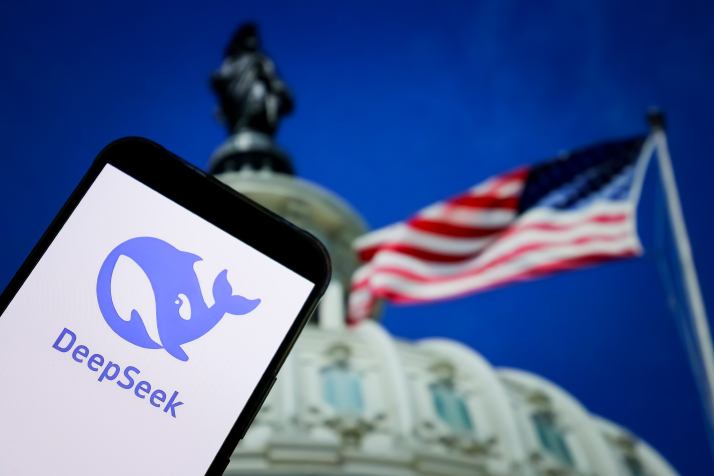 The DeepSeek logo with the national flag of the United States in the background on October 20 (XINHUA)
Flo Crivello runs a startup in San Francisco, the United States, that develops AI assistants to manage e-mails, arrange meetings and handle other routine tasks. As his company, Lindy.ai, attracted more customers, one expense began to grow faster than expected: not salaries or office rent, but the cost of using AI. Lindy.ai initially relied heavily on models developed by American companies, including Anthropic's Claude. By the middle of this year, however, its spending on Anthropic had exceeded the combined salaries of more than two dozen employees. "By far, our No.1 expense was Anthropic," Crivello told U.S. broadcast network National Public Radio (NPR) in July. The company eventually moved its AI workloads to DeepSeek-V4, an open-weight long-context reasoning model released by Chinese AI startup DeepSeek in April. According to Crivello, the shift reduced inference costs, or the expense of running a trained AI model, to one 10th of their previous level, saving millions of dollars. "It was a very, very simple business decision," he told NPR. Three months later, the Chinese model that had helped Lindy.ai cut costs was again making headlines, this time because of restrictions imposed by Washington. On October 19, the U.S. Department of Homeland Security issued an order requiring federal civilian agencies to remove DeepSeek products and related third-party services from their information technology systems and prohibiting future procurement. The department cited "cybersecurity concerns," including the so-called possibility that sensitive information could be transferred to China. Yet proposals to further restrict Chinese AI models have encountered opposition from parts of the American technology industry. Some companies have warned that losing access to affordable models will increase their operating costs and make it harder to compete with larger rivals. The appeal of affordable AI Lindy.ai's experience illustrates a growing concern among businesses developing AI applications. Unlike OpenAI, Anthropic and other major model developers, many startups do not train their own foundation models. They purchase access to existing systems and build products around them. These services are generally charged according to usage, which is measured in tokens—the units of information processed by AI models. As more customers use an application, the number of tokens consumed rises, often bringing higher operating expenses. A lower-priced model capable of performing the same tasks can therefore make a substantial difference to a company's spending on AI. Chinese AI developers have attracted attention by offering models that combine competitive performance with relatively low costs. DeepSeek and Alibaba's Qwen series have also gained international users through their open-weight approach. In simple terms, the model's core files—its "weights," or the learned parameters that determine how it responds, are published for download, so developers can run the system on their own equipment instead of only accessing it remotely, subject to the license terms. This gives developers more flexibility over costs, data handling and the technical requirements of their products. In January 2025, DeepSeek released its R1 reasoning model with openly available weights, allowing developers worldwide to modify and use it commercially. Its performance rivaled that of then top-tier models such as OpenAI's GPT-4, but at a fraction of the cost, thanks to algorithmic and training-efficiency gains. The release attracted international attention and encouraged further experimentation with Chinese AI technology. The growing interest is reflected in data from American platforms. Ramp, a U.S. corporate spending management company serving more than 50,000 businesses, identified DeepSeek as one of its fastest growing software vendors in June. The developer platform OpenRouter also reported increasing use of Chinese models. DeepSeek's share of token usage on the platform rose from approximately 9 percent in January to 18 percent in June. A divided Silicon Valley In July, 179 American technology founders and companies represented by the Little Tech Association sent a letter to the White House urging the government to preserve access to open-weight AI models, including those developed overseas. The signatories warned that broad restrictions could raise development costs, limit technological choices and place smaller businesses at a disadvantage against established technology companies. Their concerns centered on the ability of startups to obtain affordable AI without becoming dependent on a handful of dominant suppliers. The association called for security safeguards addressing specific risks rather than restrictions that would broadly prevent American developers from accessing foreign models. The commercial interests involved extend beyond AI developers themselves. Chipmakers supply the hardware necessary to run models, cloud providers sell computing services and software companies build applications using technology from different suppliers. Broader access to AI tools can boost demand across the industry, but leading proprietary model developers have different concerns. Both OpenAI and Anthropic rely on premium models and commercial application programming interfaces (APIs), standardized interfaces that let developers call AI models on a pay-per-use basis, for revenue, and the entry of lower-priced Chinese open-weight models is putting pressure on their pricing. According to a July report by news company AXIOS, OpenAI and Anthropic had discussed "potential security and intellectual property (IP) risks" associated with Chinese open-weight models with officials in Washington. However, Anthropic Chief Executive Officer Dario Amodei has clarified that his company does not support a blanket ban on open-weight AI. Instead, he has advocated measures targeting the specific risks posed by advanced systems. Divergent views reflect the different priorities of companies operating within the same industry. Firms developing advanced proprietary models have invested heavily in research and computing infrastructure, while smaller application developers must manage the recurring cost of using those models. Restrictions that limit access to lower-priced alternatives could affect these groups unevenly. The restrictions debate China has criticized the latest American measures against DeepSeek. At a regular press conference on October 20, Chinese Foreign Ministry spokesperson Mao Ning said, "China consistently opposes overstretching the concept of national security and politicizing tech and trade issues. We will resolutely safeguard Chinese businesses' lawful rights and interests." The Ministry of Commerce (MOFCOM) also expressed opposition to the order, describing it as "a discriminatory restriction on Chinese companies." It said China attaches great importance to both AI development and security and has established related laws and regulations governing cybersecurity and personal information protection. The ministry urged Washington to withdraw the restrictions and address differences through dialogue, including the bilateral AI dialogue mechanism established in late September. Ma Jihua, a Chinese telecommunications industry analyst, has questioned the potential economic consequences of further restrictions. He told newspaper Global Times that restrictions could increase expenses for American government agencies and contractors if they were required to adopt more expensive alternatives. He also noted the practical difficulties of restricting technology that can be downloaded and independently deployed. The distinction between hosted AI services and open-weight models has become an important part of the debate. In short: Hosted services run on the provider's servers, while open-weight models can be downloaded and run in-house. When a company uses an AI service hosted by an overseas provider, information may be transmitted to servers operated by that provider. A downloaded model running on a company's own infrastructure can involve different arrangements for data storage and processing. Security risks therefore depend partly on how a model is deployed and what information it can access. The Little Tech Association has urged American policymakers to recognize such differences when designing regulations. The Department of Homeland Security's latest order does not prohibit private American businesses from using DeepSeek. Companies such as Lindy.ai can still choose among available models according to their budgets, technical requirements and applicable regulations. Whether that freedom will continue under future restrictions remains uncertain. (Print Edition Title: The Costs of Cutting Off) Copyedited by Elsbeth van Paridon Comments to liwenhan@cicgamericas.com |
|
||
|
||||||||||||||||||||||||||||
|