
|
| World |
| The bigger picture | |
|
|
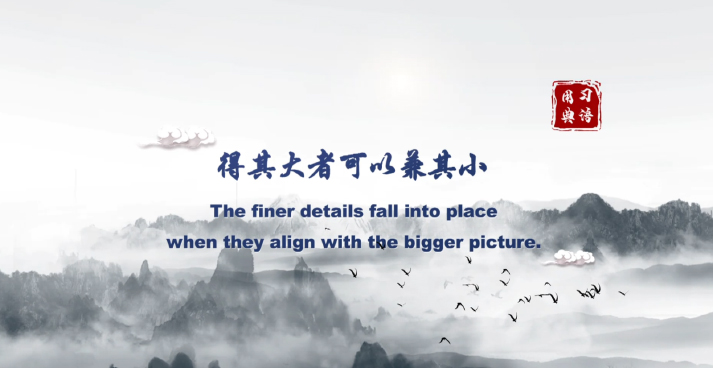 'The finer details fall into place when they align with the bigger picture." The line comes from an essay by Ouyang Xiu, a renowned literary figure in the Northern Song Dynasty (960-1127). It means that one should first grasp the bigger picture. Only by keeping in mind the bigger picture, can we properly address the smaller, specific issues at hand. On September 22, 2015, ahead of his first state visit to the United States, President Xi Jinping quoted this saying in a written interview with U.S. newspaper The Wall Street Journal. Drawing on this quote, Xi highlighted the importance of viewing China-U.S. relations from a holistic and strategic perspective, addressing differences with the bigger picture in mind, and thereby finding the right way for the two countries to get along. So what is the bigger picture of China-U.S. relations? As the world's two largest economies and permanent members of the United Nations Security Council, the two countries are closely linked by extensive trade ties and together account for more than one third of the world economy and one fourth of the global population. Their relationship has transcended bilateral boundaries to shape global dynamics. This broader perspective is essential to understanding China-U.S. relations. It encompasses the principles of mutual respect, peaceful coexistence and win-win cooperation, while also reflecting the shared aspiration of the two peoples for a better life. This is the path forward for China-U.S. relations, one that not only serves the interests of both peoples but also contributes to global peace, stability and development. What, then, are the smaller issues in China-U.S. relations? The two countries do have disagreements in areas ranging from economic ties, trade and technological competition to social systems, values and regional affairs. Given their differences in history, culture, stages of development, national conditions and political systems, it is only natural that the two large, influential countries do not see eye to eye on everything. Yet history shows that such differences need not define the relationship. Since China and the U.S. established diplomatic relations in 1979, their relationship has weathered its share of ups and downs while remaining largely stable and continuing to move forward. Over time, their interests have grown increasingly intertwined. Many historic breakthroughs have occurred during the past almost 50 years, beginning with the establishment of diplomatic relations in 1979, followed by the U.S. granting China permanent normal trade relations status in 2001 and joint efforts to address the global financial crisis in 2008. The relationship has also seen its fair share of friction, including the U.S. trade and tech war against China. Both China and the U.S. stand to gain from cooperation and lose from confrontation. This is what history tells us. Moving forward, the two countries must keep the larger picture in view rather than allow differences and confrontation to define their relationship. Otherwise, they risk losing sight of what truly matters, which would ultimately harm the interests of both countries and undermine global stability and development. During their meetings in Washington, D.C., in September, the leaders of the two countries agreed to build a constructive relationship of strategic stability based on respect, fairness and reciprocity, providing clear strategic guidance for the China-U.S. relationship. Such guidance takes on added significance at a time when regional conflicts, climate change, AI governance and other pressing issues are posing mounting challenges for humanity. Against this backdrop, cooperation between China and the U.S. can play an important role in bringing greater certainty and stability to an increasingly unstable world. When frictions emerge, the two countries need to rise above their differences and hold fast to their common ground. Only by doing so can they steer the bilateral relationship through rough seas and keep it on the right course. BR Copyedited by G.P. Wilson Comments to lanxinzhen@cicgamericas.com |
|
||||||||||||||||||||||||||||
|