|
| World |
| The only way forward | |
|
|
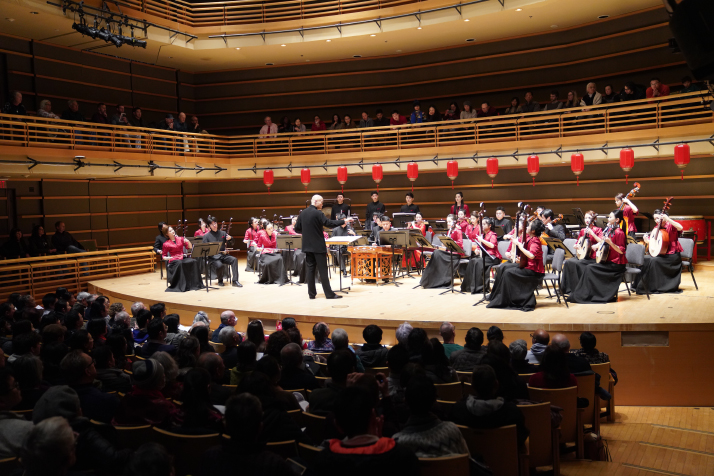 Musicians from the Central Conservatory of Music Chinese Orchestra perform at the Kimmel Center's Perelman Theater in Philadelphia, Pennsylvania, the United States, on January 29 (XINHUA)
Since China and the United States redefined the mutual relationship as one of "constructive strategic stability" during U.S. President Donald Trump's state visit to China on May 13-15, how the two countries can manage differences and pursue coexistence amid competition has become a focal point in academic communities. More than 50 scholars and experts from Chinese and American think tanks and universities attended the China-U.S. High-Level Think Tank Dialogue in Beijing on May 27, sharing insights on strengthening trade ties and people-to-people exchange between China and the U.S. The event, themed Expand People-to-People Ties and Foster Mutual Trust in China-U.S. Relations, was co-organized by the Academy of Contemporary China and World Studies (ACCWS), a think tank under China International Communications Group (CICG), and the Carter Center, a nongovernmental, nonprofit organization founded in 1982 by former U.S. President Jimmy Carter. Yu Yunquan, Vice President of CICG, told the forum that the new positioning of China-U.S. relations has brought valuable certainty to bilateral think tank cooperation and cultural exchange. According to Yu, both sides should "seek common ground while shelving differences, enabling people of both countries to better understand each other." Yu also urged for the expansion of mechanisms for youth dialogue and cultural exchange, saying such efforts could inject fresh momentum into the stable development of bilateral ties. Christopher Hobbs, Deputy Director of Peace Strategy and Operations at the Carter Center, said at the event that he hoped the discussions would help strengthen dialogue on issues including security, the economy and transnational challenges, creating a path forward for future generations. Interconnected Many of the participants believe that China and the U.S. still possess broad potential for cooperation, and that stable bilateral relations serve the fundamental interests of both countries. Chen Dingding, a professor at the School of International Relations at Jinan University, said recent diplomatic engagement between the two countries could provide an opportunity for stabilizing bilateral relations. "This is the first time that the United States has officially reached a stable parity with China, and this certainly would be impossible if the two countries were not of almost equal strength," Zhou Bo, a senior fellow and China Forum expert with the Center for International Security and Strategy, Tsinghua University, noted. Zhou admitted that the China-U.S. relationship is one in which competition actually prevailed over cooperation over the years, but he said he remains cautiously optimistic about bilateral relations. "If the two countries are competing within the same system, and are not enemies but just competitors, the relationship in the 21st century actually looks rosier than it did in the 20th century," he said. During the event, Ralph Winnie Jr., Vice President of the US Asian Cultural Academy, said trade policy today has turned into an intersection of economics, national security and geopolitics. According to Winnie, the importance of the U.S.-China trade relationship is difficult to overstate. "At the macro level, the relationship influences global economic stability; at the micro level, it directly affects how companies structure operations and manage risks," he said. Winnie also noted that tariffs are increasingly characterized by negotiated, positive and calibrated adjustments rather than continuous escalations. Policymakers on both sides should pursue targeted de-risking instead of broad decoupling, and seek institutional dialogue, he said. 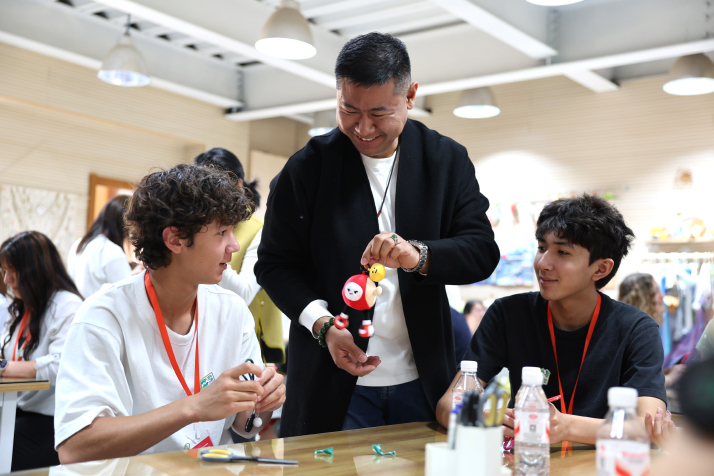 American exchange students take a DIY class at the Shijiazhuang Foreign Languages School in Shijiazhuang, Hebei Province, on April 11 (XINHUA)
Boosting exchange People-to-people exchange plays an important role in improving mutual understanding, according to the dialogue participants. Neysun Mahboubi, Director of the Penn Project on the Future of U.S.-China Relations, University of Pennsylvania, warned that the academic exchange between the two countries has declined in recent years. He noted that both countries need to "appreciate the importance of genuine knowledge-seeking between students and scholars." Carla Freeman, Director of the Foreign Policy Institute at Johns Hopkins University's School of Advanced International Studies, said the decline in exchange is creating a knowledge gap in the United States about China. "Even when this knowledge does not necessarily erase disagreements, it remains essential. It reduces the risk of miscalculation," she said. Ren Hongsheng, Associate Dean of the School of Political Science and Public Administration at China University of Political Science and Law, also highlighted the importance of communication, particularly between U.S. and Chinese academics. During his 2023 visit to San Francisco, the U.S., Chinese President Xi Jinping announced that China would invite 50,000 young Americans to China on exchange and study programs over the following five years to increase exchange between the two peoples. As of this May, China had already hosted more than 50,000 young Americans, hitting the five-year target well ahead of time, the Ministry of Education said on May 29. The young American visitors traveled across China's 31 provincial-level regions and Hong Kong and Macao special administrative regions, the ministry said. Their activities included language learning, summer and winter camps, sports competitions, and credit-bearing or degree-seeking academic studies. Through such institutional arrangements and networks, people-to-people exchange can flourish, helping to steer China-U.S. relations in a sounder direction, Ren said. Li Yafang, Associate Editor in Chief of CICG and President of ACCWS, underscored the role of think tanks in mutual exchange. "Think tanks should play major roles in advancing bilateral relations, including fostering mutual understanding, facilitating youth exchange and managing differences," Li said. In an interview with Beijing Review, Winnie said the U.S. and China should restore media exchange to tell the story of what is going on, which would be a win-win for both countries. The biggest blind spots in this area are the inability to access archives, difficulty conducting interviews and field research and the issue of visas, he said at the forum. "Talking to people is better than just [reading] reports," he said. BR Copyedited by Elsbeth van Paridon Comments to lixiaoyang@cicgamericas.com |
|
||||||||||||||||||||||||||||
|