|
| World |
| A look back at the history of China-U.S. friendship | |
|
|
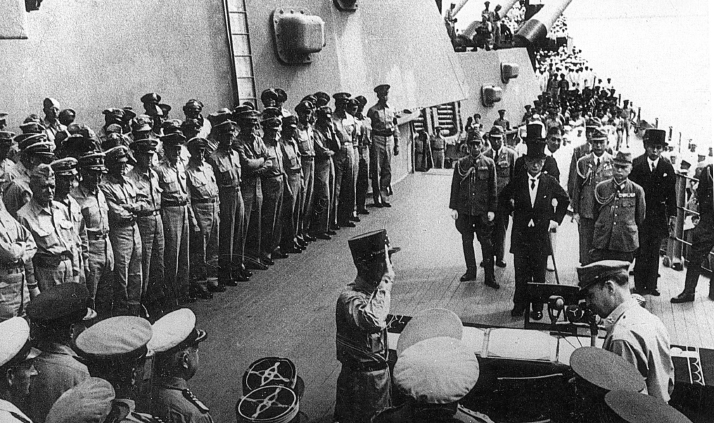 Representatives of China and the United States—two of the principal Allied victors of World War II—stand side by side aboard the USS Missouri battleship on September 2, 1945, as Japan formally surrenders (XINHUA)
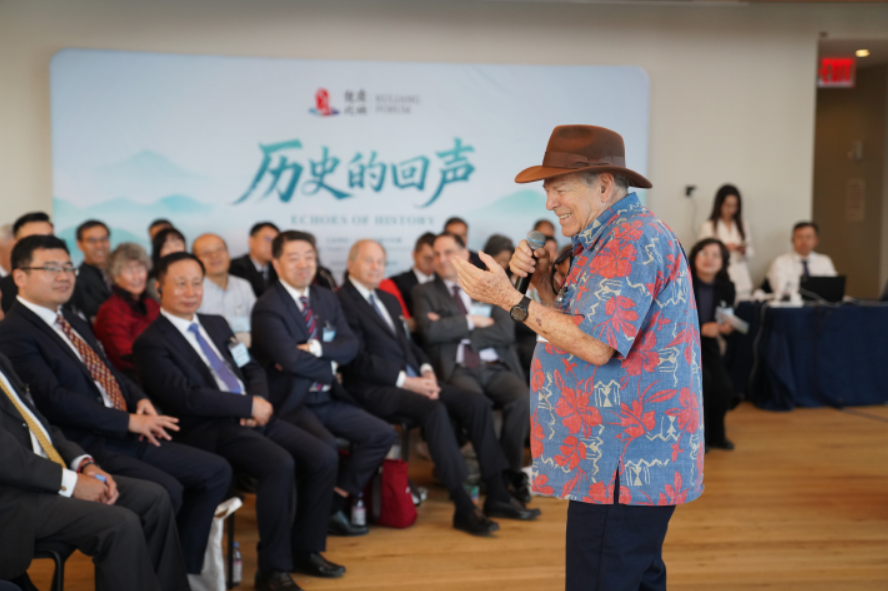
The mid-May meetings between Chinese President Xi Jinping and U.S. President Donald Trump in Beijing drew global attention. If we place these meetings within a broader historical context, one thing becomes clear: China-U.S.cooperation brings both bilateral and global benefits, and confrontation takes a toll on both countries and the world at large. This is not mere rhetoric but a lesson repeatedly proven through the history of interactions between the two countries. Back-to-back:safeguarding peace Take China-U.S. relations in the global fight against fascism as an example. On September 18, 1931, Japanese troops blew up a section of railway under their control near Shenyang, Liaoning Province, and accused Chinese troops of sabotage as a pretext to attack. Later that night, they attacked barracks near the city. The September 18 Incident marked the beginning of the Chinese People's War of Resistance Against Japanese Aggression (1931-45) and the World Anti-Fascist War. A decade later, on the morning of December 7, 1941, Japan launched a devastating surprise attack on the U.S. naval base at Pearl Harbor, Hawaii, bringing the war to the United States. During the war, China and the U.S. fought in coordination and formed a close partnership. In March 1941, the U.S. Congress passed the Lend-Lease Act, providing military supplies to China and other Allied nations. From the steady supply of American aid to China to the Chinese civilians who risked their lives to rescue U.S. soldiers stranded in Japanese-occupied regions, each episode attested to a "back-to-back" bond forged in wartime. During the 14-year war of resistance, China tied down the bulk of Japan's military forces, inflicting over 1.5 million casualties and disrupting Japan's coordination with Nazi Germany and Fascist Italy. This prevented Japanese forces from fully reinforcing the Pacific theater and created favorable conditions for Allied advances. This hard-fought cooperation helped defeat fascist tyranny and safeguard world peace. On September 2, 1945, Japan surrendered aboard the USS Missouri battleship, marking the end of the war. China and the U.S., as major victorious nations, witnessed this historic moment together and became key participants in shaping the postwar international order. Shoulder-to-shoulder: advancing development History, however, does not always move smoothly. After the founding of the People's Republic of China in 1949, ideological confrontation and geopolitical conflicts led the two countries into more than two decades of Cold War hostility. It was not until the early 1970s that a seemingly small but highly significant series of event—Ping-Pong Diplomacy—reopened the door long closed between the two countries. This "small ball moving the big ball" moment broke the ice. The impacts were swift and far-reaching. In 1972, then U.S. President Richard Nixon visited China and China's national table tennis team visited the U.S. In 1979, the two countries formally established diplomatic relations, ushering in a new stage of development. Since then, bilateral exchanges in trade, culture and science and technology have expanded rapidly, creating deeply intertwined economic ties. Statistics from the United Nations show that in 2024, trade in goods between China and the U.S. reached $688.28 billion, which was 275 times the volume of the trade in 1979. UN data show that in 2024, China was the destination for 51.7 percent of U.S. soybean exports, 29.7 percent of its cotton exports, 17.2 percent of its integrated circuit exports, 10.7 percent of its coal exports, 10.0 percent of its liquefied petroleum gas exports, 9.4 percent of its medical equipment exports, and 8.3 percent of its passenger motor vehicle exports. The U.S.-China Business Council estimates that in 2024, exports to China supported 531,232 American jobs and this number had been as high as 931,231 in previous years. Bilateral trade has also delivered tangible benefits to American consumers. Imports from China, ranging from consumer goods to intermediate and capital goods, have expanded choices, lowered living costs, and increased real purchasing power, especially for low- and middle-income households. Beyond bilateral gains, China-U.S. cooperation has contributed significantly to global peace and development. The two countries have worked together on issues such as public health, counterterrorism and nonproliferation, providing important public goods to the international community. A participant shares his family connection with China’s Fujian Province at the 2025 Kuliang Forum in New York City, the United States, on November 25, 2025. The event recounted the memories of Americans who once lived in China and carried on the legacy in both countries (XINHUA) Face-to-face:addressing challenges In recent years, however, China-U.S. relations have experienced turbulence. Beginning in March 2018, the U.S. sharply hiked tariffs on a range of Chinese imports, citing goals such as reducing the trade deficit, reshoring manufacturing and increasing employment—triggering trade frictions between the two countries. In the years that followed, the U.S. doubled down on tariffs, technology restrictions and supply chain decoupling, further exacerbating bilateral strains. In April 2025, the tariff war intensified. U.S. tariffs on Chinese goods at one point reached 145 percent, while China responded with countermeasures, imposing tariffs of up to 125 percent on U.S. imports. Their economic relationship was severely impacted until several rounds of talks in the following months helped de-escalate tensions. What impact has the trade war had on the U.S.? Over the past seven years, trade coercion and containment measures against China have not achieved Washington's intended goals of reshoring manufacturing or reducing the trade deficit. Instead, they have backfired—hurting the U.S. economy by causing the loss of the China market, eroding Washington's credibility, fueling inflation and driving up supply chain costs. U.S. businesses and consumers have borne the brunt of the trade war, as they reportedly pay for roughly 90 percent of the additional tariffs on Chinese imports. It is true that there are no winners in a trade war. China, too, has felt the impact: rising costs for export-oriented firms and declining profits in some sectors. The share of China-U.S. trade in China's export-import volume has gradually declined, from 13.7 percent in 2018 to 8.8 percent in 2025. Even during years of friction, bilateral trade has remained at the level of hundreds of billions of dollars. Businesses and market forces on both sides continue to drive cooperation. This demonstrates that the deeply intertwined economic relationship between China and the U.S. cannot easily be severed. While competition and differences persist, so too do broad and substantial shared interests. Finding opportunities for shared prosperity amid competition and stabilizing mutual expectations through cooperation serves the fundamental interests of both peoples and meets the global demand for stability and development. Times are different now, but the lessons of history remain relevant: When China and the U.S. fight back to back against common threats, they help safeguard world peace. When they stand shoulder to shoulder for development, they contribute to global prosperity. When they turn their backs on each other in confrontation, both sides and the world at large suffer losses. When they engage face to face in dialogue, they move forward steadily together. (Print Edition title: Forged Under Fire) Copyedited by G.P. Wilson Comments to linan@cicgamericas.com |
|
||||||||||||||||||||||||||||
|