|
| World |
| An American crosses divides to put down roots in China | |
|
|
 Evan Kail presents a copy of the Chinese version of his autobiography Through the Storm to Beijing Review during an interview in Beijing on March 27 (ZHANG WEI)
In late March, Beijing's spring arrived cloaked in a thin mist. A fortnight had passed since the hashtag #EvanKailOfficiallySettlesInChina went viral on Weibo, a Chinese microblogging platform, igniting much public discourse. As the digital roar continued, the 36-year-old American boarded a high-speed train from Tianjin to the capital.
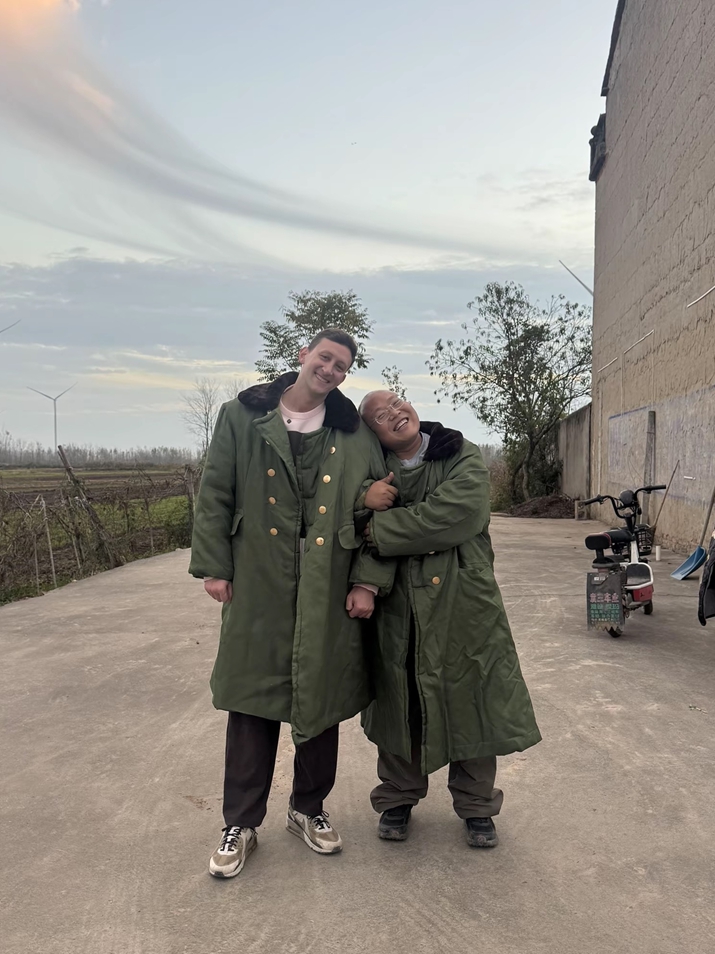
"My process of moving here didn't happen immediately," he told Beijing Review. "But it was [the] obvious [thing to do] to me right away." This was the third in-depth sit-down Beijing Review has had with Kail. From his donation of a World War II photo album documenting Japanese wartime atrocities in China in 2022 to now, the trajectory of this young American's life has been entirely rewritten. This time, however, he is no longer a guest or visitor; he is a settler who now calls China home. Teddy bears and greatcoats Kail has settled in Tianjin. He now appears less guarded than before, more at ease. The former pawnshop owner from Minneapolis, Minnesota, who once spent hours on social media defending his reputation against online attacks and smears regarding his donation decision, is no longer there. In his place is someone who seems to have found a quiet sense of purpose. "When walking out of baggage claim, I was not expecting that there were airport security police officers waiting for me when I got off the plane. I thought, 'Am I in trouble?'" Kail recalled of his first arrival in November 2024 and being met by airport police, a sight that initially sparked apprehension. Instead, the officers were there to offer a formal welcome. Someone even handed him a teddy bear. This sense of contrast has become the defining hue of his life in China. In Kail's narrative, intimate details carry far more weight than grand abstractions. He still treasures a heavy greatcoat—a gift from a stranger who saw him shivering in his thin suit during the daily flag-raising ceremony in Tiananmen Square in Beijing. A year later, in 2025, Kail drove to that man's rural home to share a simple family meal. "That human story, that human element, that human connection meeting him, really stood out to me," he said. Still, these connections carry weight. At the Memorial Hall of the Victims in the Nanjing Massacre by Japanese Invaders in Nanjing, Jiangsu Province, standing before the skeletal remains of victims, Kail realized that the album he had opened in his pawnshop three years prior was more than an artifact. It was a small echo of the many lives lost. The Nanjing Massacre took place when Japanese troops captured the then-Chinese capital on December 13, 1937. Over the course of six weeks, they killed approximately 300,000 Chinese civilians and unarmed soldiers in one of the most barbaric episodes of World War II. 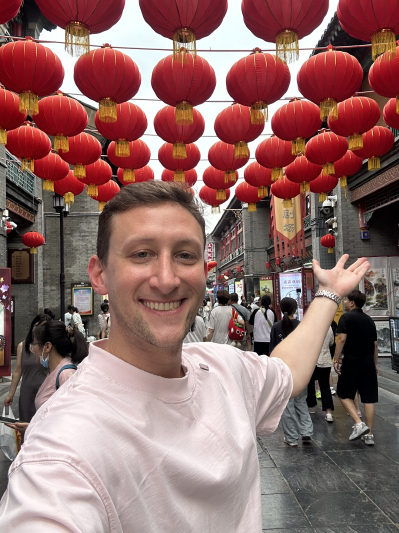 Evan Kail shares on X a selfie taken at Tianjin Ancient Cultural Street on August 20, 2025
The silent shore Kail's journey has not been met with universal approval. Under the scrutiny of the Internet, he finds himself in an awkward position: When an American adopts Chinese dress, learns the customs and speaks positively of China's social order, skepticism can arise. Some Western media outlets have suggested he is acting as a mouthpiece, while some Chinese netizens question whether his gestures of friendship are driven by a desire for attention. Kail does not shy away from these controversies. If anything, he meets them with frankness. "I have had one article written about me by my local paper [in Minneapolis], the Star Tribune, and it was very skeptical. It's just been like a complete media blackout about me," he said. The reach of his TikTok videos on Chinese daily life remains modest. But he is patient. "I have the rest of my life and I'm certainly not going to be daunted or give up," Kail said. Kail admits feeling aggrieved, to some extent. "I'm trying to build a bridge, but a bridge is a two-way street. And in America, I'm getting zero help at all," he said. He even feels reverse culture shock, missing China's safety and cohesion amid U.S. hyper-individualism. Kail finds himself caught between two opposing narratives. He understands how social media works, yet he also feels trapped by algorithms and assumptions beyond his control. As his autobiography Through the Storm suggests, he takes the long view. He struggled as a screenwriter in Hollywood, worked an unhappy job at a jewelry store, and later opened a pawnshop, where he came across the photo album that changed his life. The landing of an idealist Choosing Tianjin reflects Kail's turn toward everyday life. He appreciates the city's openness and unhurried pace. Here, he is more than "the American who donated the album." At the Tianjin Library, he recommended The Great Gatsby to readers; perhaps, in some small way, he feels a resemblance to Gatsby, both trying to grasp something just out of reach. The difference, maybe, is that Gatsby pursued a dream that could not be caught, while Kail reaches for something called understanding.
Evan Kail visited Hu Tong’s hometown of Huai’an in Jiangsu on November 16, 2025, bringing a new coat as a gift for Hu—the same man who had draped a military coat over Evan a year earlier. Hu surprised Evan with a one‑year anniversary cake in return. (PHOTO: @EvanKail on X) His observations of young people in China carry a quiet weight. He notices in them a certain steadiness and sense of propriety, qualities he feels have become less common among his peers back in America. "It seems that Chinese kids balance their time and their head space better than American kids. It seems to me that social media consumption is ruining the American youth. And I don't see that quite the same here in China," he said. While these views are filtered through his personal lens, they reflect his perspective as a cross-cultural observer. He is learning the texture of Chinese life, from the traditional etiquette of temple visits to the nuanced philosophy of restrained conduct. "I want to be a living symbol of China-U.S. friendship," he said with a serious expression. For Kail, this is not just politics but a shared human mission. He speaks of space exploration, of the possibility that humans might land on Mars in 30 years. He believes that compared to such grand futures, today's resource wars and divisions seem very small. "The people of our two nations are not nearly as divided as we imagine," he insisted. "We might have different cultural values, we might have different cultural norms, we might have perceptions about each other. But the fact is we are both human." The public discourse surrounding Kail remains complex and multifaceted. Time will eventually settle all debates. But before the final answer comes, how we view this new resident who, with warmth and determination, tries to bridge a chasm, put down roots in China—that also reflects the openness and inclusiveness of today's society. "Looking forward to next time," Kail said, waving goodbye. This young American is trying to write his dreams in China's soil. That, in itself, is a story worth telling. (Print edition title: Journey of a Lifetime) Copyedited by Elsbeth van Paridon Comments to taozihui@cicgamericas.com |
|
||||||||||||||||||||||||||||
|