
|
| Print Edition |
| Creating a community and boosting tourism one dance at a time | |
|
|
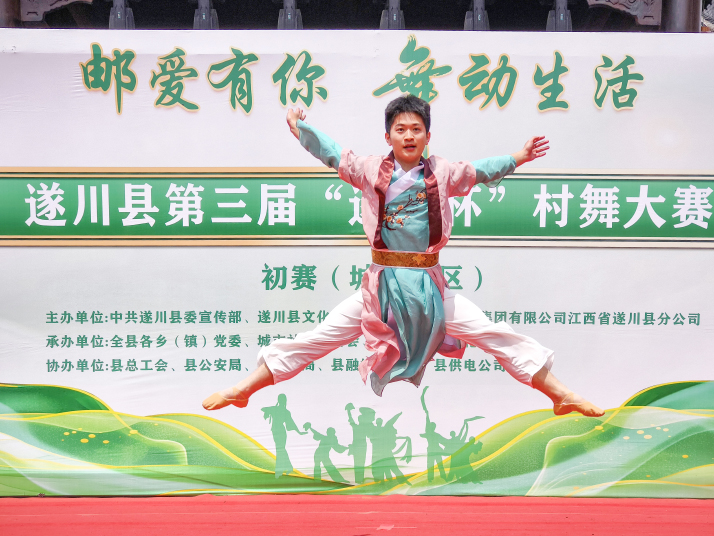 The Village Dance Competition kicks off in Suichuan County, Jiangxi Province, on April 30 (XINHUA)
What began as a modest community gathering in a village in central China quickly exceeded organizers' expectations, drawing crowds from far beyond the local area. On May 30, the Village Dance competition debuted in Luodian Village, Dangyang City, Hubei Province. Thirteen local teams took the stage, with contestants ranging in age from 24 to 70.
Alongside the villagers' self-choreographed routines, the event featured a diverse lineup of regional arts, a hi-tech robot dog demonstration and stalls showcasing local agricultural products. While initially intended to be a low-key gathering for nearby residents, the festival quickly attracted an influx of outside tourists. A major draw was the event's promotional "one-yuan deals," which offered ice cream, cold noodles, dumplings and even haircuts for a single yuan (just a few U.S. dollar cents). Demand was immediate: An initial inventory of 800 ice creams sold out instantly, followed by an emergency restock of 500 more that was quickly cleared. The momentum carried over into the local economy as tourists moved from the event grounds to nearby restaurants and farmhouses. The single-day event finally generated over 20,000 yuan ($2,900) in rural consumption, effectively translating grassroots culture into tangible economic output. "This down-to-earth event has a better vibe than most mainstream tourist attractions," a visitor named Zhou Qin told China News Service. "Next time, I'm bringing my friends." 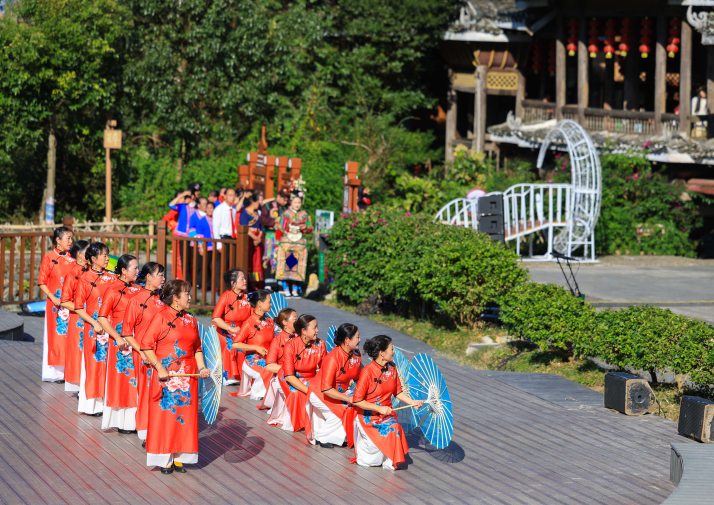 A village dance competition of the Dong ethnic group in Liping County, Guizhou Province, on November 23, 2025 (XINHUA)
Grassroots rhythms Similar scenes are unfolding across China. On May 27, Sichuan Province launched its inaugural Village Dance event in Yuechi County, Guang'an City. The competition drew 21 teams from across the province, bringing more than 300 rural performers to the stage. The performances were entirely self-produced by participants, the vast majority of whom are farmers. Drawing creative material directly from daily life, the routines artistically reconstructed agricultural scenes like rice transplanting and harvesting. The lineup spanned square dancing, traditional folk dances and modern choreography tailored to rural themes. As with other iterations, the venue doubled as a marketplace for local agricultural products. This phenomenon is part of a broader trend. Alongside other community-driven initiatives that have gained traction, including the VBA (Village Basketball Association) tournament, the Village Soccer Match and Village Galas, these events have become central highlights of contemporary Chinese rural culture in recent years. The movement gained traction nationwide in 2024 with the launch of the first national Village Dance competition, which has since become an annual fixture. Today, the initiative has evolved beyond a mere cultural showcase, anchoring an integrated ecosystem that links performance, tourism and regional identity. In the process, the dance form has broken out of its original mold, carrying a cultural significance that extends far beyond the fields. Last year, the gold medal at the national Village Dance competition went to a team from Sichuan. Named Shixian Taibai after Li Bai, a renowned poet from the Tang Dynasty (618-907), the crew hails from Li's hometown of Qinglian Town in Mianyang City. Unlike most village dances that center on agricultural labor, this routine draws its inspiration directly from Li's poetry. The concept originated with Pu Chunmei, a rural cultural worker in the village. For Pu, the connection is visceral. "For people from Li Bai's hometown to perform his poetry," she told local newspaper Mianyang Daily. "It feels like something that runs through the veins." Initially, local residents were hesitant to participate. "Many farmers considered dancing a waste of time compared with fieldwork," Pu said. Through her persistent encouragement, a team eventually formed, comprised of rural women 33 to 62 years old. Operating without a professional choreographer, the dancers learned their movements by watching videos on their smartphones. After six months of rehearsing, they successfully translated classical verse into a physical expression, transforming the poetry into a shared memory. Dancing ties Recognizing this cultural potential, some local governments have woven regional traditions, ethnic customs and intangible heritage crafts into the fabric of village dances. In Qianxinan Bouyei and Miao Autonomous Prefecture of Guizhou Province, the initiative has provided a major platform for diverse ethnic groups to showcase their traditional dances. Over the recent New Year's and Spring Festival period, from late December in 2025 through mid-February this year, nearly 200 events allowed visitors to experience the region's authentic festive atmosphere through these performances. A key highlight was a special session on December 28, 2025, featuring Amei Qituo, a traditional dance of the Yi ethnic group. With a history spanning nearly 500 years, this wedding dance requires no musical instruments—only chants and the rhythm of feet stomping on the earth. Fittingly dubbed the "Oriental Tap Dance," it was added to the country's national intangible cultural heritage list in 2014. "In the past, this dance was only performed in villages or at weddings," local resident Che Wangyan told newspaper Guizhou Daily. "Now it's on a national stage. We even teach it in schools, breathing new life into its preservation." A similar grassroots revival is taking place in Changtan Village, located in Guizhou's Taijiang County. Every evening at 6:30 sharp, more than 30 villagers gather to practice dances with movements derived entirely from daily life, mimicking tasks like weaving, embroidery and sowing seeds. Beyond cultural The Village Dance initiative has also served as a practical tool for grassroots governance. "During the agricultural off-season, people used to just watch TV or scroll on their phones, and neighbors barely interacted," Shi Jun, Secretary of the Communist Party of China Changtan Village Branch, said. "We decided to leverage village dance to rebuild community ties and regularly gather public feedback, allowing us to address and solve real local issues." The impact of the village dance extends far beyond entertainment. Since the initiative took off, Changtan has built a governance and consultation platform around the nightly gatherings. Discussions span administrative permits, policy access and agricultural supplies. To date, the mechanism has successfully addressed 14 major community issues, ranging from housing and infrastructure upgrades to local employment. What began with a dozen participants has grown into a village-wide movement. "During gatherings for dancing, we talk openly about village hygiene, local disputes and dividends," village resident Long Xuezhen told Guizhou Daily. "The job of community management has become much easier." By linking these cultural offerings with popular sporting events like the VBA tournament, the community has seen substantial economic returns. During the 2026 Sisters Festival, a festival of the Miao ethnic group celebrated on April 30-May 10 this year, the village attracted over 20,000 tourists, generating more than 2 million yuan ($290,000) in comprehensive tourism revenue. This blend of tradition and modern engagement is facilitating the preservation and sharing of rural culture. In nearby Qinglong County, Wang Laihong, a teacher at No.2 Middle School, drew inspiration from Miao embroidery to choreograph a dance of the same name. By mimicking the embroidering movements, such as "inserting the needle" and "pulling the thread," and inviting onlookers to join in, his team successfully dissolved the boundary between performer and spectator. It is this open, inclusive spirit that defines the true momentum behind the movement. As Yan Jiao, deputy head of the local publicity department, said, "There is no age limit, specific styles or professional requirements, just a pure love for dance." (Print Edition Title: The Grassroots Groove) Copyedited by Elsbeth van Paridon Comments to yuanyuan@cicgamericas.com |
|
||||||||||||||||||||||||||||
|