
|
| Voice |
| The blue wave that changed little | |
|
|
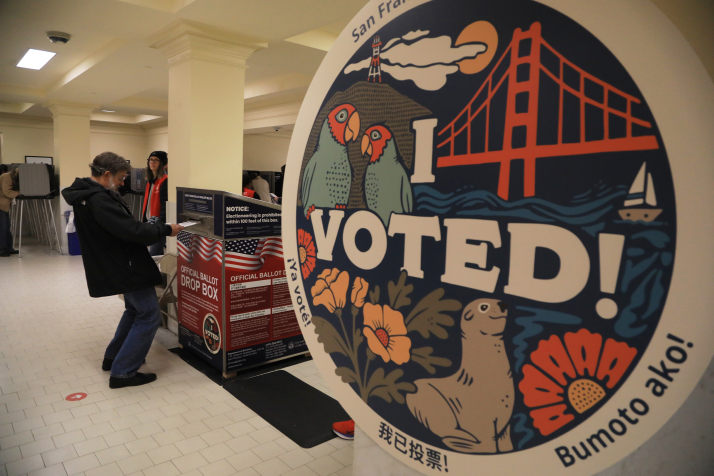 The voting center in San Francisco City Hall, the United States, on November 3 (XINHUA)
The U.S. midterm elections on November 3 delivered the Democrats control of both the House and the Senate. The result, driven by high prices and the war with Iran, has been widely described as a rebuke of the second Donald Trump administration. From the standpoint of someone who has watched American politics from both sides of the Pacific, the more interesting question is what the institutional outcome actually changed. The numbers show a large Democratic gain. However, the structure of power on the issues that matter most to ordinary people and to the rest of the world shows continuity. In the immortal words of hip-hop artists 2Pac and Digital Underground, it's the "same song." What voters voted against Exit polling and pre-election surveys make the drivers of the vote clear. Gallup found that the economy and healthcare ranked highest in importance, with the situation in Iran close behind, rated extremely important by 47 percent of registered voters. NBC News exit polls showed the economy as the top issue for 39 percent of voters, with large majorities concerned about gas, groceries and utilities. Roughly two thirds said Trump's policies had made the economy worse or were responsible for high prices. On the war itself, 63 percent said the decision to use military force against Iran was wrong. Research institute Responsible Statecraft reported that 74 percent of voters considered the war with Iran a crucial or major factor. Trump himself acknowledged the connection. In comments after the results were announced, he said it was "largely true" that the Iran war cost Republicans the election, because it drove gasoline prices higher in the short term, even while insisting that, to prevent Iran from acquiring a nuclear weapon, he would do it again. Vice President JD Vance was more direct. He said on November 4 that "the reason we lost is the war. The president himself said so last night." These are not left-wing interpretations. They are statements from the administration that lost. The discontent is real. Tariffs pushed prices up, and the energy shock from the Iran war pushed them up again. Voters punished the party in power for that. What they did not do is produce a Congress whose leadership is prepared to reverse the foreign-policy commitments that helped bring about the price shock. AIPAC, leadership, limits Hours after the results were made public, well-known lobby organization the American Israel Public Affairs Committee (AIPAC) posted that more than 234 candidates supported by its members had already won, and it specifically congratulated Senate Democratic Leader Chuck Schumer and House Democratic Leader Hakeem Jeffries. Independent trackers put the win rate for the candidates most heavily backed by pro-Israel political action committees (PACs) in the neighborhood of 90 percent among called races. That figure is close to the incumbent win rate; much of the money goes to safe seats. The leadership outcome is clearer. Jeffries is set to become speaker. His voting record on Israel-related measures is, on net, supportive of continued U.S. security assistance. He has received substantial campaign support associated with pro-Israel interests (more than $1.7 million over his career by some tallies, including hundreds of thousands in the most recent cycle). In 2014 he told the crowd at a rally, "Israel today, Israel tomorrow, Israel forever!" He has criticized aspects of Israeli policy since the Gaza conflict began and called for a "major reset," but he has also opposed measures to cut military aid and continues to support Israel's right to exist as a Jewish and democratic state, along with ongoing U.S. security assistance. Schumer's long record is similarly aligned. The new Democratic majorities will be led by figures who have operated inside the long-standing bipartisan consensus on major U.S. security partnerships and foreign-policy commitments. Observers noted the continuity. One independent commentator wrote that swapping one leadership team for another, while those in favor of established foreign-policy interests celebrated, left the midterms among the least consequential elections in recent memory on the core questions of foreign policy. The record of those leaders and the readiness of donors to congratulate them support the narrower claim that the institutional center of gravity on major security commitments and overseas military assistance did not shift when party control of Congress changed. At this year's mid terms, Democratic Socialists of America (DSA) expanded its House presence from two members to eight. The new members won in safely Democratic districts after primary victories. DSA's own statement claimed the largest socialist bloc in Congress in U.S. history and pointed to more than 100 wins at all levels. Open questions on China Public opinion polls before the election showed deep dissatisfaction with both parties. Large majorities viewed the country and the economy as headed in the wrong direction. Favorability for the Democratic Party remained low even as voters preferred its candidates over Republicans on the generic ballot. The midterms registered a demand for lower prices and relief from the Iran war's immediate economic effects. They did not register a demand for leadership prepared to cut the military budget or to fundamentally reorder major overseas commitments. That gap creates space for argument after the election. Anti-war and fiscal critics will press the new Democratic majorities to redirect resources away from a military budget that is approaching or exceeding $1.5 trillion. The case is straightforward: The same voters who rejected the party that launched and sustained the Iran war are now represented by a party whose leadership has a long record of supporting large-scale military assistance abroad. Whether that pressure produces concrete votes on the National Defense Authorization Act, or is absorbed into the ordinary business of a new majority, will be visible in the months ahead. The midterms settled the question of who controls the committees. They did not settle the question of whether control of the committees will alter the priorities that produced the discontent in the first place. For the near term in U.S.-China relations, the domestic results point in two directions. Trump, facing a hostile Congress and a clear electoral rebuke on the economy and the war, is likely to lean harder into international stagecraft and legacy moments—summits, trade announcements or high-visibility bilateral encounters—while his domestic leverage is reduced. Any modest openings or tactical adjustments in the U.S. approach to China that appeared under the second Trump administration will now face a Democratic House and Senate prepared to scrutinize them. Looking further ahead, a unified Democratic government after 2028 would almost certainly review those adjustments, and could reverse them. The same institutional consensus that kept major security commitments intact throughout this midterm cycle is the one that has historically treated strategic competition with China as a bipartisan priority. Electoral waves change the faces in the committees. They have not, so far, changed the song. The author is founder of the Iron Mic and Dana Culture Media Co. He lives in Shanghai and is active in the China Is Not Our Enemy campaign Copyedited by G.P. Wilson Comments to dingying@cicgamericas.com |
|
||
|
||||||||||||||||||||||||||||
|