
|
| Voice |
| Misunderstandings lead to missing out | |
|
|
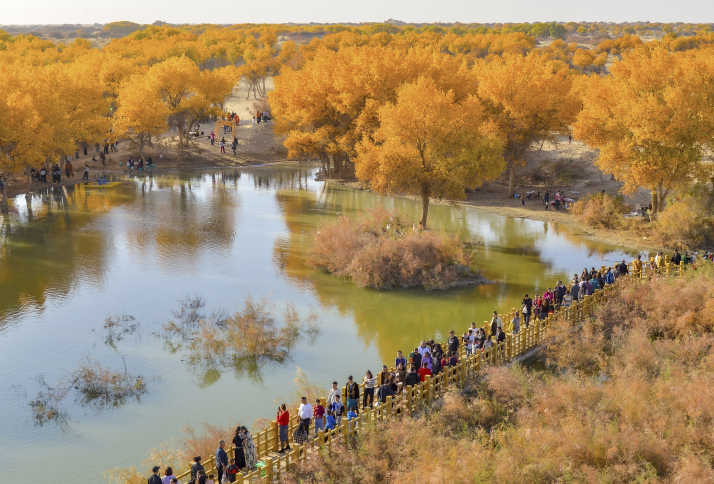 A scenic area characterized by populus euphratica forests in Lop County, Xinjiang Uygur Autonomous Region, on October 18 (XINHUA)
There are some places in the world that everybody knows the name of, and has an opinion on, but that almost no one has been to. Xinjiang [Uygur Autonomous Region] is one of them: Ask anyone on the street in many a Western country what they associate it with and the answer will be almost eerily uniform—concentration camps, forced labor and genocide. I've traveled enough to have learned one thing: Extreme opinions about distant places rarely survive contact with the place itself. This is all the more true for places few people have visited, where there is no accumulated weight of ordinary firsthand experience to push back against wild claims. So I fully expected a gap between the narrative and what I'd actually find. What I did not expect was that the gap would be this wide. I wanted to spend a lot of time there, see as much of it as possible, travel entirely freely on my own terms and meet as many locals from as many walks of life as I could. So with my wife and our two daughters (aged 7 and 10), we rented a recreational vehicle (RV) in the regional capital of Urumqi and toured the whole region, north and south, for five weeks, sleeping in the RV. Close to 6,000 km through cities, villages, grasslands, mountains and deserts, meeting hundreds of people along the way. No guide, no minder, no itinerary filed with anyone. We then stayed a further 10 days in Urumqi, where our daughters spent a week in a holiday camp with local, mostly Uygur, kids, while we met journalists, university professors, public servants, people working for the Xinjiang Production and Construction Corps, community workers and businesspeople. (The XPCC is an organization with a mission that integrates economic activities, such as agricultural and industrial development, with the crucial role of maintaining border security—Ed.) Our trip Our route formed a vast loop through north and south Xinjiang over 34 days. From Urumqi we headed west to the hot spring town of Wenquan on the border with Kazakhstan, then south to Sayram Lake and into the Ili Valley: lavender fields, the border town of Horgos, the Qing Dynasty (1644-1911) garrison town of Huiyuan and the city of Yining. Further south came Zhaosu, home to extraordinary ancient pink-colored horse breeds (I'm not kidding!), and the high grasslands of Xiata, Tangbula and Nalati, where Kazak and Kirgiz nomads still summer in yurts. From Nalati we crossed the massive Tianshan mountain range via the Duku Highway, open only four months a year, into south Xinjiang. (The Duku Highway, deemed one of China's most beautiful roads, is a scenic mountainous section spanning over 500 km between Dushanzi and Kuqa on National Highway 217—Ed.) There we explored the ancient city of Kuqa and its royal palace (where a genuine Uygur princess still resides—we met her!), drove through the Taklimakan Desert and spent several days in Kashgar, an ancient Silk Road hub. From there we made a detour deep into the Pamir Plateau and climbed a glacier on the 7,500-meter Muztagh Ata. We then headed back east through the ancient Buddhist caves of Kizil, the ruins of Subashi Temple and the city of Korla, before returning to Urumqi via the Tianshan Shengli Tunnel, the longest expressway tunnel in the world—22.13 km. A region's diversity What struck us almost immediately, and what Western reports almost completely erase, is Xinjiang's extraordinary diversity. Diversity, first of all, of landscapes and climates. Some mornings we woke up shivering in the RV, parked among nomadic yurts at the foot of snow peaks, and the very next day we'd be driving through the Taklimakan Desert in 40-degree-Celsius heat, with sand blasting the windshield. Nowhere else in the world can you find, within a single administrative region, an elevation range of nearly 9,000 meters: from the Turpan Depression, 154 meters below sea level, to the summit of K2, at 8,611 meters. (K2 is the second highest peak in the world after Mount Qomolangma, known as Mount Everest in the West—Ed.) All this within a region you could fit the United Kingdom, France, Germany, Austria, Switzerland, the Netherlands and Belgium into—and still have room left. Diversity, also, of peoples. Xinjiang typically gets reduced to the Uygurs, but they make up about 45 percent of the population (11.62 million out of 25.85 million), overwhelmingly concentrated in the south. During the first 18 days of our trip, through north Xinjiang, we rarely met any Uygurs at all. We stayed among Kazak nomads in the grasslands, hiked with Kirgiz shepherds in the mountains and discovered an entire Russian neighborhood in Yining (with ethnic Russians of Chinese nationality). There is even a great deal of diversity among the Uygurs themselves. The culture we encountered in Kashgar (food, music and architecture) was strikingly different from what we saw in Kuqa or Korla. Scholars such as Dru C. Gladney have documented distinct musical traditions and dialects from one oasis to the next. No wonder: Until a few decades ago, crossing the Taklimakan to get from one oasis to another was a life-threatening endeavor. Buddhism was the dominant civilization of the region for over a thousand years, longer than Islam has been. One of the most moving moments of our trip was standing inside the Kizil Caves near Kuqa: grottoes carved into a cliff face from the third century onward, covered in paintings of breathtaking beauty. This is quite literally where Buddhist art in China began. Not far away stand the ruins of Subashi Temple, where Kumarajiva, the great translator of Buddhist sutras into Chinese, once studied, and where Xuanzang—the real-life monk from the Chinese epic Journey to the West—stayed on his pilgrimage to India. And there is diversity in the practice of Islam itself. Among the Uygurs, spiritual life centered on shrine pilgrimage and the meshrep, communal gatherings of music, dance and feasting recognized by UNESCO. The Kazaks and Kirgiz have always been famous for their alcohol consumption, and the Uygurs of Turpan have been making wine since long before Islam arrived. By reducing one of the most complex, layered and fascinating places on Earth to a black-and-white storyline, several Western media outlets are the ones actually erasing Xinjiang's culture, the very thing they accuse China of doing. Security and stability Security is taken very seriously in Xinjiang, more seriously than anywhere else I've been in China, and I know what "normal" looks like there: During our 2023 RV trip through the northeast Xinjiang, we weren't stopped by police a single time in 32 days. In Xinjiang, you go through police checkpoints every day, and police booths dot crowded streets. Police officers told us their target time-to-intervention was three minutes. We tested it by accident: Our RV got jammed under a collapsed barrier on a one-way road near Kashgar. We called the police and timed it. Three minutes. They then called the village chief, who showed up in under two. Five minutes after picking up the phone, we were back on the road. To my surprise, most locals we spoke with were reassured by the security. They had lived through the alternative. Between roughly 2009 and 2017, Xinjiang went through a period of extreme violence. The 2009 Urumqi riots alone killed nearly 200 people and injured over 1,700 in a single weekend, followed by years of stabbings, bombings and vehicle rammings that reached deep into the rest of China, such as the 2014 Kunming railway station massacre. A Han Chinese woman born and raised in Urumqi told me how she rushed home by train during the 2009 riots. The carriage, full of people from every ethnic group, sat in complete silence: You didn't know whether the person next to you was rushing home to protect their family, or to join the killing. China's response combined deradicalization and security with enormous investment in development, notably tourism: Xinjiang now receives some 300 million tourist visits a year. Vocational training centers were established from 2017 for people influenced by religious extremism or those who had committed minor crimes, teaching standard spoken and written Chinese, law and job skills. One year earlier, France had announced its own centers for people "suspected of being radicalized" who had never been convicted of anything. No one accused Paris of genocide. (Trainees at vocational education and training centers in Xinjiang have all graduated, the local government announced in December 2019—Ed.) Several Uygurs told us, in so many words, that the extremists had hijacked their culture and that they were relieved the crisis was over. And the immense majority of people we met were welcoming, open, curious and generous to a degree that often caught us off guard. What Xinjiang needs from the world Many people say they care about the Uygurs. As Singapore's former Foreign Minister George Yeo once quipped, "The Americans are not known to love Chinese nor Muslims, but somehow they love Chinese Muslims a lot." For those who genuinely want to help, here is what I would suggest. First, and perhaps counter-intuitively, campaign against Western sanctions related to Xinjiang. In the lavender-growing village of Huanghuang, the No.1 employer used to be a lavender essence factory. It went bankrupt, and the locals told us why: Sanctions such as the U.S. "Uyghur Forced Labor Prevention Act" effectively block Xinjiang companies, no matter how small, from international markets. It cascades down the supply chain: If a Shanghai cosmetics company buys lavender essence from Huanghuang and exports perfume to Europe, that perfume can't be exported. The law effectively makes working with Uygurs toxic, which is why it should really be called the "Uyghur Labor Prevention Act." The United Nations Special Rapporteur on unilateral coercive measures on the enjoyment of human rights, Alena Douhan, reached the same conclusion as the lavender farmers in a report to the UN Human Rights Council, documenting the livelihoods destroyed by these measures and calling for them to be lifted. Western sanctions have never, in modern history, improved the human rights situation in the country they target. What they achieve is the economic punishment of ordinary citizens, and a siege mentality: Sustained external pressure on a system doesn't reform it but rigidifies it. Second, go there. China offers visa-free entry to citizens of dozens of countries, including virtually all of Europe. Every tourist dollar spent at a Uygur restaurant, guesthouse or a Kashgar bazaar stall is a small act of material solidarity. It also helps the truth surface: I posted live on social media for six weeks and not once was I told to stop. Lastly, restore depth. Everything about the Western discourse on Xinjiang is shallow, and shallowness is the precondition for manipulation: You can only turn a people into a geopolitical weapon if you first strip away everything that makes them human. The Uygurs I met were not the Uygurs I'd read about. Some were deeply thoughtful; others would spend their day scrolling on Douyin (the Chinese version of TikTok). Some were religious; others couldn't care less. They were, in short, exactly like people everywhere: messy, contradictory, irreducible to a single story and infinitely more interesting than the flattened version of themselves that the world has been sold. That's all the Uygurs need from the world: not pity, not sanctions, not performative outrage—just honest and genuine curiosity. Everything else follows from that. BR The author is a French entrepreneur and writer Copyedited by Elsbeth van Paridon Comments to ffli@cicgamericas.com |
|
||||||||||||||||||||||||||||
|