|
| Voice |
| The GGI's deep historic roots | |
|
|
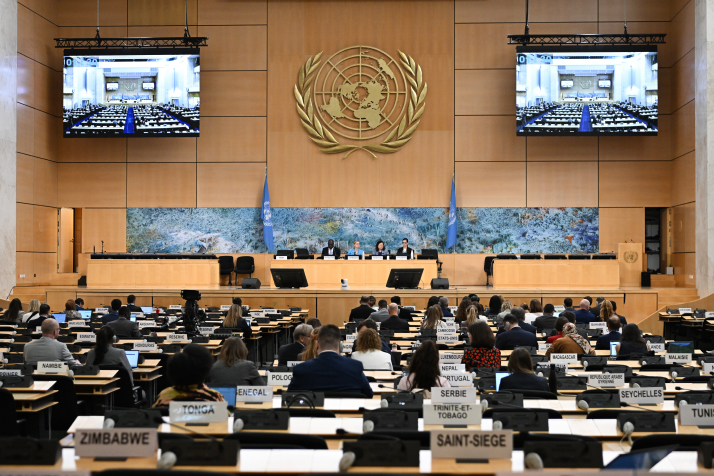 The 63rd Session of the United Nations Human Rights Council at the Palais des Nations in Geneva, Switzerland, on September 30. During the session, China called on the international community to establish a just, equitable and inclusive global human rights governance system guided by the Global Governance Initiative (XINHUA)
China has marked its arrival as a progressive, capable, responsible and confident actor on the world stage with a slew of key initiatives concerning security, development and civilizations. Then came the Global Governance Initiative (GGI) as their capstone, defining China's distinctive foreign policy. Commentary has focused on many key aspects, including its opposition to hegemonism and double standards of the United States and the West. However, its central importance, I would argue, lies in its endorsement of the United Nations and its charter as the foundation of international governance. It is no accident that China chose the 80th anniversary of the founding of the UN in 2025 as the occasion of the publication of the GGI. The GGI's core commitment This endorsement of the UN comes at a time when the global body is under attack from all sides. Western governments are concerned about what they consider the obstruction to the exercise of their will represented by the presence of Russia and China in the Security Council. Many well-meaning people point to the UN's increasing ineffectiveness in preventing conflict and addressing pressing issues, whether of climate change, development, terrorism or AI. Many others despair at the skewing of its institutions, whether of aid, culture or health, from their original and intended purposes by the power Western corporations have come to wield over them. If all this were not enough, many, if not most, dismiss the UN as a mere plaything in the cynical games of the Big Powers. The GGI snatches redemption of the UN from the formidable jaws of all this criticism. It seeks to reaffirm the historical promise of the UN and set it on a path that will realize it fully for a multipolar world that is also more socially just and developed, more civilizationally rich and more secure. The GGI clearly recognizes the proliferating problems plaguing the UN. Indeed, its identification of the UN's three "deficiencies" covers the gamut described above: "the serious underrepresentation of the Global South," the "erosion of authoritativeness" which the GGI blames, rightly, not on obstruction by Russia or China but on practices such as unilateral sanctions and illegal wars, that "have violated international law and disrupted the international order," and "governance gaps" in the face of existing and new challenges. For all these deficiencies, however, the GGI does not give up on the UN. China is very aware that, though its recent rise and its growing economic, military, technological and diplomatic power have vaulted it to the status of not just a Big Power but one of two really big powers, it is a big power of a special sort, of a historically new sort. It is, moreover, one that made its mark on the UN at the very moment of its birth, giving the UN the progressive potential that must now be salvaged and redeemed. UN's progressive founding The first and second world wars are considered two separate wars. The first is generally regarded, depending on your perspective, a great and perplexing tragedy or an inter-imperialist conflict. The second is almost universally hailed as a just war against fascism. The reality is that the two catastrophic wars constituted a single inter-imperialist conflict with a pause between two active phases, which was ended only by the intervention of historically novel forces, of which China was one—having pinned down two thirds of Japan's ground forces. This single war, the Thirty Years' War, as American historian Arno Mayer called it, started as an inter-imperialist war, the result of competition among imperialist powers spinning out of control. It could hardly be ended by some of these imperialist powers being defeated by the others—and it was not. The 1919 Versailles Settlement settled nothing, and only prepared the ground for the Second World War. And if that war did end, it was not because the imperialist powers had turned over a new leaf. Rather, it was because of the historically monumental intervention of a historically novel force, Communism. Victory in Europe would not have been possible without the critical Soviet contribution, at the cost of over 30 million lives. Victory in the Pacific theater would not have been possible without Chinese forces, again at the cost of nearly 30 million lives. This was why, while the attempt to create organizations that would end war and promote peace did not work after the First World War, it stood a much better chance after the Second World War. The League of Nations was created by imperialist powers themselves, and inevitably, it could not transcend their ongoing competition: In a world still dominated by modern empires, it excluded the vast majority of human societies from membership; the most powerful of them refused to join for fear of even its relatively minimal restrictions on its freedom of maneuver; it actually permitted aggressive war; its fantasy that they could be ended "cheaply" by the imposition of sanctions foundered on the shoals of the first wars they were applied to. The list of the league's limitations is long. The UN, created as the defeat of the Axis powers (Germany, Italy and Japan) was on the horizon, was no creation of the imperialist powers alone: Among its creators were the Soviet Union and China, the two most powerful anti-imperialist forces known to humankind to date, which had made the critical difference between victory and defeat against fascism. Their commitment to anti-imperialism and decolonization ensured that the UN had wide membership to start with and provisions to widen it as decolonization proceeded. It also made the principle of sovereign equality of all its more numerous membership the foundation of the post-war international order. 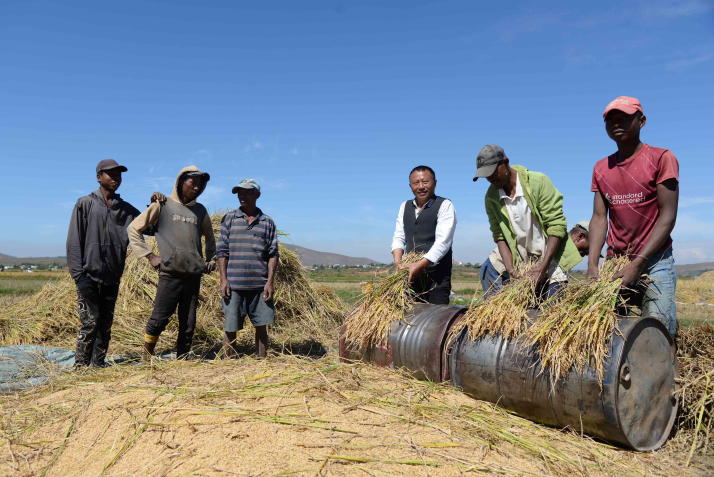 A Chinese hybrid rice expert works with local farmers in a field in Mahitsy, Madagascar, on May 12, 2023 (XINHUA)
Sovereign equality While it is true that this principle of sovereign equality was compromised by the veto granted to the five permanent members of the Security Council, two competing considerations must be kept in mind. First, as the 17th century French moralist François de La Rochefoucauld said, "Hypocrisy is the homage that vice pays to virtue." Thanks to their declining power in the face of rising resistance, the virtue of sovereign equality had to be acknowledged, however hypocritically, even by the imperialist powers. Second, the five permanent members included the Soviet Union and China and, with regard to the latter, the U.S. had to drop its charade of giving China's seat to the province of Taiwan by 1971. The presence of these powers has since represented a standing challenge to imperial power, preventing it from shaping the world order to suit itself during the Cold War and, after the end of the Soviet Union, forcing the exercise of imperial power outside the parameters of the U.S. system whether through its illegal wars via "coalitions of the willing" or its illegal unilateral sanctions. This has contributed mightily to undermining the legitimacy of these actions, requiring the imperialist powers to invest massively in propaganda. The GGI affirms the UN's centrality and its charter at a time when imperial power is in accelerated decline along all its dimensions: economic, military, diplomatic and cultural. As this power declines, and as that of countries determined to defend their sovereignty—and they range from the Democratic People's Republic of Korea, through Iran to Cuba—grows, the importance of the UN to the new multipolar world to be built will only grow. China and its GGI must be congratulated for standing up for it. The author is a professor in the Department of Political Studies and director of the Geopolitical Economy Research Group at the University of Manitoba, Canada Copyedited by G.P. Wilson Comments to liangxiao@cicgamericas.com |
|
||
|
||||||||||||||||||||||||||||
|