|
| Voice |
| The long road traveled... by a book | |
|
|
 Overseas and Chinese scholars, alongside students from Peking University, visit Yan'an, Shaanxi, on July 3 (XINHUA)
As one of the world's largest markets for imported literature, China has translated and published over 100,000 American titles since joining the Berne Convention for the Protection of Literary and Artistic Works in 1992—a massive volume that has long cemented the United States as its top source of foreign book copyrights. But China's appetite for American literature runs far deeper. The genesis of this exchange is widely traced back to 1864 Beijing, when a Chinese edition of prominent American jurist Henry Wheaton's Elements of International Law first rolled off the presses. What began with a single legal treatise has expanded into a monumental cultural dialogue that spans more than 160 years, touching generations of readers. Deeper questions about the nature of this literary bond beckon. Which American writers have truly captured the imagination of Chinese readers, and why do certain works remain timeless bestsellers? Beyond individual tastes, how do these choices reflect China's own shifting needs, values and societal transformations over time? To what extent have these translated works forged China's perception of the U.S.? And as American stories continue to find an eager audience across the ocean: When will Chinese literature achieve a similar place on American bookshelves? It was only after laying out these questions that I realized I was, perhaps unwittingly, following in the footsteps of American journalist and author Edgar Snow and his classic work Red Star Over China. In 1936, a 31-year-old Snow, relying heavily on Chinese collaborators who were proficient in English, ventured with an anxious heart into the Shaanxi-Gansu revolutionary base area, the foothold of the Communist Party of China (CPC) in northwest China, becoming the first Western journalist to do so. In the volatile political climate of the day, it was a journey into the unknown, one from which he knew he might never return. What drove the young American was an insatiable curiosity, captured at the very start of his book, where he poured out 80 burning questions in a single breath. 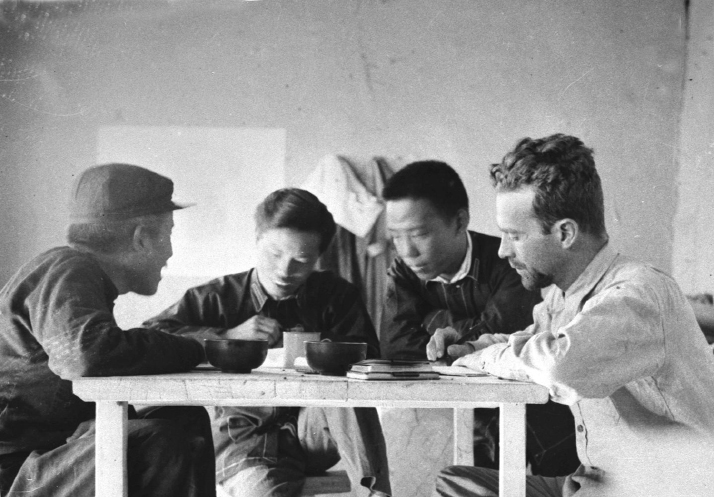 Edgar Snow (first right) in north Shaanxi Province in 1936 (XINHUA)
An enduring legacy When it comes to the most influential American books ever published in China, Red Star Over China is in a league of its own. Since 1938, dozens of Chinese editions have rolled off the presses, accompanied by countless derivative works based on its most key chapters. Today, tallying its total circulation is a near-impossible feat, though it easily climbs into the tens of millions. Its legacy was further cemented in 2017, when it was added to China's national core curriculum as recommended reading—guaranteeing a fresh audience of millions of young readers each year. Beyond its massive public reach, Red Star Over China remains a landmark model of literary journalism and a pioneering work of war reportage, widely revered by reporters and newsrooms. Yet the journey of Red Star Over China across nearly nine decades of publication in its namesake country was far from smooth sailing. Though an instant bestseller in Britain and the U.S., bringing the book home to China was full of obstacles due to political censorship and the threat of severe punishment under the Kuomintang regime. Publishing a book that positively portrayed the CPC and the Red Army was simply not permitted. Its name even had to be changed—appearing under the title Xixing Manji (Westward Journey). A team of over 10 translators, led by publisher Hu Yuzhi, translated the book in just one month and then released it in February 1938 under the secret publishing collective Fushe. But printing proved harder than translating: With no capital, Snow waived his royalties and the publishers sold advance subscription vouchers to raise funds. In 1979, Dong Leshan's landmark unabridged translation restored the excised chapters and the original title, rescuing the book from obscurity just as China began its reform and opening-up journey. When Snow finished writing Red Star Over China in 1937, he could never have foreseen its miraculous life. Beyond the pages The enduring value of Red Star Over China rests on five distinct pillars: Snow offered one of the earliest detailed accounts of the Red Army's Long March (1934-36), framing it as "one of the great exploits of military history." He captured raw, first-person oral histories from key communist leaders like Mao Zedong and Peng Dehuai; he documented daily life across the revolutionary bases, painting a vivid picture of a novel social order and spirit; he outlined the Party's vision and strategic path toward national independence and social revolution; and finally, he preserved a priceless visual chronicle through extensive photography. Snow was never a member of any political party, nor was he ever a Communist. Yet throughout his life, he maintained an abiding passion for China—one so deep that he requested in his will for part of his ashes to be buried on the campus of Yenching University—now Peking University—where he had once taught. Over the decades, Snow and Mao met many times. Their final long conversation took place on December 18, 1970, when Mao signaled that then U.S. President Richard Nixon would be welcome to visit China. When Snow published the interview in Life magazine, Washington took note: The ice in China-U.S. relations was ready to be broken. On February 21, 1972, Nixon arrived in Beijing, just six days after Snow passed away. Unlike other American classics or bestsellers introduced to Chinese audiences, the people, the stories, and the creation of Red Star Over China were entirely rooted in China itself. It offered the outside world a window into the CPC, becoming essential reading for anyone seeking to understand the Chinese revolution—a value that has only deepened with time. Today, more than ever, the world needs more figures like Snow and more works like Red Star Over China; storytellers and stories that not only resonate with readers in China, but ultimately serve the interests of China, the U.S. and the world at large. The author is president and editor in chief of New Star Press Copyedited by Elsbeth van Paridon Comments to yuanyuan@cicgamericas.com |
|
||||||||||||||||||||||||||||
|