|
| Voice |
| Europe on the sidelines | |
|
|
|
At the invitation of U.S. President Donald Trump, President Xi Jinping landed at Joint Base Andrews on September 23, for his first state visit to the United States since 2015. The meeting is part of a rising cadence of diplomatic engagement between the two states. The Washington visit is the third in under 12 months, marking an exchange of visits between the two leaders within six months.
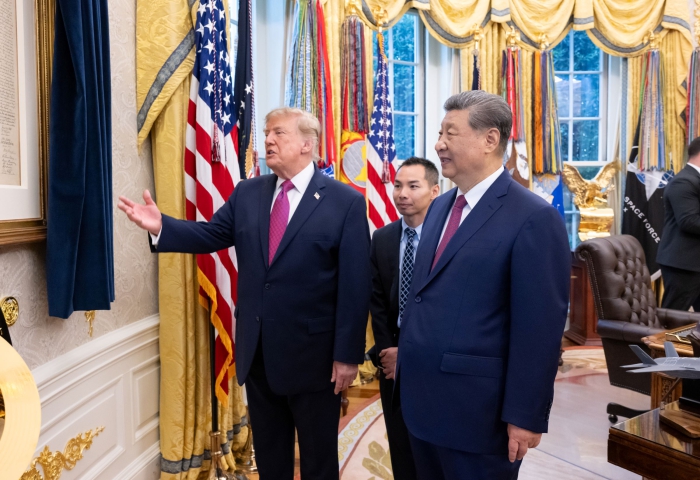
President Xi Jinping and President Donald Trump tour the White House Oval Office in Washington, D.C., the United States, on September 24(XINHUA) Trump greeted the Chinese president on the tarmac, a rare break with U.S. presidential protocol. And he did so with full honors: a 30-meter red carpet, an honor guard and military band playing both national anthems, a 21-gun salute, and a flyover of two B-1 Lancer bombers so loud that Trump visibly winced. The greeting was extraordinary if only because the U.S. never volunteers such generosity. Indeed, it routinely metes out humiliation for its allies and violence for its enemies. The disparity in treatment reflects an emerging hierarchy: Washington is compelled to devote attention to China because China has things that Washington needs. This is therefore a symptom of a profound shift in the global balance of forces, and a decisive victory for Chinese development and Chinese diplomacy. For Europe, caught entirely on the sidelines, it reflects an ongoing and precipitous collapse in global standing. Empire confronts its limits The Egyptian scholar Samir Amin wrote that imperialism walks on two legs: a political leg and a military leg. Politically, the U.S. and its allies have long relied on a package of policies to advance their hegemony, from sanctions and structural adjustment to debt and dollar dominance. When these have failed to achieve their objectives, Washington has always turned to war. Countries of the Global South have long sought to build a new form of international cooperation. In 1955, at the Afro-Asian Conference at Bandung, they articulated the Five Principles of Peaceful Coexistence, namely, mutual respect for sovereignty and territorial integrity, mutual non-aggression, non-interference in each other's internal affairs, equality and mutual benefit, and peaceful coexistence. This broke with the long tradition of colonial domination that was imposed on them, and it gave rise to the Third World as a political subject. The past decade has seen a fundamental shift in that status quo. China's peaceful rise has provided an alternative development path to the Third World. At the third Belt and Road Forum for International Cooperation in 2023, Xi called on states to treat each other as friends and partners, respect and support each other, and help each other succeed. The Chinese President stressed, "As the saying goes, when you give roses to others, their fragrance lingers on your hand. In other words, helping others is also helping oneself." This approach not only reflects the spirit of Bandung. It also represents the rise of a new material force in the world economy, which increasingly enables states to resist the economic leg of imperial domination. China has kept open the door for the U.S. to take part in that new order, framing its relationship with Washington in terms of coexistence rather than confrontation. Xi stressed in a written speech at the arrival ceremony at the White House in Washington, "China and the United States, as two major countries, stand to gain from cooperation and will both lose in confrontation. We do not need to avoid mentioning competition, but our competition should be a healthy one and should be kept within bounds. It should be a race of catching up with one another, not a wrestle in which one either wins or loses." But it is not only imperialism's political leg that is facing challenge. Researchers estimate that the war with Iran has consumed more than 1,500 Patriot interceptors, reducing the U.S. inventory from roughly 2,330 to fewer than 830, while roughly 40 percent of the 452 THAAD interceptors available at the beginning of the war have been expended. The list goes on. Rebuilding these stockpiles means expanding industrial capacities and supply chains that have become increasingly reliant on global production networks and on rapidly-dwindling energy flows. For now, Washington has failed to assert itself economically against China, and it cannot intimidate it militarily.So it has come to the table. Even if the U.S. meetings produce little of substance, they reflect a historic inflection point and, one would hope, reduce the risk that Washington might seek wider escalation. The European contradiction Europe has watched these developments from the sidelines, increasingly peripheral to the negotiations that cut against some of its core interests. Its isolation is becoming difficult to ignore. Russian Foreign Minister Sergey Lavrov quipped that "there is no one to negotiate with in today's Europe." Chinese officials might never use that language, but it is clear that Brussels has far less leverage over the decisions that structure its relationship with both Washington and Beijing than it would like to believe. The consequences extend beyond diplomatic protocol. The decisions being negotiated between Washington and Beijing concern questions on which Europe has enormous interests but little influence: tariffs and trade flows, Chinese purchases of U.S. goods, rare-earth and critical-mineral exports, advanced technology and AI, and the terms of the wider global economic order. They also touch on issues with direct geopolitical consequences for Europe, including the wars in Ukraine and Iran. Europe faces a contradiction. Through NATO, it has largely surrendered military policy to Washington, and its security remains heavily dependent on the U.S. Through neoliberal restructuring, the boomeranging effect of sanctions, and decades of austerity, it has blunted its industrial edge, producing an economy that is deeply connected to China. Economically, Europe and China are deeply integrated and mutually dependent in their industrial and supply chains. Europe has sought to navigate both sides. One one side, it makes extravagant displays of loyalty to the U.S., from dramatic increases in NATO military spending to Denmark's recent surrender of sweeping rights over Greenland to Washington. On the other, it seeks to "manage" the relationship with China, while frequently engaging in the kind of aggressive zero-sum politics that Chinese foreign policy seeks to overcome. The result is not simply that Europe has lost influence. It no longer has the ability to act as an independent pole in the international system. European economies are stagnating and their political leadership is facing historically-unprecedented levels of unpopularity. That is why Europe is putting its economy on war footing, a last-ditch attempt to reindustrialize, dismantle the social democratic arrangement, and rescue the project from the contradictions that are gradually tearing at its seams. These are some of the symptoms of an emergent post-imperial order. It is one where the imperial powers, accustomed to dictating terms by force, instead come to the negotiating table. It is a system where goods manufactured in the Global South can serve its development, rather than enriching a small clique in the Global North. And it is a system where the 500-year reign of European colonialism and imperialism finally approaches its sunset. The author is a Polish researcher, writer and organizer. He serves as political coordinator at Progressive International Copyedited by G.P. Wilson Comments to dingying@cicgamericas.com |
|
||
|
||||||||||||||||||||||||||||
|