
|
| Voice |
| Navigating uncertainty in China-U.S. relations | |
|
|
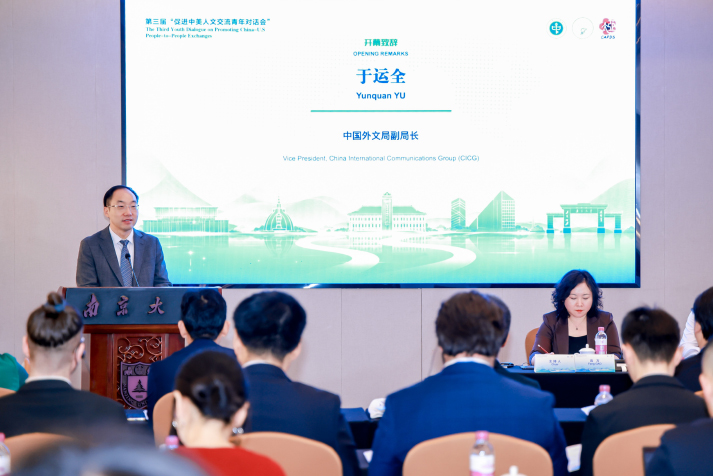 Yu Yunquan, Vice President of China International Communications Group, delivers a speech at the third edition of China-U.S. Youth Dialogue on People-to-People Exchanges in Nanjing, Jiangsu Province, on August 31 (COURTESY PHOTO)
The third edition of the China-U.S. Youth Dialogue on People-to-People Exchanges was held in Nanjing, Jiangsu Province, on August 31. Young experts and scholars from China, the United States, Cambodia, Ecuador and other countries gathered to discuss key issues in China-U.S. relations, ranging from geo-economic interdependence to global governance cooperation. The annual program was jointly launched by the Academy of Contemporary China and World Studies under China International Communications Group (CICG) and the Carter Center in 2024. In an exclusive interview with Beijing Review on the sidelines of this year's event, CICG Vice President Yu Yunquan shared his observations on the status quo of China-U.S. relations and the role people-to-people exchange can play in shaping the relationship. Edited excerpts of the conversation follow: Beijing Review: At the Dialogue Between China-U.S. Think Tanks in March 2025, you noted that there were "many uncertainties" between China and the U.S. In May, the two heads of state met in Beijing and agreed that both sides will work toward building a constructive relationship of strategic stability. You pointed out that this new vision has injected "precious certainty" into the bilateral relationship. How do you interpret this shift from uncertainty to certainty? Yu Yunquan: Certainty and uncertainty are, in fact, relative. The current sense of certainty stems from the consensus reached by the two heads of state. When they met in May, they agreed to build a constructive relationship of strategic stability, providing strategic guidance at the highest level. Both sides are seeking to advance cooperation in a more pragmatic way, setting aside some differences for the time being, working toward each other and looking to the future together. Another source of certainty is that exchanges between China and the U.S. in various fields have reached a new level of activity. Previously, for various reasons, interaction between the two sides was limited, and many channels and mechanisms faced obstacles. But over the past two years, we have collaborated with the Carter Center to host three editions of dialogues involving think tanks and young people. This initiative is merely a microcosm of the broader bilateral cooperative framework. Exchanges in other areas, particularly trade and economic cooperation, have been even more active. The uncertainty lies in the fact that, compared with the past, the environment for China-U.S. interactions has changed noticeably, while the foundations for stable bilateral relations have weakened. The greatest fragility of China-U.S. relations today is their susceptibility to unexpected events, particularly changes in the U.S. domestic political landscape. During election cycles, the U.S. side may politicize certain China-related issues to serve domestic agendas, potentially undermining the broader picture of constructive strategic stability. If differences are not properly managed and isolated disputes escalate into major crisis, they could undermine the stability of bilateral relations. In your view, what are the main drivers of the uncertainty in China-U.S. relations? Looking back at China-U.S. interactions over the past 20 years, the relationship has undergone profound changes. China, in particular, has experienced historic transformation: Its economy has maintained steady growth, gradually building strong momentum for development, while achieving disruptive innovations and breakthroughs in many key areas. Faced with this reality, some groups in the United States have found their long-held perceptions of China challenged and have been reluctant to acknowledge China's economic catch-up. Traditional international relations theory features an analytical framework that pits the emerging power against the established power. Under this theoretical logic, international influence is construed as a zero-sum game, with the strength of major countries waxing and waning in inverse proportion. Those who adhere to this perspective are skeptical of China's call for win-win cooperation, and baselessly predict that China's development will undermine America's global standing. This is a deeply rooted strategic perception that cannot be simply dismissed as prejudice. And this perception has profoundly shaped the structural dynamics of bilateral relations. Breaking through stereotypes is difficult, but it is possible. There remains considerable room for communication and shaping correct perceptions. That is why people-to-people communication, think tank exchange and international communication, which we are dedicated to, are so important. Following the May agreement between the Chinese and American leaders on the new vision of building a constructive China-U.S. relationship of strategic stability, how do you interpret this idea? Strategic stability must be maintained between our two major countries. At present, both sides still face many practical challenges. The stability we refer to is stability at the strategic level: The focus is on maintaining stability regarding major, structural and framework issues. At the same time, this stability is not rigid or static. Even in the presence of competition and friction, major-country relations can remain stable. What we pursue is constructive strategic stability, which must accommodate positive and constructive elements. Therefore, how we understand and articulate this concept requires careful consideration. Over the past 40 years, or more, the China-U.S. relationship has remained relatively stable despite many twists and turns. The sheer scale and global roles of the two countries make cooperation imperative. This is a broad historical trend that many people recognize. In 2015, American scholar David M. Lampton said at the Carter Center that China-U.S. relations had reached a "tipping point." This sparked extensive discussion among academic communities in both countries around 2016. By 2019, the change had become much more apparent. The discourse of competition had replaced that of cooperation, and the U.S. had adopted a new approach to defining its relationship with China. In fact, having weathered the storms of the past few years, China-U.S. relations have demonstrated remarkable resilience. These experiences have been both unforgettable and instructive for both countries, and perhaps even a source of wealth. Have you noticed any changes in China-U.S. relations since the May agreement? In the U.S., there is still broad consensus that China-U.S. relations should remain on the track of constructive strategic stability. Youth and think tank exchange programs like those we have initiated serve as representative communication channels that transcend partisan divisions. In addition, sub-national communication and economic and trade exchanges between the two countries have also been quite active recently, with both sides working to expand the list of areas for cooperation in line with the consensus reached by the two heads of state. A survey released by the U.S.-China Business Council in June showed that 92 percent of U.S. companies surveyed were profitable in China in 2025, while 95 percent said their operations in China helped them maintain global competitiveness. Additionally, the 2026 China Business Climate Survey Report, released by the American Chamber of Commerce in China in January, showed that 57 percent of surveyed companies plan to increase their investment in China. Many in U.S. foreign policy and think tank circles still have strategic suspicions about China. How do you think these can be addressed? Communication is always better than trying to understand each other simply by reading documents. Seeing is believing. I believe that when American scholars visit China and see things for themselves, it will not only benefit their research but also help them form a more accurate and objective understanding of China. Some U.S. media outlets have sensationalized so-called security risks in China. This indirectly reflects that the current level of mutual trust between China and the U.S. remains limited, and bilateral relations are overall quite fragile. Yet, precisely against this backdrop, it is even more necessary to continuously promote people-to-people exchange between the two countries. As more and more Americans visit China and see it firsthand, mutual engagement will gradually become normalized. In the future, both sides should ease policies where appropriate and create a more favorable environment for people-to-people communication and economic and trade exchanges. U.S. President Donald Trump has invited Chinese President Xi Jinping to visit the U.S. in late September. What are your expectations for this potential visit? The two countries have entered a rare window of opportunity. It may not be stable or last long, but it has emerged alongside many positive trends and changes. All sides should work together to sustain this window and strengthen its foundation. Many issues related to global governance, including AI collaboration, economic and trade exchanges, cultural engagement, sub-national communication and youth dialogues, require the establishment of more regularized exchange mechanisms to deliver more tangible outcomes. BR Copyedited by Elsbeth van Paridon Comments to ffli@cicgamericas.com |
|
||||||||||||||||||||||||||||
|