
|
| Voice |
| Why Hangzhou is a paradise for tourists | |
|
|
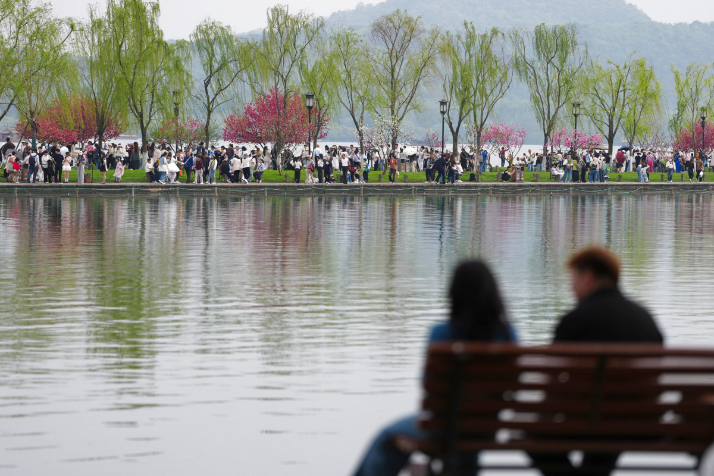 The West Lake scenic area in Hangzhou, Zhejiang Province, on April 2.(XINHUA)
Owing to my work, I have been a frequent visitor to China since the 1990s. I had visited Hangzhou before as part of press delegations, yet my understanding of the city was largely limited to its reputation as China's "cultural capital." The city, which is the capital of Zhejiang Province, boasts three UNESCO World Heritage Sites: the picturesque West Lake, the Grand Canal, a manmade waterway that connected Beijing and Hangzhou in ancient times, and the archaeological ruins of Liangzhu, a cluster of Neolithic sites. Thanks to these treasures, Hangzhou ranks among China's top-tier cities in terms of international image, alongside Beijing, Shanghai and Guangzhou in Guangdong Province. In April, I visited the city again. This time, however, Hangzhou revealed itself to me as a core hub of China's technological innovation. Home to ground-breaking AI startups and enterprises engaged in core technologies, such as DeepSeek, a developer of large scale AI models; Game Science, creator of the game Black Myth: Wukong; and Unitree Robotics, a robot manufacturer, Hangzhou has become a genuine "innovation driver" and a "model of a smart, livable city." During this trip, I visited several of these enterprises, including Unitree Robotics and DEEP Robotics. Both companies specialize in developing quadruped and humanoid robots, Unitree's robots once famously having performed at the nationally televised Chinese New Year Gala. The capabilities of these robots truly amazed us, as did augmented reality (AR) smart glasses made by Rokid (Hangzhou Lingban Technology). Incidentally, these glasses offered us an incredible, immersive journey back in time when we visited the ruins of Liangzhu, which offers outstanding insights into China's 5,000-plus-year-old civilization.
Tourist-friendly digital infrastructure Hangzhou is also the home base of Alipay. Today in China, Alipay is far more than a payment app. It represents fundamental digital infrastructure, a symbol of the country's technological strength and financial inclusiveness deeply woven into daily life, and a key component of the national digital ecosystem. Alipay and its parent company Ant Group are headquartered around the West Lake, making Hangzhou the center for the platform's research and development (R&D) and strategic development. Alipay serves as a one-stop service portal for foreign visitors traveling around Hangzhou. Integrated services greatly improve travel comfort. One example is the tourist QR code under the One Code for All system: Visitors can use Alipay's QR code for public transport, hotel check-in, scenic spot admission and shopping. Additionally, Alipay provides access to AI Hangzhou, a municipal service hub for foreigners, through which users can book medical appointments and obtain transport information. Tourists can also access a 16-language translator, ride hailing, hotel and ticket booking, power bank rental and many other functions. What makes Hangzhou unique nationwide is that international visitors can receive instant tax refunds (up to 11 percent of purchase value) directly into their Alipay accounts at partner stores and the airport. In short, Alipay's role in Hangzhou goes well beyond payment functions; it forms the city's digital foundation and has helped make Hangzhou one of China's most technologically advanced and tourist-friendly destinations. It actively participates in urban digitalization and supports major national events, demonstrating the redefined role of large digital platforms within the national economy. Hangzhou today excels not only in Internet applications but also in cutting-edge industrial technologies including chips, bio-manufacturing and robotics. During our visit to Hangzhou Wensan Advanced Technology Center, we saw how the city is moving from software-oriented solutions toward building its own independent hardware technology base.
East-West cultural exchange Tech firms offering cultural excursions allow tourists to understand why Hangzhou earns the title Paradise on Earth. I also toured the West Lake and watched Impression West Lake, a spectacular outdoor show created by renowned director Zhang Yimou exclusively for the 2016 Group of 20 (G20) Summit. This was my third viewing, and it still moved me deeply. As one of Hangzhou's calling-card attractions watched by nearly all visitors to the city, it merits a more detailed introduction. The show's centerpiece is its stage: A special platform sits merely 3 cm below the lake surface, creating the illusion that performers are dancing on water. State-of-the-art lighting and sound systems together with 3D projection technology blend magical visual effects seamlessly into the natural landscape, blurring the boundary between fantasy and reality. The performance mixes Chinese and international classical music to highlight cultural dialogue. Tea Dance, performed by 300 artists in traditional costumes, pays tribute to Hangzhou's famous Longjing tea. The classic Chinese tragic romance Butterfly Lovers is interpreted with the traditional pipa lute and violin. These pieces interweave with famous Russian composer Tchaikovsky's Swan Lake, staged on water for the very first time in history—an enormous challenge for dancers. The grand finale uses Beethoven's Ode to Joy. Thanks to Zhang's creative vision, Impression West Lake is a symphony of East-West cultural exchange. It has been listed among China's high-quality tourist performances and was nominated for the ITIA Awards for Best Visual Aesthetics.
Blending history with technology I finally saw the Beijing-Hangzhou Grand Canal, one of the world's largest and oldest manmade waterways stretching roughly 1,800 km, with Hangzhou located at its southern end. The canal connected rice and silk-rich southern provinces to northern imperial capitals. It functioned as the empire's vital lifeline: Grain and goods flowed northward, while cultural and political influences traveled south. Emperors of the Ming and Qing dynasties (1368-1911) embarked on famous southern inspection tours along this waterway, and Hangzhou was considered an indispensable stop. Comparing the Grand Canal and the Great Wall: The Great Wall stands as a majestic symbol of China's power and heroic past; the Grand Canal is its living, relentlessly beating economic artery that once united and still unites the nation. Even in the high-speed rail era, the Grand Canal continues to serve China with water regulation functions and cargo transport. I first came to China in 1991, and over the past 35 years I have traveled extensively across its cities for comparison. Each has its own charm, yet only Hangzhou has historically borne the name Paradise on Earth. I would add that Hangzhou is truly "a paradise for tourists." It blends age-old history and elegance with cutting-edge technology and modern comfort. Rather than merely preserving ancient heritage, Hangzhou integrates it virtuously into contemporary life. Instead of becoming a static open air museum, it turns history into interactive experience. For example, at the Deshou Palace Site Museum, 3D projection and AR reconstruct scenes of Song Dynasty (960-1279) life atop archaeological ruins, allowing visitors to take a virtual step back into the past. Hangzhou also fosters creative urban spaces. Hefang Street, for instance, houses not only souvenir shops inside historic buildings but also trendy cafés serving coffee infused with ginseng and herbal extracts. One senses the city's people living fully modern lives embraced by history, a special draw for young visitors. This is the hometown of tech giants such as Alibaba, as well as rising unicorns including DeepSeek and Unitree Robotics. This innovation ecosystem builds Hangzhou's image as a dynamic, future-oriented city, drawing global travelers eager to see China's equivalent of Silicon Valley. Last but not least, the city shows genuine care for visitors. Huge resources have been invested to build a welcoming, tourist-friendly environment, placing Hangzhou among China's top destinations for travel service quality. For 15 consecutive years it has ranked within China's Top 10 cities for tourist satisfaction. Visitors also remark on its warm human atmosphere: chatty taxi drivers and efficient public services. This intangible human warmth cannot be measured in statistics yet greatly enriches the travel experience. The author is Editor in Chief of Russia and China magazine Copyedited by G.P. Wilson Comments to liangxiao@cicgamericas.com |
|
||
|
||||||||||||||||||||||||||||
|