|
| Voice |
| Seventy years in the making | |
|
|
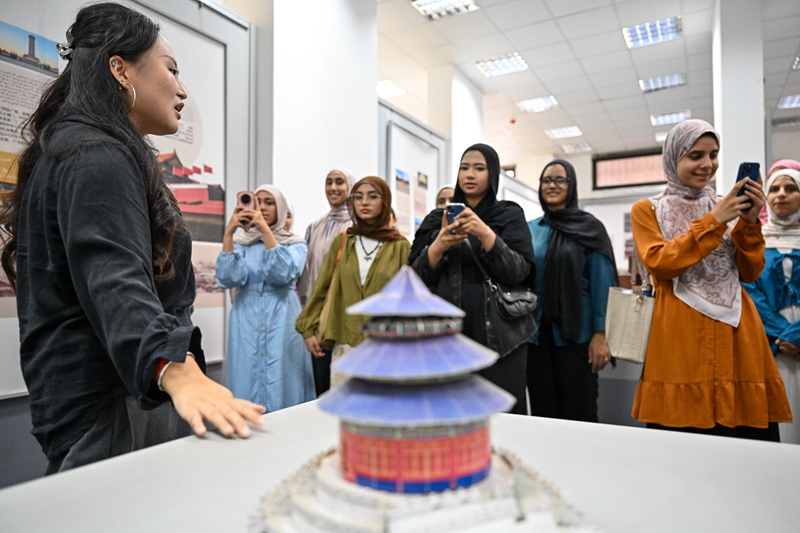 A teacher introduces Chinese culture to students at the Confucius Institute at Suez Canal University in Ismailia, Egypt, on July 14 (XINHUA)
When Chinese President Xi Jinping touched down in the Egyptian capital in early September, after the Shanghai Cooperation Organization Summit in Kyrgyzstan on September 1, he ended a wait that Cairo has measured in years and, in one sense, in a full decade. The state visit was Xi's first to Egypt since 2016. The visit came as the two countries mark the 70th anniversary of diplomatic relations, established in 1956 when Egypt became the first Arab and African country to establish diplomatic ties with the People's Republic of China. For President Abdel Fattah El-Sisi, the visit was a chance to convert a decade of warm rhetoric into concrete deliverables. For Beijing, it was a signal that its anchor on the African continent and its gateway to the Arab world stand ready for a deeper embrace. And for both governments, it was an opportunity to close gaps that have quietly widened beneath the surface of an otherwise booming relationship. The relationship has come a long way since 1956. Egypt and China found common cause in the anti-colonial politics of Bandung and the Non-Aligned Movement, drifted apart in the later Cold War decades, and rebuilt ties in the 1990s. The past decade, though, has been transformative: The two countries established a comprehensive strategic partnership in 2014, while Sisi and Xi have met frequently over the years, providing high-level political momentum to the relationship. There is a symmetry to Xi's return. His last visit, in January 2016, produced the memorandum that brought Egypt into the Belt and Road Initiative. This one is to produce the framework for the next decade, spanning strategy, politics, economics and culture. A practical partnership The economic pillar is the most visible. Chinese investment in Egypt has exceeded $10 billion, with more than 3,000 Chinese-funded enterprises operating in the country, according to Egyptian statistics cited by the Chinese Embassy in Cairo. And the landscape shows it: a Chinese-built business district in the New Administrative Capital, its 385-meter Iconic Tower, the tallest building in Africa; the TEDA industrial zone in the Suez Canal Economic Zone, home to roughly 200 Chinese companies and tens of thousands of jobs; monorail lines, solar farms and port upgrades scattered across the country. Bilateral trade reached about $20.8 billion in 2025. In June, the two central banks renewed and expanded their bilateral currency-swap agreement from 18 billion yuan to 30 billion yuan ($2.68 billion-$4.47 billion), with the aim of facilitating trade and investment and expanding the use of local currencies. Yet the bigger story may be what regional turbulence has exposed: Attacks on Red Sea shipping since late 2023 have driven vessels away from the Suez Canal, cutting revenues that once exceeded $10 billion a year to under $4 billion. For an economy still under an IMF program, Chinese investment and trade are no longer a complement to Western ties; they are a lifeline. Egypt's diplomatic architecture has followed the money. It signed on to the Belt and Road Initiative in 2016, became a dialogue partner of the Shanghai Cooperation Organization in 2022, and in January 2024 joined an expanded BRICS. That trajectory gives the itinerary its symbolism: Xi traveled directly from a summit of Eurasian powers to an Arab and African capital that now sits, formally, inside China's expanding network of institutions. Cairo is not alone in recalibrating. Across the region, Beijing has moved from buyer to broker, convening Arab and African leaders at periodic summits, deepening energy ties and presenting itself as a partner that attaches none of the West's political conditions. Egypt, the Arab world's most populous state, is the keystone of that outreach in every sense: geographic, demographic and symbolic. The political convergence is just as striking. On Gaza, both governments have pressed for a permanent ceasefire and the two-state solution, with Cairo mediating between the parties and Beijing hosting Palestinian factions for reconciliation talks in 2024. Egypt views China's insistence on Palestinian statehood as validation from a power that carries weight far beyond the region. Concerning Iran, Cairo and Beijing share an interest in de-escalation that has aligned their positions. Egypt has cautiously reopened channels to Tehran following the Saudi-Iranian rapprochement China brokered in 2023, and both capitals oppose any conflagration at the Strait of Hormuz that would send oil prices and insurance premiums soaring, a lesson the Suez Canal has already learned the hard way. The road ahead Perhaps one of the most revealing indicators of the relationship's depth comes not from government statements, but from a new survey conducted by the Global Times Institute. The survey, conducted from July 16 to 28 among 1,845 respondents aged 18 to 69 across China's 31 provincial-level regions, provides a rare picture of how ordinary Chinese citizens perceive Egypt. Eighty-five percent of respondents said they had some degree of understanding of Egypt, with around 40 percent describing themselves as very or relatively familiar with the country. When asked what they associated most strongly with Egypt, 66 percent cited iconic elements of ancient civilization, including the pyramids, pharaohs, mummies and the Sphinx. But the survey goes well beyond tourism and archaeology. Sixty-three percent described China-Egypt relations as "very good" or "relatively good," while more than 70 percent regarded Egypt as either a "friendly country" or a "strategic partner." Nearly 70 percent expressed optimism about the future of bilateral relations. Even more significant is the appetite for deeper cooperation: About 99 percent of respondents said China and Egypt should deepen cooperation in the future. That support extends into areas ranging from tourism and people-to-people exchanges to green development, new energy, agricultural products, food supply chains, trade and investment. More than 90 percent expressed interest in stronger people-to-people cooperation. These figures suggest that the relationship has acquired something that cannot be manufactured by diplomatic agreements alone: public familiarity and goodwill. People-to-people links have also expanded. Egypt has sought to attract more Chinese tourists, while Egyptian agricultural products have gained greater access to the Chinese market. Chinese-language education has expanded in Egypt, alongside cultural centers, scholarships and student exchanges. What, then, will the visit actually produce in the future? It focused on expanding practical cooperation in areas including trade and investment, green development, transportation, manufacturing, agriculture and digital economy. The larger stakes transcend the bill of particulars. At issue is whether Egypt, straddling the world's most important maritime chokepoint, becomes a durable pillar of the order China is assembling across the Global South, or remains a transactional partner that hedges indefinitely. Beijing's bet is that economics, over time, becomes strategy. BR The author is director and founder of Asia Center for Studies and Translation, Egypt Copyedited by G.P. Wilson Comments to dingying@cicgamericas.com |
|
||||||||||||||||||||||||||||||
|