
|
| Voice |
| Rediscovering the Dragon | |
|
|
 The Hangzhou Six Little Dragons zone within the Digital and Smart Future Theme Exhibition Area of the Fourth Global Digital Trade Expo in Hangzhou, Zhejiang Province, on September 25, 2025 (XINHUA)
I have been traveling across China extensively since the late 1990s. I stopped counting the number of cities I visited after it hit 60. For years, I felt like a rare type of China watcher who had walked the back streets and hutongs (alleys or small streets between rows of courtyard residences) of provincial capitals most expats never see. After I decided to slow down, the travel bug returned. What I quickly realized is that the cities I thought I knew like the back of my hand have been completely transformed. High-speed rail, frictionless payments, AI services and carefully restored heritage sites have rewoven the urban fabric. I am back at ground zero, getting to know China all over again. That realization crystallized during three days in Hangzhou, capital of Zhejiang Province in east China, against the backdrop of a tourism industry roaring back. In 2025, inbound arrivals hit 154.5 million (up 17.1 percent year on year), with spending surging 39.2 percent to $131.1 billion. Visa-free entries that year alone jumped 49.5 percent from 2024, to 30.08 million. Domestic trips reached a record 6.52 billion. By the first half of 2026, cross-border trips set another record at 369 million, foreign arrivals up by 20.6 percent. These numbers are not just recovery. They represent a deeper shift: Travelers now seek the fusion of deep history and living modernity, safety and digital ease, cultural immersion and technological wonder. As an American who has lived in the country more than 25 years, I am watching it from the inside—and Hangzhou showed me exactly how the shift feels on the ground. I went straight into the city that has long fused ancient genius with tomorrow's technology. World Heritage At the Archaeological Ruins of Liangzhu City, a UNESCO World Heritage site since 2019, I stood on 5,300-year-old ground that proves China engineered full-scale advanced civilization while much of the West was still prehistoric. The world's earliest large-scale water conservancy system now stands confirmed at 132 dams. This network controlled nearly 100 square km of flood-prone land through reservoirs, dikes, irrigation canals and flood retention, supporting sophisticated rice agriculture and urban planning with a jade-based social hierarchy. It is the original sponge-city blueprint. Standing there, the continuity hit me hard: This was not a museum piece. Hangzhou presents Liangzhu as a living classroom of digital archaeology campaigns, bilingual guides and interactive reconstructions, drawing international visitors who come not for photo ops but for proof of civilizational depth that never broke. The same unbroken thread runs through the Grand Canal, the longest artificial waterway on Earth. I traveled sections of the 1,794-km waterway with parts dating to the fifth century B.C. and connected during the Sui Dynasty (581-618). During the Song Dynasty (960-1279), Hangzhou (then Lin'an) ranked among the world's largest cities, home to 1-1.5 million people. Marco Polo called it the City of Heaven, describing the stone houses sitting along the canal, markets that drew 40,000-50,000 shoppers daily and streets safe enough for ordinary citizens to walk at night without fear. That infrastructure never vanished; it evolved. Today the canal corridor is a major tourism artery where visitors experience living history beside modern waterfront life. This mirrors the national turn toward culture-driven travel. Nearly 30 percent of travelers now prioritize cultural experiences; 78 percent express enthusiasm for them. Cities across China are answering with immersive heritage events, virtual reality reconstructions and "living like a local" stays that move far beyond checklist landmarks. 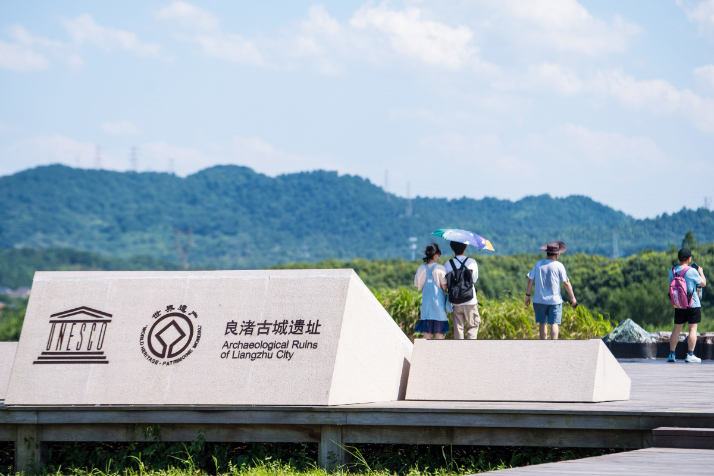 Visitors at the Archaeological Ruins of Liangzhu City in Hangzhou on July 4, 2024 (XINHUA)
Tech revelation Hangzhou's technology scene delivered the other half of the revelation. I stood among the city's legendary Internet Plus giants: Ant Group's cashless system that made digital payments seamless for over a billion people; NetEase's entertainment and tech powerhouse; Hikvision and Dahua's AI vision systems reshaping smart cities worldwide; Supcon's industrial automation; and Rokid's spatial computing and augmented reality technologies. I felt the pulse of the AI era driven by the Six Little Dragons. (The Six Little Dragons refer to a group of rapidly rising tech startups in Hangzhou—Game Science, DeepSeek, Unitree Robotics, DEEP Robotics, BrainCo and Manycore Tech—Ed.) West Lake holographic performances, moxibustion wellness flows and streets so safe that families are planning futures, instead of navigating daily chaos, complete the picture. This is not borrowed technology. It is the same civilization that built Liangzhu's hydrology and the Grand Canal now rewriting global innovation rules. The hard numbers confirm what the streets already show. China filed 1.8 million patent applications in 2024—49.1 percent of the world total. Valid invention patents surpassed 5 million. That same year, China installed a record 295,000 industrial robots, or 54 percent of global demand, bringing operational stock to 2.027 million, the highest of any country. Hangzhou's fusion of over 5,000-year foundation and cutting-edge technology explains why China's tourism industry is pulling foreigners in record numbers. International visitors increasingly want the real China, where ancient water systems still inform modern sponge cities, digital payments feel effortless and public safety allows genuine ease. Zhejiang, with Hangzhou as its standout, continues to post strong inbound growth; the city's airports see rising foreign passenger flows for both tourism and business. Nationally the industry is moving from volume-driven sightseeing to experience-led travel. Secondary destinations and small cities are booming as travelers chase local vibes, events and cultural immersion. Domestic tourism remains the core engine, but inbound growth is deliberate: expanded visa facilitation, tax refunds, multilingual services and offerings that showcase both heritage and hi-tech achievements. Foreigners are no longer just photographing landmarks. They are riding high-speed trains, trying traditional medicine, attending holographic performances and touring smart factories. From the rust of my hometown Detroit, the United States, to Hangzhou's roar, the contrast is clear and personal. China builds on its own 5,000-year foundation. Tourism is becoming a powerful soft-power platform precisely because it lets visitors touch that continuity themselves. I thought I was coming to revisit a familiar city. Three days in Hangzhou confirmed what over a quarter of a century in China has taught me: The dragon never needed to copy-paste anyone else's rulebook. It has been rewriting civilization's operating system for millennia, and the world is finally buying tickets to watch it happen in real time. The cities keep changing. So must the watchers. The author is founder of the Iron Mic and Dana Culture Media Co. He lives in Shanghai and is active in the China Is Not Our Enemy campaign Copyedited by Elsbeth van Paridon Comments to liangxiao@cicgamericas.com |
|
||
|
||||||||||||||||||||||||||||
|