|
| Voice |
| The humanitarian war on Venezuela | |
|
|
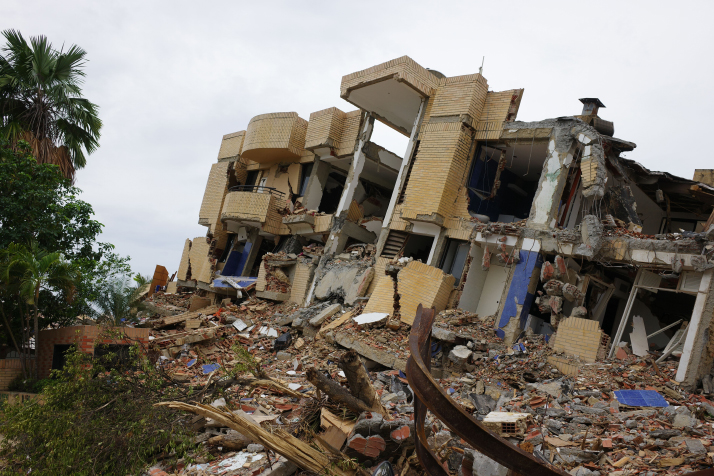 A scene of earthquake devastation in Caraballeda, La Guaira State, Venezuela, on July 3 (XINHUA)
As twin earthquakes tore through Venezuela on June 24 and the death toll climbed past 5,300, it should have surprised no one that the first foreign force to reach the port of La Guaira was the U.S. Southern Command (SOUTHCOM). Within hours, two warships had entered Venezuelan waters: the littoral combat ship USS Billings and the amphibious transport dock USS Fort Lauderdale, carrying Marines of the 24th Marine Expeditionary Unit based in Puerto Rico. The Fort Lauderdale became, in SOUTHCOM's own words, a "vital command-and-control node" for the so-called relief effort, with Marine Corps Major General Kevin J. Jarrard sent to lead operations. Behind them came C-17 and C-130 aircraft, MV-22 Ospreys and CH-47 Chinook helicopters from Joint Task Force-Bravo in Honduras. Estimates ranged from "hundreds" to nearly 1,000 troops, all under the authority of the newly renamed Department of War. SOUTHCOM has a long history of rushing its presence into Latin America, and also a very recent history of doing so in Venezuela. It was SOUTHCOM that barely six months earlier had kidnapped Venezuela's President Nicolás Maduro and First Lady (known within Venezuela's Chavismo movement as First Combatant) Cilia Flores. It was SOUTHCOM that spent months enforcing a naval "quarantine" of Venezuelan oil, bombing Caracas and seizing tankers in international waters, with Donald Trump announcing that he would "run" the country and its oil: "Maybe we will sell it, maybe we will keep it." Investment firms are already circling his $100-billion Venezuelan oil play. SOUTHCOM was also the command behind the 1989 invasion of Panama (Operation Just Cause), and the one that housed the School of the Americas, rebranded as WHINSEC, whose graduates went on to lead coups, death squads and campaigns of repression across Latin America, from El Salvador to Guatemala. It also ran the logistics of the 2019 "humanitarian aid" operation that attempted to bring down Maduro, with Puerto Rico serving as a platform for U.S. power projection against Caracas. The Red Cross and the UN refused to take part, warning that the aid was being politicized. It is against this backdrop that the earthquake "relief operation" arrived. The U.S. military is not arriving in a sovereign country to render aid, but in a Venezuela the United States has moved to subjugate by force. China's Foreign Ministry called the assault on Caracas "a grave violation of international law"; Russia, Cuba, Iran and Brazil's President Luiz Inácio Lula da Silva all demanded Maduro's release, in contrast to the shameful complicity of British, Canadian and German leaders. Three days after the kidnapping, European leaders invoked the "universal principles of the UN Charter," but only in relation to the Danish territory of Greenland. U.S. War Secretary Pete Hegseth was not so quiet about the operation: It was "a message to the world," a deterrent "so absolute… our enemies will not dare to test us." Even as the Financial Times blames "the grim legacy of Chavismo" for hampering the earthquake response, sanctions against Venezuela remain in place, impeding relief. Financial channels for aid, spare parts for heavy machinery and fuel for rescue operations all run through the blockade, a policy the economist Jeffrey Sachs described as "deliberately aiming to wreck Venezuela's economy," and one blamed for some 40,000 deaths from sanctions-induced food and medicine shortages from 2019. The Monroe Doctrine SOUTHCOM has always been a key instrument for reasserting Latin America as a U.S. sphere of influence, a role now more urgent than ever. The designation of Latin America is laid down in several White House documents and executive orders—a careful and non-accidental architecture in the making since day one of the Trump administration. The November 2025 National Security Strategy explicitly pledges to "reassert and enforce the Monroe Doctrine" and to deny "non-Hemispheric competitors" any foothold, dropping even the post-World War II pretense of respect for sovereignty. And while the National Security Strategy provides the geopolitical objective, the Counterterrorism Strategy provides the mechanism of execution. For the first time in U.S. history, three official categories of terrorist are legally merged into one: "narcoterrorists and transnational gangs," "legacy Islamist terrorists" and—unprecedented—"violent left-wing extremists, including anarchists and anti-fascists." Legally, the strategy for Latin America consists of merging "narcoterrorism" and "left-wing extremism" into a single category and attributing it to elected governments and leaders deemed hostile to Washington, thereby opening the door even to military intervention. Following this script, on November 13, 2025, Hegseth formally launched Operation Southern Spear, billed as an "anti-narcoterrorism" campaign, yet fielding some 15,000 troops in the Caribbean, one of the largest force build-ups in the region since the Cold War. Led by SOUTHCOM and Joint Task Force Southern Spear, and armed with bombers, drones, aircraft carriers and amphibious ships, it was an ostentatious naval deployment against small fishing boats allegedly carrying drugs. Maduro had already been designated the leader of a "foreign terrorist organization" by a Trump executive order on the very first day of his second term, and on January 3, U.S. forces struck Caracas and seized the head of state of a sovereign nation. On June 10, from the naval base at Guantánamo Bay in Cuba, Hegseth indicated that Venezuela was a test case for a strategy designed for the entire continent: "We are taking back our hemisphere." And to do so, he said, the U.S. is already deploying in Latin America the same intelligence, the same networks and the same military force used in the Middle East, in coordination with the allied countries of the Shield of the Americas. The redeemer nation SOUTHCOM's dual identity as a humanitarian actor and instrument of military intervention in sovereign nations is not a contradiction but by design. Across U.S. administrations, from Republicans to Democrats, from Woodrow Wilson to Joe Biden, the justification for acting on Latin American soil has been remarkably constant, even in its most volatile personification, Trump. U.S. presidents have consistently claimed that the U.S. is saving the Latin American people from something: Spanish tyranny, communism, dictatorship, narcoterrorism and backwardness. The U.S. has secularized its theological concepts while retaining the grammar of salvation: America as a chosen nation with a providential assignment and a manifest destiny. In Trump's recasting, "America First" and "Make America Great Again," this has become the U.S.' anachronistic identity in the multipolar order and in the trade war against China. After the disaster that has been the Russia-Ukraine war, and the total humiliation in Iran, Venezuela stands as the only paradigm of success, and, above all, as the testing ground for the entire Latin American continent. This religious thinking infuses U.S. foreign policy and, without necessarily evoking God, nevertheless delivers a moral rationale for intervention, which, in Trump's administration, is only bolder and more unapologetic. When Paula White, Trump's longtime personal spiritual adviser and head of the White House Faith Office, prays in tongues for God to defeat Trump's opponents, or when Hegseth prays in the Oval Office for "violence against those who deserve no mercy," mistakenly quoting Pulp Fiction in the belief that it was Ezekiel 25:17, this should not be dismissed as merely humorous. Under U.S. pragmatic thinking, the moral-religious frame and the material interests are not rivals. The providential narrative is psychologically instrumental to the imperialist pursuit. So when SOUTHCOM arrived so swiftly and in such force to aid Venezuela, it came to consolidate a project. American providential self-righteousness is "saving" Venezuelans from a "narcoterrorist" dictator: Maduro, an evil to be exorcised; a people to be redeemed; earthquake relief as literal salvation. U.S. supremacy casts its shadow over the hemisphere as a quasi-natural, quasi-sacred order. A religion without God. BR Sara Vivacqua is an investigative journalist from Brazil Copyedited by G.P. Wilson Comments to dingying@cicgamericas.com |
|
||||||||||||||||||||||||||||
|