
|
| Voice |
| Why China shock 2.0 misses the mark | |
|
|
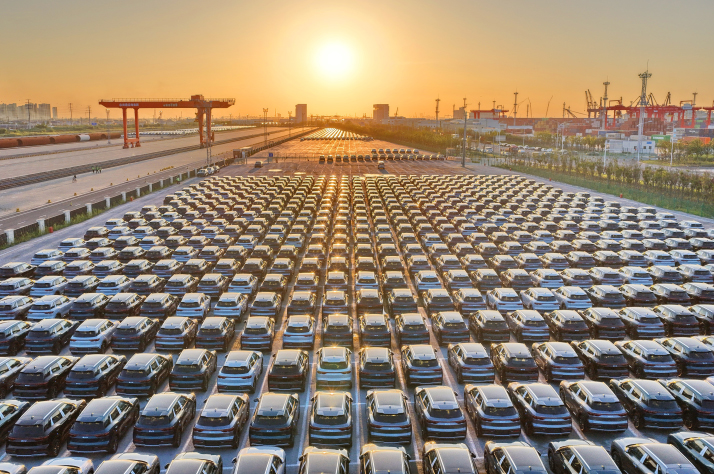 New-energy vehicles await shipment at the Yanglu Railway Logistics Base in Nantong, Jiangsu Province, on May 29 (XINHUA)
China's entry into the World Trade Organization in 2001 fueled a surge in low-cost manufactured exports, giving rise to what Western observers dubbed China Shock 1.0. In recent years, as China has emerged as a major player in electric vehicles (EVs), renewable energy, AI and other advanced industries, some commentators have revived the term under a new label: China Shock 2.0. In this telling, China's industrial upgrading is portrayed as a systemic "threat" to Western industrial leadership, economic security and even the rules-based international order. Viewed through the broader lens of economic development rather than zero-sum rivalry, China's industrial upgrading is a necessary step toward higher-income status, while its growing presence in advanced manufacturing, clean energy and AI simply mirrors its climb up the value chain. Far from undermining global prosperity, China's enhanced competitiveness fosters shared growth and mutual benefits for its global partners. A natural stage China's economic success has transformed the very foundations of its competitive edge. As the country has moved into the ranks of upper-middle-income economies, rising labor costs, stricter environmental standards and market-oriented reforms have steadily reduced the traditional cost advantages that once underpinned its export growth. Rather than weakening China's growth prospects, these evolutions have created strong incentives for industrial upgrading. For an economy of China's size, sustaining long-term growth and avoiding the middle-income trap, a situation where a country's economic growth slows after reaching middle-income levels as it loses the original advantages, require the cultivation of new competitive strengths rooted in innovation. China's industrial strategy for new competitive strengths is twofold. First, it is moving up the global value chain through sustained investment in research and development, strengthening technological capabilities and expanding into high-end equipment manufacturing, advanced components and intelligent systems. Second, it harnesses technological innovation to improve efficiency across entire industrial chains, leveraging its vast domestic market and comprehensive manufacturing ecosystem to reduce the cost of deploying advanced technologies without compromising performance. History shows that every economy that has successfully advanced to high-income status has undergone a similar industrial transformation. Some moved from labor-intensive industries to advanced manufacturing, while others shifted from low-value processing to technology-intensive production. China's industrial upgrading follows the same economic logic that has historically driven industrial transformation elsewhere. Framing this process as a deliberate "shock" simply disregards these broader realities of economic development. Effects of competition As Chinese industries continue to move up the value chain, the country's companies have entered sectors that were once dominated by advanced economies, including EVs, clean energy and AI. This inevitably creates pressure for established industry leaders and may accelerate industrial restructuring in some economies. But these adjustments are a defining feature of a competitive market economy. Competition rewards innovation, raises productivity and drives long-term industrial progress. In the latter half of the 20th century, automakers from newly industrialized economies entered mature markets with affordable and fuel-efficient vehicles. The resulting competition spurred traditional brands to innovate, improving vehicle efficiency and delivering better products to consumers. A similar dynamic is unfolding today in the global EV market. As Chinese EV manufacturers expand overseas, global auto giants have accelerated their electrification strategies. Models that were originally scheduled for later release have been brought to market sooner, while intensified competition has contributed to more competitive pricing. Consumers now have access to EVs with longer driving ranges, smarter features and lower prices. The clean energy sector presents an even clearer demonstration of competition's positive effects. For many years, the global photovoltaic industry was dominated by a limited number of manufacturers from developed countries, and high production costs constrained the deployment of renewable energy in many countries. As Chinese companies improved manufacturing technologies and expanded production capacity, the efficiency of the entire industry increased greatly. The cost of solar modules fell dramatically, enabling renewable energy to compete with fossil fuels. Rather than undermining the global solar industry, Chinese competition supercharged the market, creating new opportunities for businesses across the entire value chain. The same logic applies to AI. Chinese companies have made notable progress in applying this transformative technology to industrial manufacturing, autonomous driving, smart energy systems and other specialized sectors. Their efforts have helped shift global attention from an exclusive focus on general large model parameter competition toward practical and real-world applications capable of generating economic value. Competition among firms operating in different markets and application scenarios has accelerated the commercialization of AI solutions while reducing deployment costs. As implementation becomes more affordable, digital transformation is increasingly within reach not only for large corporations but also for small and medium-sized enterprises. Worldwide benefits China's industrial upgrading benefits businesses and consumers in both developed and developing economies. China's highly integrated supply chains for batteries, electric drive systems, intelligent cockpits and autonomous driving components have substantially reduced EV manufacturing costs. Many international automakers have begun sourcing batteries and key components from Chinese suppliers to improve the cost-effectiveness of their own models. In clean energy, China has become a leading supplier of solar panels, wind turbines and energy-storage batteries. Its large-scale and efficient manufacturing has lowered the cost of renewable energy technologies, enabling many developing countries to build domestic renewable energy systems within years rather than decades. As a result, they are better positioned to accelerate the transition to clean energy without following the lengthy and carbon-intensive path once taken by many advanced economies. Chinese companies have also contributed to lowering the cost of large-scale computing through advances in data center technologies and intelligent computing systems. As AI infrastructure becomes more affordable, more countries, including smaller and developing economies, are able to invest in digital capabilities and participate in the growth of the digital economy. China's industrial upgrading also creates new market opportunities. As its industries move up the value chain, imports of advanced components, specialized materials and high-end manufacturing equipment has grown accordingly. The rapid expansion of China's EV industry, for example, has generated strong demand for products ranging from automotive chips to high-performance materials, creating new business opportunities for suppliers across global value chains. On the other hand, as Chinese manufacturers establish production facilities abroad, they increasingly localize their supply chains by purchasing components, materials and services from host-country suppliers. In many markets, localized procurement has become an important feature of Chinese manufacturing investment, supporting the development of domestic supplier networks while creating employment opportunities. Across renewable energy projects in Africa, Southeast Asia and other developing regions, Chinese companies provide more than just equipment and technology; they also contribute to engineering services, infrastructure construction, operations and maintenance, and labor training. These investments help build industrial capabilities that previously did not exist, laying the foundation for long-term economic development rather than simply delivering finished products. Beyond the 'threat' narrative Framing China's industrial upgrading as a threat reflects a static and incomplete view of economic competition. It fixates on short-term pressures while ignoring the broader, longer-term benefits that technological progress and market competition bring to the global economy. Economic history offers a consistent lesson: Open competition does not inevitably produce zero-sum outcomes. More often, it raises productivity, accelerates innovation and increases shared benefits. A more constructive response to China's industrial upgrading lies not in erecting trade barriers but in adapting to the shifting global value chains. Advanced economies can continue to build on their strengths in frontier research, high-value brands and core software development, while complementing these advantages with China's manufacturing capabilities and large-scale application of new technologies. Developing countries, meanwhile, can leverage China's green technologies and industrial expertise to build their own emerging industries, enabling them to pursue a more sustainable path to growth without repeating the carbon-intensive trajectory followed by earlier industrializers. As the world navigates the twin transitions toward carbon neutrality and digitalization, no country can meet the growing global demand for green technologies and digital innovation on its own. China's industrial upgrading is not a threat to the global economy, but an important source of innovation, efficiency and growth that can help advance a more sustainable and prosperous future for all. BR The author is a professor at the School of Economics and director of the National Center for Economic Research, Peking University Copyedited by G.P. Wilson Comments to zhangshsh@cicgamericas.com |
|
||||||||||||||||||||||||||||
|