
|
| Voice |
| Europe and China: From trading partners to industrial partners | |
|
|
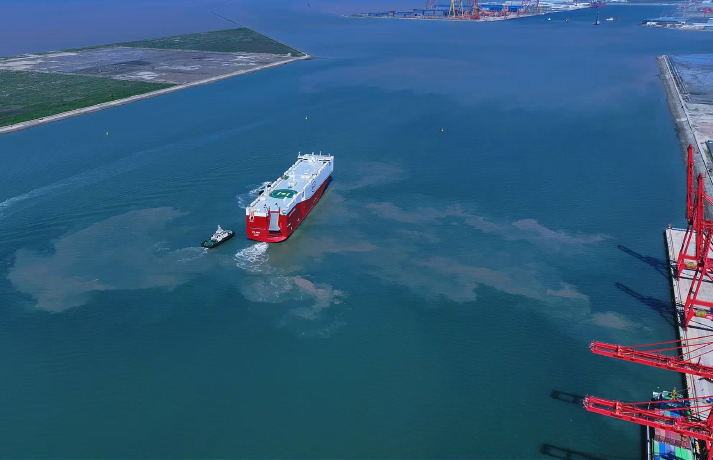 A vessel carrying BYD vehicles sets sail from Nantong Port in Jiangsu Province for Europe on May 31 (XINHUA)
The latest statistical reports offer an important insight into the evolving economic relationship between China and Europe. Chinese foreign direct investment (FDI) in the European Union and the United Kingdom increased by 67 percent in 2025, reaching 16.8 billion euros ($19.1 billion)—the highest level since 2018. It was the second consecutive year of growth, signaling that Europe has become one of the most important destinations for Chinese capital among developed economies. The significance of these figures extends beyond the investment totals themselves. They reveal a deeper transformation in how Chinese companies engage with international markets and in how Europe is responding to China's growing economic influence. Chinese investment upgrade Over the past decade, China has undergone a remarkable industrial upgrade. Chinese enterprises are no longer competing on labor costs. Instead, they are increasingly active in advanced manufacturing, electric vehicles, batteries, renewable energy equipment, digital technologies and consumer brands. As these industries mature, Chinese companies naturally seek greater access to global markets, particularly developed economies with strong purchasing power and advanced technological ecosystems. Europe occupies a unique position in this strategy. The European market is large, affluent, technologically sophisticated and comparatively open to foreign investment. As Chinese investment in the United States remains constrained by geopolitical tensions and regulatory barriers, Europe has become the most attractive developed-market destination for Chinese firms seeking long-term growth opportunities. Greenfield investment remained the largest channel of Chinese investment in Europe, reaching a record 8.9 billion euros ($10.12 billion) in 2025. At the same time, mergers and acquisitions rebounded strongly, rising 89 percent to 7.9 billion euros ($8.98 billion). This combination suggests that Chinese firms are pursuing a balanced approach: building new industrial capacity while also acquiring strategic assets, brands, technologies and market access. One of the most important trends is the continued dominance of the automotive sector. Chinese investment in European automotive projects reached 7.6 billion euros ($8.64 billion) in 2025, accounting for nearly half of total Chinese investment in Europe. Most of this activity is concentrated in the electric vehicle supply chain, including battery manufacturing and related technologies. Hungary remains the leading recipient of Chinese investment, attracting 3.9 billion euros ($4.43 billion) in 2025. The country has successfully positioned itself as a major European hub for battery production and electric vehicle manufacturing. Major projects by companies such as CATL, BYD and Sunwoda have transformed Hungary into a strategic bridge between Chinese industrial capabilities and European consumers. However, the geographical distribution of Chinese investment is becoming more diversified. Germany and France both received substantial increases in Chinese investment during 2025. Germany attracted 2.5 billion euros ($2.84 billion), while France received 1.9 billion euros ($2.16 billion). This development suggests that Chinese firms increasingly recognize the value of establishing a presence in Europe's largest economies, where industrial expertise, consumer demand and innovation ecosystems remain highly attractive. Europe's paradox At the same time, an interesting paradox is emerging. While Chinese investment in Europe continues to grow, Chinese exports to the continent are expanding even faster. Chinese exports to Europe increased by 9 percent in value in 2025. Exports of batteries rose by 43 percent in value and 65 percent in volume, wind power equipment by 15 percent in value and 29 percent in volume, and automobiles by 15 percent in value and 29 percent in volume. This trend highlights an important reality. For many Chinese companies, exporting remains more attractive than investing. Several factors explain this preference. First, China's industrial base remains highly competitive. Second, domestic production capacity in sectors such as batteries, electric vehicles and renewable energy equipment is substantial. Third, the depreciation of the yuan has enhanced the competitiveness of Chinese exports in international markets. As a result, Chinese firms increasingly pursue a dual-track internationalization strategy. They invest selectively in strategic locations while continuing to rely heavily on exports to serve overseas demand. This approach allows companies to maintain flexibility while minimizing investment risks in an increasingly uncertain global environment. European policymakers are responding with a mixture of openness and caution. On one hand, Europe requires investment to support industrial modernization, green energy development and economic growth. Chinese companies bring capital, technology, manufacturing expertise and employment opportunities. On the other hand, concerns regarding economic security, supply chain dependence, technology transfer and industrial competitiveness have led to growing regulatory scrutiny. The European Union has strengthened its foreign investment screening mechanisms and is exploring new industrial policies to encourage greater localization of production. Some policymakers advocate linking market access to local employment, technology transfer and domestic value creation. Such measures reflect broader concerns about maintaining Europe's industrial sovereignty in a rapidly changing global economy. Nevertheless, Europe faces a strategic dilemma. Excessive restrictions on Chinese investment may not necessarily reduce China's economic presence. Instead, they could encourage Chinese firms to rely even more heavily on exports from domestic production facilities. In such a scenario, Europe would continue to import Chinese products while receiving fewer benefits from local investment, including employment, tax revenues and technological cooperation. Looking ahead, the future trajectory of Chinese investment in Europe will depend on several factors. Domestic economic conditions in China, exchange-rate developments, European regulatory policies and broader geopolitical dynamics will all play important roles. However, one conclusion appears increasingly clear: Economic ties between China and Europe remain deep, resilient and mutually significant. The relationship is evolving from one primarily based on trade to one increasingly characterized by industrial integration, technological cooperation, and strategic investment. Despite political debates and regulatory adjustments, economic realities continue to create powerful incentives for engagement. The growth of Chinese investment in Europe in 2025 demonstrates that globalization is not disappearing. Rather, it is entering a new phase—one in which capital, technology, and industrial capabilities are being reorganized around emerging centers of economic strength. China is now one of those centers, and Europe remains one of its most important partners. The author is former prime minister of Kyrgyzstan, a distinguished professor at the Belt and Road School of Beijing Normal University and author of the book Central Asia's Economic Rebirth in the Shadow of the New Great Game (2023) Copyedited by G.P. Wilson Comments to dingying@cicgamericas.com |
|
||||||||||||||||||||||||||||
|