|
| Voice |
| A historic turning point | |
|
|
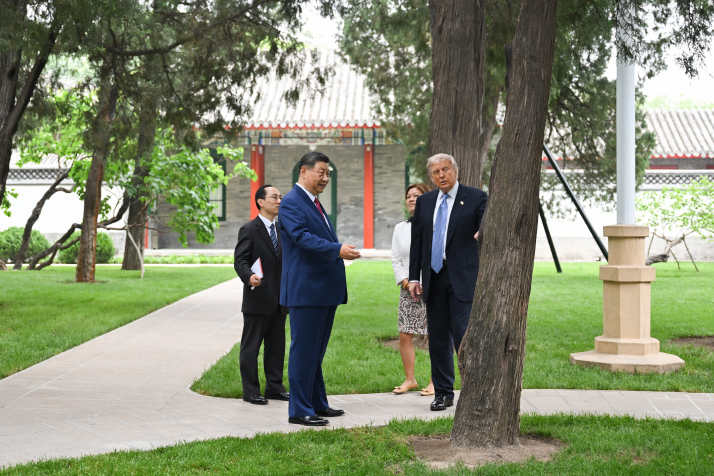 Chinese President Xi Jinping and U.S. President Donald Trump at the Zhongnanhai leadership compound in Beijing on May 15 (XINHUA)
U.S. President Donald Trump's recent state visit to China was far more than a routine high-level diplomatic engagement. It was a joint effort by China and the United States to move bilateral relations away from unrestrained competition and toward what Chinese President Xi Jinping has described as "a constructive China-U.S. relationship of strategic stability." This concept is rooted in pragmatic realism. It neither denies the existence of competition nor surrenders to it. Instead, it seeks to regulate competition, manage differences and preserve the possibility of mutually beneficial cooperation between the world's two most important major countries. The timing of the meetings between President Xi and President Trump on May 14 and 15 was particularly critical. In recent years, China-U.S. relations have gone through one of their most difficult periods since diplomatic ties were established in 1979. The real danger lies not simply in the existence of differences, but in the possibility that both sides interpret each other's actions through the most hostile lens, creating a vicious cycle of suspicion and escalation. Against this backdrop, the questions raised by President Xi were clear and direct: Can China and the United States overcome the Thucydides Trap and create a new paradigm of major-country relations? Can they meet global challenges together and provide greater stability for the world? Can they build a bright future together for our bilateral relations in the interest of the wellbeing of the two peoples and the future of humanity? The weight of the phrase "constructive strategic stability" lies in the fact that it opens a middle path between two extremes. One is naive optimism that pretends structural competition does not exist. The other is fatalistic confrontation, which assumes that a rising China and an established United States are destined to collide. China's approach rejects both. The constructive strategic stability it advocates is positive stability with cooperation as the mainstay, healthy stability with competition within proper limits, constant stability with manageable differences, and lasting stability with expectable peace. Moving beyond competition The meetings between the two heads of state may become an important turning point in the history of China-U.S. relations. Of course, expecting a single summit to resolve every dispute would be unrealistic. But transformation in major-country relations often begins not with the elimination of all conflicts, but with the establishment of strategic guidance and political guardrails. If both sides can recognize the need for a broader strategic framework for the relationship in the years ahead, then mechanisms covering areas including high-level dialogue, crisis management, economic consultation and military communication can be restored and strengthened, and the meetings have already laid part of that foundation. The atmosphere surrounding the summit was shaped by years of friction. During Trump's first presidential term (2017-21), Washington shifted toward tougher trade pressure and strategic competition. The subsequent Joe Biden administration (2021-25) further institutionalized the view of China as the only competitor with both the intent and the capability to reshape the international order. Now, during Trump's second term, although the rhetoric has evolved, Washington continues to place strong emphasis on reciprocity, industrial strength, tariffs, supply-chain security and Indo-Pacific deterrence. This broader context both underscores the difficulty of the Beijing meetings and explains why they were necessary. China and the United States are unlikely to return to the earlier era of simple engagement. Nor are they destined to enter a new Cold War. The real task before both countries is to construct a more mature model of coexistence, one in which differences remain normal but crises are not inevitable; competition remains real but war is not destiny; and cooperation, though selective, continues to carry substantive meaning. Core bilateral issues Current discussions are centered on three major areas. The first is trade and economic relations. President Xi stressed that China-U.S. economic and trade ties are mutually beneficial in nature. The two economies remain deeply interconnected through markets, investment, supply chains and beyond. The tariff wars initiated by the U.S. and its attempts to decouple from China may generate short-term political gains, but they inflict enduring costs on U.S. businesses and consumers, as well as global markets. During the talks, President Xi noted that the economic and trade teams of both countries had produced generally balanced and positive outcomes. The announcement carries important significance, helping restore confidence and stabilize market expectations. The second area is technology. The United States seeks to preserve what it views as critical technological advantages, while China is determined to safeguard its legitimate right to development and resist technological containment. A comprehensive solution will not be easy. But at a minimum, both sides can work to distinguish genuine national security concerns from the over-expansion of economic suppression. If all advanced technology becomes securitized, normal trade and innovation will inevitably suffer. The third area is security. Xi made clear that the Taiwan question is the most important issue in China-U.S. relations and warned that mishandling it could place the entire relationship in great jeopardy. The Taiwan question relates to China's sovereignty and territorial integrity. For both countries, the only responsible approach is one of restraint: avoiding provocative actions, maintaining communication channels and preventing the Taiwan question from becoming a trigger for direct confrontation. Global implications The Middle East, in particular, will pay close attention to the summit between the Chinese and U.S. presidents. The region is not a bystander in China-U.S. relations. Rather, it sits at the intersection of energy security, maritime routes, infrastructure investment, financial flows, military presence and diplomatic mediation. If China-U.S. relations deteriorate sharply, countries in the Middle East could face growing pressure to choose sides, especially in areas such as technology standards, port operations, energy infrastructure, digital systems and security partnerships. By contrast, a more stable bilateral relationship would provide the region with greater diplomatic space and a more predictable global environment. In recent years, China has expanded its presence in the Middle East through trade, energy cooperation, infrastructure development and political dialogue. The United States, meanwhile, remains the region's principal security actor. Neither side can address the Middle East's crises alone. If Beijing and Washington can effectively manage their competition, they may at least avoid turning the Middle East into another arena for zero-sum rivalry. The fact that the two leaders exchanged views on issues such as the Middle East situation, the Ukraine crisis and the Korean Peninsula further demonstrates that the impact of China-U.S. relations extends far beyond the Pacific. From the American perspective, Trump's objectives during the visit can largely be summarized in three areas: demonstrating to U.S. voters that he can secure better economic deals; seeking Chinese cooperation, or at minimum restraint, on global and regional crises; and stabilizing bilateral relations so they do not disrupt his domestic agenda. Although Trump's approach is often transactional, that does not mean its significance is limited. Transactional diplomacy can sometimes create room for pragmatic compromise, particularly in trade, investment, agriculture, energy and business cooperation. For China, the priority is strategic predictability, respect for core interests, especially the Taiwan question, a more stable trade and technology environment, and a bilateral framework capable of preventing competition from sliding into confrontation. Beijing does not expect Washington to abandon competition altogether. But it does expect the United States to compete within proper limits, avoid crossing red lines and recognize that cooperation with China is necessary for global stability rather than a form of concession. The real test of this visit will lie in what follows afterward. "Constructive strategic stability" must ultimately be translated into working mechanisms: regular high-level dialogue, restored military communication, substantive economic consultations, cooperation on global issues and disciplined management of disputes. In this sense, the Beijing meetings between the Chinese and U.S. presidents should be viewed neither as a final solution nor merely as a symbolic reset. Rather, they marked the beginning of a new phase: one in which both countries acknowledge their differences while placing greater emphasis on the significance of their shared responsibilities. For the Middle East, the Global South and the wider international community, that is a welcome development. The author is a research fellow at the Huazhong University of Science and Technology's Institute of State Governance Copyedited by G.P. Wilson Comments to dingying@cicgamericas.com |
|
||||||||||||||||||||||||||||
|