|
| Voice |
| Piloting 'constructive strategic stability' | |
|
|
|
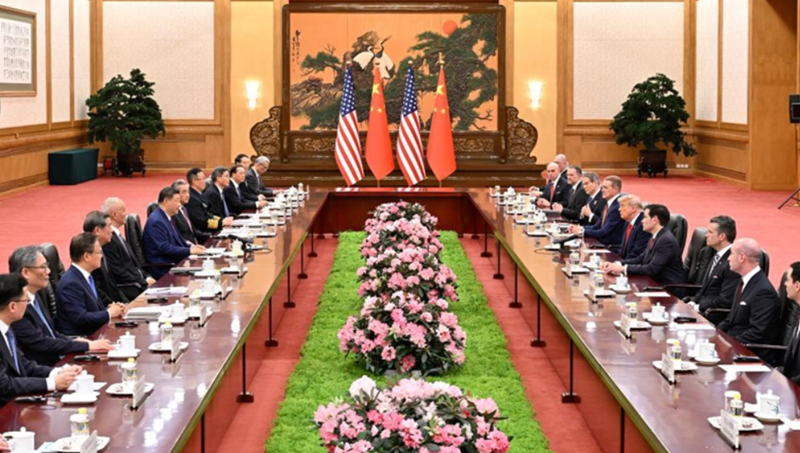
Chinese President Xi Jinping holds talks with U.S. President Donald Trump, who is on a state visit to China, at the Great Hall of the People in Beijing, capital of China, May 14, 2026. (XINHUA) The mid-May meetings between U.S. President Donald Trump and Chinese President Xi Jinping were an important moment in the broader history of U.S.-China relations. High-level meetings do not have to be transformative to be important. The most recent sessions serve a different purpose: reinforcing a pattern of sustained leader-level engagement between Washington and Beijing aimed at stabilizing relations, even amid continuing deep disagreements on several matters. Avoidance of contact, as happened in the COVID-19 years, can make the relationship vulnerable to mistrust and heightened geopolitical volatility. The fact that the two leaders met again--and appeared comfortable pursuing practical, limited areas of cooperation while managing differences--is a positive signal for the global economy and international stability. The tone set by President Xi and President Trump seems exceptionally positive. "Constructive strategic stability" appears to be the new moniker for the relationship that China intends to use going forward. The resulting atmosphere of stability, reflected in the presence of a large delegation of top American executives, is good news for businesses on both sides of the Pacific. The two leaders appear to seek stability for the coming year, if not throughout President Trump’s remaining time in office. The summit also demonstrated concrete progress on trade and commercial cooperation. Talks and agreements touched on commercial purchases, tariff reductions and export controls, while the business delegation accompanying Trump spanned sectors including technology, finance and industrials. Discussions surrounding structured future engagement, including a new “Board of Trade,” were particularly notable. If designed effectively, such mechanisms could help create more regularized channels for managing disputes and identifying areas of mutual economic interest. At the same time, these frameworks carry risks if they fail to deliver tangible outcomes, create unrealistic expectations, or increase distrust. It was also quite striking that there was public discussion by the White House of resuming a more open U.S. stance toward Chinese business investment in the United States, something that has been missing in recent years. Moreover, senior U.S. officials referenced the shared responsibility of the United States and China to ensure that the rapid development of artificial intelligence does not pose a threat to our economies or societies. This seems truly timely and important. Of course, it remains to be seen whether stability will truly prevail in U.S.-China relations and, if so, to what extent. Both governments are pursuing policies intended to strengthen their respective positions, and in America’s democracy there are many voices that remain fundamentally suspicious of China’s intentions. Neither side approached the mid-May events expecting a transformational reset. Instead, the focus was on preserving dialogue, reducing the risk of misunderstanding, and demonstrating that competition does not preclude cooperation. If one were to choose a single measure of progress, it would be whether the two sides make good on President Trump’s invitation to President Xi for a visit to Washington, D.C., in the fall. Such a visit would be deeply symbolic, and likely substantively important, perhaps more so than possible sideline engagements surrounding the APEC meeting in Shenzhen and the Group of 20 meeting in Florida later this year. Kurt Tong is a managing partner at The Asia Group, a Washington-based firm that helps companies excel across Asia with integrated strategies and solutions, former U.S. ambassador to APEC, and former U.S. consul general and chief of mission in Hong Kong and Macao. Tong is also an organizer of the China-America Student Conference, a student exchange program. Henry Wessel is an associate at The Asia Group Copyedited by G.P. Wilson Comments to taoxing@cicgamericas.com |
|
||||||||||||||||||||||||||||||
|