|
| Voice |
| The heavy price of Panama's seizure of key ports | |
|
|
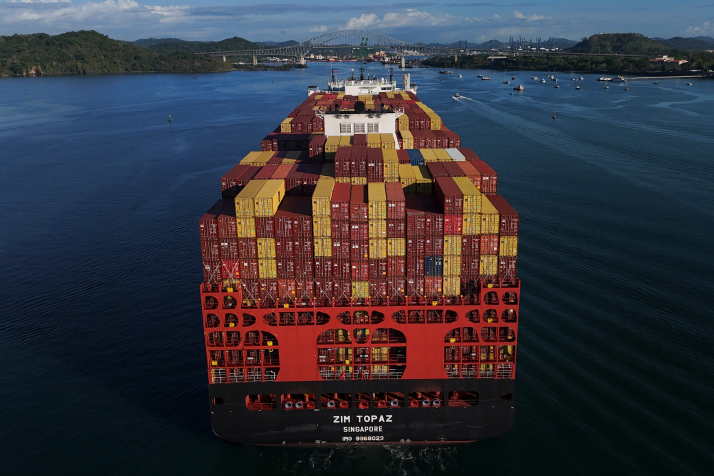 A cargo ship moves through the Panama Canal on March 24 (VCG)
In January, Panama's Supreme Court ruled that the decades-long concession held by Hong Kong-based CK Hutchison Holdings for operating Balboa and Cristóbal ports, located at each end of the Panama Canal, was unconstitutional. On February 23, the Panamanian government moved to take control of the two ports and sought to bring in Western shipping giants as replacements. This unilateral termination of a long-standing agreement has been a violation of contractual principles and a blow to Panama's international credibility. In response, CK Hutchison initiated international arbitration, seeking compensation for economic losses. The fallout set off a chain reaction, as some Chinese enterprises adjusted or temporarily scaled back their shipping and infrastructure activities in Panama in response to the evolving situation, adding to the country's economic challenges. Why the takeover Behind the port dispute lies not only Panama's own policy calculus, but also long-standing U.S. strategic interest in the Panama Canal and mounting external pressure. As a global trade hub, the canal is Panama's economic lifeline, handling over 5 percent of global maritime trade and connecting more than 170 countries and regions. The ports at Balboa (Pacific side) and Cristóbal (Atlantic side) serve as critical nodes supporting the canal's operations. For the United States, the canal also carries deep historical and strategic significance. In 1903, the U.S. supported Panama's separation from Colombia and secured control over the canal zone through an unequal treaty, granting itself rights to "permanent use, occupation and control." For nearly a century, Washington maintained firm control, using the canal for both economic gain and military projection, including establishing a regional command presence. Only in December 1999 did Panama fully regain sovereignty over the canal following decades of struggle. Despite this, debates within the U.S. over the canal's transfer have persisted. In recent years, the canal's importance has expanded beyond economics and defense into broader geopolitical competition over global trade routes. Donald Trump publicly criticized the decision to return the canal as "foolish" and repeatedly suggested reasserting U.S. control. He accused Panama of overcharging U.S. vessels and claimed the canal remained a vital U.S. asset, even warning of efforts to "take it back." Such statements drew strong objections from Panama. Against this backdrop, Panama's decision to revoke the concession and take over the ports—under the pretext of unconstitutionality—is widely viewed as a concession to external pressure. A subsidiary of Hong Kong-based CK Hutchison Holdings signed a 25-year concession agreement with the Panamanian government in 1997. After its expiration in 2010, the contract was automatically renewed for another 25 years in accordance with its terms. Yet in 2026, it was abruptly nullified, and Panama moved to replace the operator with companies including A.P. Moller-Maersk and Mediterranean Shipping Co. Consequences Panama's unilateral move has produced serious repercussions across its economy. Chinese enterprises responded with legal and operational measures, while Chinese authorities reaffirmed support for protecting corporate rights. Within weeks, the crisis spread beyond the shipping sector to the broader national economy, prompting Panama to request that Chinese companies resume operations. The risks are substantial. CK Hutchison has filed for arbitration at the International Chamber of Commerce, seeking over $2 billion in damages—equivalent to roughly one eighth of Panama's annual fiscal revenue. If Panama loses, it could face heavy financial burdens and potential asset freezes. Investor confidence has also been shaken. Major firms—including COSCO Shipping and China Communications Construction affiliates—have scaled back operations. On March 12, COSCO suspended routes at Balboa Port and withdrew empty containers. In global shipping, empty containers are essential to maintaining logistics cycles; without them, cargo flows stall. Within days, port activity declined sharply, and Panama appealed for a reversal. The ripple effects have also extended into infrastructure. Projects such as the fourth bridge over the canal, cruise terminal developments and metro lines were delayed or suspended. Meanwhile, international rating agencies downgraded Panama's sovereign credit rating, raising borrowing costs and deterring future investment. Financial institutions warned that short-term decisions risk turning Panama from an "international financial hub" into an "investment risk zone." Another consequence has been damage to the reputation of Panama's shipping registry. A number of Panamanian-flagged vessels were detained due to safety and compliance issues, prompting ship owners to reconsider registration. Ship registration is one of Panama's key revenue sources, second only to canal transit fees, generating hundreds of millions of dollars annually. As confidence in the registry weakens, new vessel registrations have reportedly dropped sharply, with more than 200 ships applying to change their registration. Measures introduced by Panama, such as lowering registration fees and simplifying procedures, have so far had limited effect. A broader warning The port dispute highlights deeper structural issues in global governance and international cooperation. It underscores the importance of contract credibility and stable investment environments in an era of interconnected supply chains. Over recent decades, globalization has integrated value chains across borders. China now contributes over one third of global economic growth and is the largest trading partner for more than 100 countries and regions. Even amid calls for "decoupling," economic interdependence remains strong. For a trade-dependent economy like Panama, disrupting established cooperation under external pressure carries significant costs. The episode also reflects shifting geopolitical dynamics in Latin America. While the U.S. continues to exert influence, regional countries are increasingly pursuing diversified partnerships. Attempts to frame cooperation through ideological or security narratives have met mixed responses. Panama's actions, seeking to balance external pressure with economic realities, illustrate the difficult choices smaller states face in great-power competition. Yet the consequences also demonstrate the risks of undermining long-term development for short-term considerations. At its core, the principle of honoring contracts remains fundamental to international economic cooperation. The Panama Canal is a vital artery of global trade, and its supporting infrastructure relies on trust, investment and stability. Unilateral actions that weaken these foundations not only harm partners but also erode a country's own credibility. For businesses and governments alike, the lesson is clear: Sustainable development depends on openness, cooperation and respect for mutually agreed rules. In a rapidly evolving global landscape, abandoning these principles may bring immediate gains, but at the cost of long-term stability and trust. The author is an assistant research fellow at the Institute of Latin American Studies, Chinese Academy of Social Sciences Copyedited by G.P. Wilson Comments to dingying@cicgamericas.com |
|
||
|
||||||||||||||||||||||||||||
|