
|
| Voice |
| When minds meet machines | |
|
|
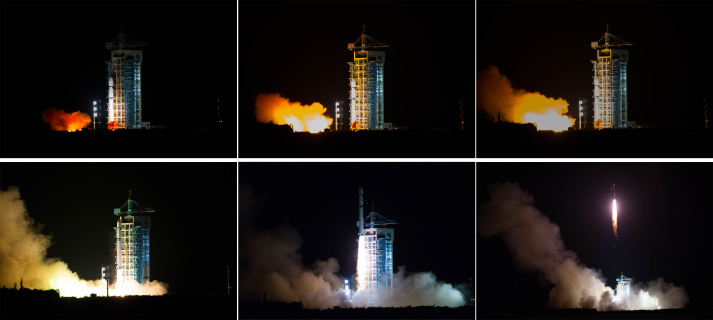 China launches the world’s first quantum satellite on a Long March-2D rocket from the Jiuquan Satellite Launch Center in Jiuquan, Gansu Province, on August 16, 2016 (XINHUA)
Imagine a world where a person, gradually robbed of the ability to move or speak by a condition like amyotrophic lateral sclerosis (ALS), finds even the simplest communication an impossible dream. Now, imagine a technology breaking those invisible chains, rekindling the light of hope for life itself. This is not science fiction, but today's reality. NorthBrain-1, a major brain science and brain-computer interface (BCI) research platform independently developed in China, has successfully enabled a 67-year-old ALS patient to "type with his mind" and synthesize speech. By establishing a direct information pathway between the human brain and external devices, the system decodes neural signals and translates thoughts into action. Cai Lei, a former vice president of Chinese e-commerce platform JD.com who has been fighting ALS for six years and is now in its advanced stages, has dedicated himself to advancing research into the disease and inspiring fellow patients worldwide, constituting an additional front in this quiet revolution. In the coming year, his team plans to actively collaborate with pioneers in BCI, embodied AI and other cutting-edge technologies to alleviate the tremendous physical, emotional and financial burdens shouldered by ALS patients and their families. What once belonged solely to the realm of science fiction work—mind control, digital life—is now, powered by the rise of future industries, entering our lived reality step by step. Science fiction to social good The contours of this new industrial era are coming into sharp focus. More than just a strategic choice for long-term national competitiveness, future industries are, through tangible technological breakthroughs, increasingly intertwined with the health, convenience and dignity of ordinary people. As China now embarks on its 15th Five-Year Plan (2026-30), a closer examination of these industries helps to better understand how they are poised to profoundly reshape tomorrow's production and lifestyles, and what new dynamism they may inject into economic and social progress. So, what exactly are "future industries?" In simple terms, they are industrial sectors driven by frontier science and technology, currently in the embryonic or early-growth stages, yet with the immense potential to fundamentally transform how we live and work in the future. The most prominent characteristic of future industries lies in their cutting-edge nature and disruptive potential. BCI and bio-manufacturing, for instance, hold the promise of greatly improving the quality of life and rehabilitation for patients with certain diseases and individuals with disabilities—helping the paralyzed to "move" and people with speech impairments to "speak." Embodied-intelligence robotics turns AI from a chat window into physical agents that grasp commands, sense environments and carry out tasks. Such robots can integrate deeply into home and elderly-care scenarios, providing hands-on assistance like turning patients over or administering medication with precision. A strategic engine Simultaneously, future industries serve as an engine for China to secure a commanding position in global technological and industrial competition. In October 2025, the Communist Party of China Central Committee released its recommendations for formulating the 15th Five-Year Plan, explicitly identifying "fostering emerging industries and future industries" as a core task in building a modernized industrial system and reinforcing the foundations of the real economy. It prospectively laid out six key directions: quantum technology, bio-manufacturing, hydrogen and nuclear fusion power, brain-computer interfaces, embodied intelligence, and 6G mobile communications. Developing future industries is essential for gaining a competitive edge in science, technology and industry, taking the initiative in development, developing new quality productive forces, modernizing the industrial system, raising living standards and advancing balanced human and social progress. (The term "new quality productive forces" describes an economic shift toward innovation-driven growth, advanced technology and high-quality, sustainable development across all sectors—Ed.) Multiple frontiers, booming innovation China's future industries are blossoming across multiple fronts, positioned at a critical juncture—transitioning from technological catch-up to forward-looking deployment, and from blueprint drawing to translating measures into practice. In the field of humanoid robotics, China has built a complete industrial chain, with embodied intelligence entering a stage of large-scale application. A leading example is AgiBot (Zhiyuan Robotics), a firm specializing in AI-driven general-purpose humanoid robots and embodied intelligence, which recently rolled out its 5,000th mass-produced robot. By the end of 2025, humanoid robots had been deployed in industrial scenarios across over 20 Chinese provincial-level regions, with inspection efficiency improved by more than 60 percent compared to human labor. Brokerage firm Orient Securities estimates that the initial market scale for their industrial application alone will exceed 1 million units. China is among the world's leaders in quantum communication and quantum computing. Facilities such as the Synergetic Extreme Condition User Facility at Beijing Huairou Science City provide strong support for scientific breakthroughs. A key advantage of quantum communication lies in its theoretically unhackable security. China has not only developed a 300-km fully connected quantum direct communication network, but also built the world's first long-distance quantum-secured communication route—the Beijing Shanghai Backbone Network—turning the science fiction idea of "unbreakable communication" into reality. China's approach to developing future industries has never been about working behind closed doors. It consistently upholds the philosophy of open cooperation and shared development. Over the next five years, as technologies across these frontier tracks continue to break through, combined with China's complete industrial system and vast market, the transition of scientific achievements from the laboratory to the production line and into everyday life is set to accelerate. This will also foster an upgrade of global supply chains from cost-oriented to innovation-oriented. Looking further ahead, the country's proactive efforts and innovative achievements in the realm of future industries will inject strong momentum into its own high-quality development. Simultaneously, they are set to contribute fresh energy to optimizing the global landscape of scientific and technological governance and bolstering world economic growth. The future, it seems, is not something we wait for—it is something we build, one connection, one breakthrough, one life transformed at a time. BR The author is an associate research fellow with the Beijing Economic and Social Development Research Institute/Beijing Development and Reform Policy Research Center Copyedited by Elsbeth van Paridon Comments to taozihui@cicgamericas.com |
|
||||||||||||||||||||||||||||||
|