|
| Governance |
| Clean governance as economic infrastructure | |
|
|
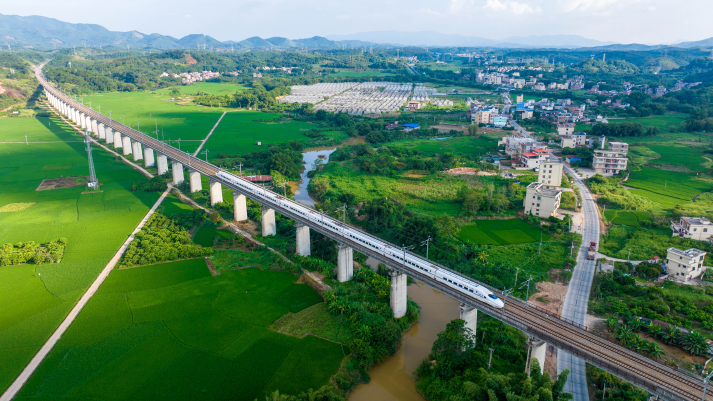 A high-speed train travels through farmlands in Wuzhou, Guangxi Zhuang Autonomous Region, on September 7 (XINHUA)
The Fifth Plenary Session of the 20th Communist Party of China (CPC) Central Committee, held in Beijing in late October, put one question at the center of its agenda: How a party of more than 100 million members keeps its own conduct equal to the tasks it sets for the country. Chinese President Xi Jinping, also General Secretary of the CPC Central Committee, delivered a work report on behalf of the Political Bureau, which is elected by the Central Committee's plenary session and consists of the Party's highest-ranking officials. He also explained a draft decision, which the session adopted on October 29 as the Resolution of the CPC Central Committee on Certain Major Issues Concerning Persevering With Full and Rigorous Party Self-Governance. The timing matters. The session comes in the first year of the 15th Five-Year Plan period (2026-30), the period that prepares China to largely achieve socialist modernization by 2035. Read in that setting, the plenum's main message was that the quality of governance is an economic input. The Political Bureau noted in July that Party self-governance has advanced markedly since 2012, and that changes in the world, in China and within the Party bring new difficulties. It called for higher standards and more concrete measures to resolve prominent problems of Party building. That is the language of a leadership attentive to how well plans are carried out. The communiqué issued by the plenum on October 29 points the same way. It calls the strengthening of Party regulations the long-term and fundamental measure of rigorous self-governance, and it closes its economic section with the aim of meeting this year's main targets and making a good start to the 15th Five-Year Plan. Matching words with actions The first channel from clean governance to economic performance is implementation. A five-year plan is carried out by local officials, and it arrives as intended only if they do what the center decides. The emphasis on matching words with actions reflects this. The communiqué reflects this when it asks for an organizational system characterized by cross-level alignment and effective implementation, so that national decisions are carried out in a coordinated, targeted and efficient way. In January, the Central Commission for Discipline Inspection (CCDI), the Party's top discipline watchdog, tied political oversight directly to the strategic tasks of the new plan: high-quality development, a modern industrial system, new quality productive forces, a unified national market and the reduction of local government debt risks. Each of these tasks depends on how local officials behave. A unified national market requires officials to resist protecting local firms. Debt control requires transparent project selection. Building new quality productive forces requires fair procurement and honest distribution of subsidies. "New quality productive forces" refer to the shift toward innovation-driven growth, technological advancement and high-quality development in different sectors of the economy. The second channel is predictability. Firms and households plan around rules. Corruption replaces rules with connections. The communiqué asks for stronger enforcement of institutions and a determined effort to eliminate "hidden rules." The January CCDI session called for tough scrutiny of collusion between officials and businesspeople and named finance, state-owned enterprises and energy among the priority sectors. Lower friction in those fields reduces the cost of doing business in a way that no tax measure can. The enforcement record shows where the work happens. In 2025, discipline and supervision organs opened 1.01 million cases. Of these, 137,000 concerned officials at township or section level, and another 91,000 concerned village Party branch secretaries and villagers' committee heads. Economic friction is felt at the grassroots, and the grassroots is where the effort is concentrated. The third channel is the one most often missed: Efficiency means the absence of paralysis as well as the absence of bribes. A campaign against corruption can make officials cautious, and a cautious official may delay a good project as readily as a bad one. The system's answer is to treat inaction and formalism as violations as well. The Regulations on Disciplinary Action, most recently revised in December 2023, address arbitrary decisions and burdens placed on grassroots work. The Party considers the correction of formalism (or doing things for show rather than substance, one of the "Four Malfeasances" targeted by Party discipline) and extravagance (another malfeasance) a long-term task. The fifth plenum communiqué restates the formula that advancing the three—ensuring officials do not have the audacity, opportunity or desire to commit corruption—together is the basic policy of the anti-corruption struggle, and it keeps the posture of strict punishment of corruption. It also asks that newly appointed leading groups, and their top leaders in particular, be trained to seek results for the people through practical work. The goal is to have an official who dare not, cannot and does not want to be corrupt, and who is also willing to act. Sustaining institutionalization This is possible because the effort has been institutionalized. The communiqué names two answers to the old cycle of order and disorder: letting the people supervise the government, and the Party's self-reform. Earlier generations of rectification came in waves, tied to a crisis and to the attention of the leadership. Since 2012, the Party has built durable institutional scaffolding: the Eight Rules on official conduct, the Regulations on Disciplinary Action, revised three times, and the 2018 Supervision Law, amended in December 2024. A standard that outlasts any one leader's attention is exactly the kind of stable institution that long-term economic planning depends on. The scale of the effort is large and, in proportion, modest. Of the 983,000 people punished in 2025, 727,000 received a Party sanction, roughly seven in every 1,000 Party members. Of 1.98 million instances handled under the four forms of oversight, a four-tier disciplinary framework with measures escalating according to the severity of the violation, nearly half ended with criticism and education alone, and about 91 percent with the two lightest forms. A system that corrects early is cheaper than one that waits for a crisis, and the saving shows up in the economy as well as in the Party's own books. At the same time, 115 cases concerned officials at provincial or ministerial level and above, which shows that seniority does not shield anyone. The central challenge is to sustain institutionalization without letting it harden. Rules that outlast any one leader can also breed formalism, with officials who meet the form of a requirement and miss its purpose, and entrenched routines that cannot adapt national plans to the divergent needs and conditions of provinces, counties and townships. The plenum's own emphasis points toward the answer: Formalism is itself a target of discipline, and the work on a modern industrial system and new quality productive forces is meant to proceed in ways suited to local conditions. Institutions should fix the standards of conduct firmly and leave the choice of methods to those who know the ground. Three tests will show whether the balance holds. First, whether implementation of national priorities becomes more consistent across provincial-level regions without becoming uniform. Second, whether the time and cost of dealing with local authorities continue to fall for firms and residents. Third, whether the rules governing officials remain stable, so that firms can plan for the long term and not for the next campaign. The old counsel from The Analects of Confucius holds that a craftsman who would do his work well must first sharpen his tools. For a plan measured in five-year cycles, with a CPC National Congress due in 2027 and a goal set for 2035, that tool is a governing apparatus that holds itself to standard. The fifth plenum is an effort to keep it sharp. The author is a professor of politics and international relations and director of the Center for Ecological Civilization at East China Normal University in Shanghai Copyedited by Elsbeth van Paridon Comments to yanwei@cicgamericas.com |
|
||||||||||||||||||||||||||||
|