|
| Lifestyle |
| Beyond the headlines | |
|
|
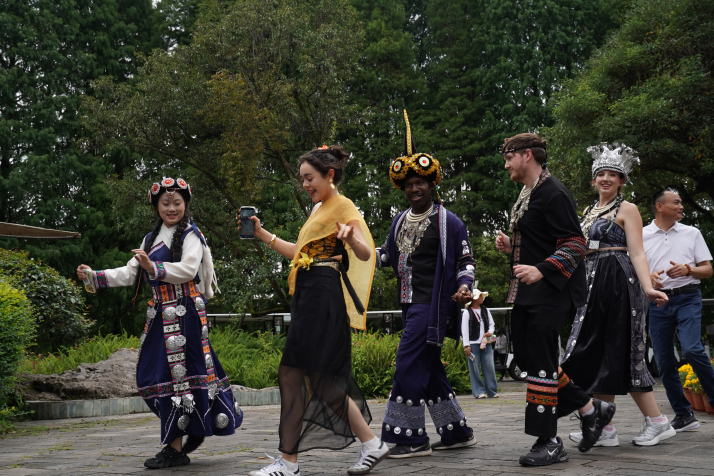 The author (second left), in a contemporary Dai ethnic minority-style costume, dances with fellow delegates of the Sixth China-America Student Conference, a U.S.-run international exchange program, at a tourist resort in Kunming, Yunnan Province, on July 16 (ZHANG WEI)
Trade war. Technology competition. Military rivalry. Geopolitical tension. It seems that every article in the newspaper follows the same story: China and the United States are adversaries, two opposing powers competing for global dominance. A single headline not only reduces the lives of billions of people to a simple dichotomy, "China" versus "the U.S.," but also reflects an approach that reinforces stereotypes and strengthens the "us" against "them" narrative. Yet, having visited China, I realized that the main weakness of this geopolitical rhetoric is that it overlooks the people themselves, their culture, traditions and the values they share. In a world of division, where cultural differences are too often mistaken for fundamental incompatibilities, what is needed is greater understanding. This can only be achieved through direct human contact and cultural exchange, which is at the heart of people-to-people diplomacy: building bridges between people from different cultures, perspectives and backgrounds through mutual understanding. During my time in China, the cultural norms around food, community and hospitality stood out to me. In the West, meals are generally organized around individual portions, with each person choosing their own dish. However, in China, food is typically served family style, with a variety of dishes placed at the center of the table for everyone to share. It was typical for people to offer food to others before eating themselves and to make sure that everyone's teacup was always filled. As my Chinese friends told me, this is a way of showing ongoing hospitality and attention. A major cultural difference that surprised me was whether guests are expected to eat everything served to them. In many Western countries, an empty plate is considered a compliment and a sign of gratitude to the host, meaning that the food was enjoyable. On the other hand, in China, an empty plate suggests that the host did not provide enough food, and by leaving a portion behind, one shows that the host has been generous and that the guest has been cared for. This illustrates how hospitality reflects a culture's values and shows how it is expressed in different but equally important ways around the world. Tea is one of the pillars of Chinese culture; it has been at the heart of the nation's historical, social and economic development. Offering someone a cup of tea is a way to extend a welcome, express respect and gratitude, and create a space for conversation. Through taking part in a tea ceremony, I came to see how this practice is closely linked to fundamental values in Chinese culture, including mindfulness, a respect for life and harmony. The process of making tea demands patience and careful attention to detail. I realized that it is a cultural activity that encourages us to slow down and spend time with the people around us. What is important is not the tea itself but the human connections it makes possible. Reflecting on this experience, I realized that the West has a very similar tradition: coffee culture. In Western society, going for a coffee is a chance to establish social connections and to get away from the everyday routine. Tea and coffee basically share the same symbolic meaning: the wish to connect with others and to place a high value on shared time. Gaining an understanding of different cultures and traditions leads to mutual appreciation and respect among people from diverse backgrounds; cultural exchange strengthens cooperation between countries. This demonstrates the importance of people-to-people diplomacy, as understanding and valuing other cultures helps build respect, trust and meaningful connections. In an international context where political differences often dominate the debate, it is important to remember that people are not always divided by the same borders that separate states. By being in China, experiencing the culture and traditions, and talking with its people, I understood something no newspaper had shown me before: The distance between people is, at its core, much smaller than the distance between their governments. BR The author is a Colombian student of international studies and political science at the University of Tampa in Florida, the United States Copyedited by Elsbeth van Paridon Comments to zhaowei@cicgamericas.com |
|
||||||||||||||||||||||||||||
|