
|
| Lifestyle |
| Theater boom is powering a new wave of urban consumption | |
|
|
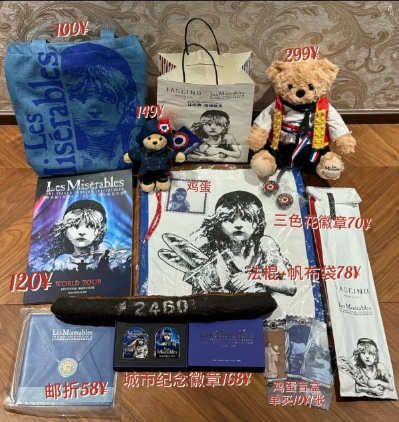 A post on Chinese social media platform Xiaohongshu (RedNote) showcases a theatergoer’s purchase of merchandise from the musical Les Misérables, after the show in Shanghai in November 2025
When the 40th-anniversary edition of the musical Les Misérables took to the stage of the Shanghai Grand Theater last November, the sold-out performances were only part of the story. Outside the theater, long queues formed at merchandise stands where fans snapped up programs, T-shirts, tote bags and commemorative pins.
"Many people lined up hours before the show started to get popular merchandise—and I thought getting a ticket was the hardest part," Shanghai resident Xu Huiping, who watched the show on November 13, told Beijing Review. She managed to get four pins, one tote bag and an Inspector Javert-inspired teddy bear. According to official data from the theater, total merchandise sales approached 20 million yuan ($2.89 million). The Les Misérables phenomenon is no anomaly. Across China in 2025, large-scale commercial performances generated an average consumption multiplier effect of 1:6.85, according to the China Association of Performing Arts (CAPA). For every yuan spent on a ticket, an additional 6.85 yuan ($1) flowed into transportation, accommodation, dining, tourism and shopping. In total, peripheral spending exceeded 220 billion yuan ($31.8 billion), more than triple the box office revenue of the performances themselves. This is the engine of what industry insiders call the "ticket stub economy," or the growing ecosystem around live theater and performances. And it is transforming how Chinese cities respond to the theater boom. After the show ends, young people are reluctant to leave, Yang Shucong, General Manager of the Beijing Tianqiao Performing Arts Center, told newspaper Guangming Daily. He said they'd purchase merchandise and post photos of their newly purchased items on social media with captions like, "It felt like a two-hour dream." Spending spree At the flagship store of Beijing People's Art Theater (BPAT) in Wangfujing, one of the capital city's busiest commercial areas, the ticket stub economy's effect is palpable. "When a hit show is on, nearby vendors stock up on extra fruit and snacks, because they know the crowds are coming," Qin Xinchun, the theater's Vice President, said at an industry conference in Beijing in December 2025. "Audiences arriving for performances generate spillover spending: meals before the show, coffee during intermission and souvenir shopping afterward." During its 2025 international drama invitational event, the theater partnered with Universal Beijing Resort and the Hanfenlou Bookstore, which sits right next to BPAT's Capital Theater, to offer discounts to ticket holders, including 85 percent off the price of books and special rates for Universal Studios Beijing. A single ticket became a key unlocking a broader set of experiences. In addition to strong ripple consumption, another testament to China's theater consumption fever is the rise of cross-city theatergoing. According to CAPA data, large-scale performances saw cross-city attendance rates exceed 60 percent for two consecutive years in 2023 and 2024. Audiences aged 18 to 34 accounted for over 70 percent of this demographic. It is a generation with disposable income, a taste for cultural experiences and a willingness to travel for them. When the English-language production of the musical Sunset Boulevard played in Shenzhen, Guangdong Province, in 2025, audiences traveled from nearby cities such as Hong Kong and Guangzhou, and even as far as Beijing to attend. When The Phantom of the Opera returned to Beijing for 24 performances in the Capital Theater, hotel occupancy in the surrounding Wangfujing area spiked. "A major production draws not only local audiences but also visitors from other cities who book hotels, dine out and extend their stays to explore the city," Qin said. "Most of the popular shows only visit major cities like Beijing, Shanghai, Guangzhou and Chongqing, so I've found myself following my favorite productions to all of them over the past two years," big fan Lin Chen, who lives in Yinchuan, Ningxia Hui Autonomous Region in northwest China, told Beijing Review. Theater in malls Partly because of the strong audience appetite for consumption and a growing passion for theater among the public, the art form is moving out of traditional performance venues and into the spaces where people usually shop, eat and gather. In Changsha, capital of Hunan Province in central China, shopping malls now house what local officials call "theater clusters." Within the city's Wuyi Commercial Circle, two shopping centers have become hubs for small theater performances. At Joyful ID Mall, three small theaters operate simultaneously. These venues belong to a growing category known as "new-type performance spaces." They are flexible, adaptable and designed to integrate seamlessly with their commercial surroundings. A theatergoer can arrive for an evening show, have dinner at a restaurant in the same mall, browse shops during intermission and stop for drinks afterward, all without leaving the building. In this setting, the line between cultural consumption and retail consumption begins to fade. "We are working to move beyond the single dimension of theater as just a performance venue, and strive to establish more emotional connection with our audience," Jiang Qiong, Deputy General Manager of the Beijing Tianqiao Performing Arts Center, said in an interview with newspaper Beijing Daily. During the 2026 Spring Festival holiday (February 15-23), China's biggest annual celebration and a time for family reunion, the center introduced production-specific installations in its lobby, including a life-sized cutout of a lead character holding a festive red lantern, inviting ticket holders to pose for pictures with them before shows. "When audiences step into the lobby and encounter these installations, they immediately enter the world of that production, experiencing a fully immersive atmosphere that sets the emotional tone before the performance even gets underway," Jiang explained. 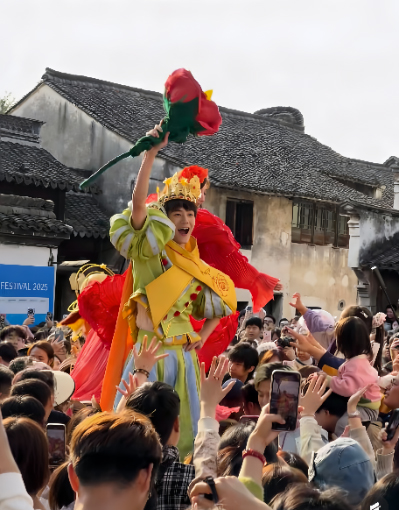 Street performers at the 2025 Wuzhen Theater Festival in Wuzhen, Zhejiang Province, on October 25, 2025 (COURTESY PHOTO)
Transforming towns No example illustrates the power of theater to reshape local economy more vividly than the Wuzhen Theater Festival in Zhejiang Province, east China. The October 2025 edition of the festival featured 71 invited productions and over 2,000 street performances, which transformed the ancient water town into a living stage. Audience members wandered through bridges and alleyways, encountering impromptu performances at every turn. The festival, along with events such as the World Internet Conference, has become the engine of the regional tourism economy. From 2013, the year the first edition was launched, to 2025, Wuzhen's annual tourist volume grew from 5.69 million to nearly 10 million. Direct attractions revenue climbed from 769 million yuan ($111 million) to a projected 1.8 billion yuan ($260 million). "What makes theater such a powerful driver of cross-city tourism is its ability to seamlessly align complementary spending opportunities, such as dining, shopping and lodging, with the performance itself. This creates a deeply integrated cultural experience that enriches the artistic core and elevates the audience's overall journey," Luo Qun, Deputy Director of the China Culture Daily Brand Innovation Center, said. Supporting role Behind this booming ecosystem lies a supportive policy environment. In September 2025, nine central government departments jointly issued measures to expand service consumption, explicitly calling for the support of theater products and performance venues. Local governments have responded with targeted incentives: Changsha has committed to developing 100 new performance spaces within the next three years; and Zhengzhou, capital of Henan Province, offers rewards of up to 3 million yuan ($440,000) for newly launched shows. At the community level, cultural initiatives are also bringing theater closer to everyday life. In January, a cultural festival was hosted in Tianqiao, a historically and culturally important area in Beijing. The festival featured intangible cultural heritage demonstrations, opera performances and interactive workshops, reflecting a broader effort to embed the performing arts into the fabric of neighborhood life. At the festival's opening ceremony, local resident Zhang Guilan said, "Going to the theater, either a small one hidden in a park or one located in a mall featuring experimental, immersive shows or the landmark venues with big-name shows, is increasingly becoming as normal as a dinner date." Copyedited by Elsbeth van Paridon Comments to zhangyage@cicgamericas.com |
|
||||||||||||||||||||||||||||||
|