
|
| China |
| Into the great outdoors | |
|
|
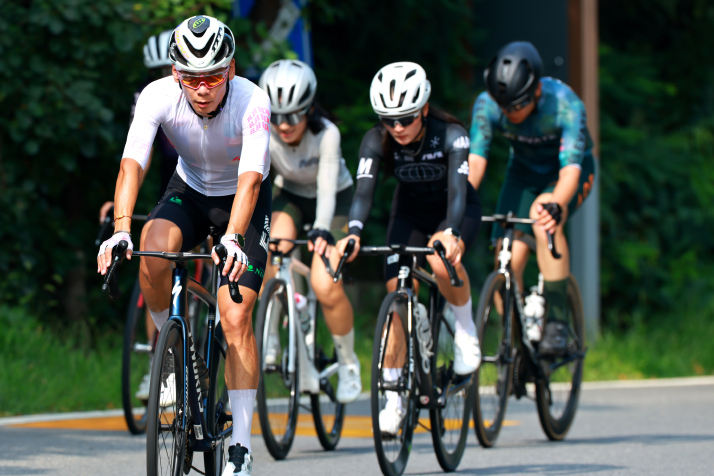 Cycling enthusiasts speed along the rugged mountain roads near Jietai Temple in Mentougou District, Beijing, on July 26 (CNSPHOTO)
Feng Xintong, a resident of Beijing's Changping District, is proud to say that the Chinese capital is one of the best cities for outdoor sports. "Whether you're in the city center or the suburbs, you can get a good workout," she told Beijing Review. "Take this season for example. In the city, you can visit the Lama Temple and walk along Guozijian Street across from it and take in the autumn leaves in the traditional alleyways. Or you can head out to the Miyun Reservoir, Xiangshan Park or Hongluo Temple in the suburbs. The facilities are all well-equipped. I stayed the night at a guesthouse near Xiangshan Park last week and spent two days looking at the fall foliage." For hiking enthusiasts, climbing and water sports fans, she added, these spots are ideal. "Now, along the Liangma River, and at many a wetland forest park for that matter, you can see people kayaking. And in pocket parks across the city, people are playing frisbee and picnicking," she said. Feng is following a trend among Beijingers known in Chinese as "measuring autumn with your footsteps." On lifestyle app Xiaohongshu (RedNote), young people are seeking out autumn walk routes for the city. Routes dotted with attractions, coffee shops, cultural creative stores and the best photo spots are repeatedly saved and shared. At the 2026 China Outdoor Sports Industry Conference, held on October 15-18, Beijing's Changping District unveiled a plan to further optimize the city's outdoor sports. While inspecting an outdoor sports park in the district on October 19, Gan Jingzhong, Secretary of the Changping District Committee of the Communist Party of China (CPC), noted that the district boasts a rich cultural heritage, abundant natural scenery and concentrated scientific and technological resources, providing broad space and a solid foundation for outdoor sports. He said the district is actively cultivating the outdoor sports industry, will further enrich its outdoor sports offerings and strive to become an all-scenario, high-quality outdoor sports destination. He also stressed the importance of balancing outdoor sports project development with ecological protection. Zhou Ling, Deputy Director of the Beijing Municipal Bureau of Sports, said Beijing will focus on creating a mega-city urban outdoor sports development model. "The city will continue to enrich its sports, revitalize its greenways, waterfront spaces and Winter Olympic legacy, promote the integration of digital technology and intelligent equipment with outdoor sports areas and facilities, advance the integration of culture, commerce, tourism, sports and exhibitions, and invite global outdoor sports professionals and enterprises to develop in Beijing." Stunning scale According to a report on China's outdoor sports industry development, released at the conference, by the end of the 14th Five-Year Plan period (2021-25), the number of outdoor sports participants in China had exceeded 500 million, which means roughly one in three Chinese people partook in outdoor sports, and the total scale of the related industry had reached approximately 3.17 trillion yuan ($475.5 billion). The popularity of outdoor sports has also been boosted by the improvement of sports facilities nationwide. The report shows that by the end of 2025, China had 182,000 fitness trails with a total length of 430,300 km, and 2,626 winter sports venues. Policy-level planning had already begun before this data growth. In October 2022, eight departments, including the General Administration of Sport and the National Development and Reform Commission, jointly issued a plan for the development of the outdoor sports industry (2022-25), which clearly proposed that the total scale of the outdoor sports industry should exceed 3 trillion yuan ($450 billion) by 2025, and made institutional arrangements to address bottlenecks including those related to equipment transportation. Just one year later, five departments issued an action plan for promoting the construction of outdoor sports facilities and services (2023-25), refining the goals into specific tasks such as promoting sports park construction, establishing a national trail system, improving mountain sports facilities and encouraging the use of four types of wasteland for outdoor sports industry development. "China's outdoor sports development is shifting from elite to mass participation, from spectating to engaging and from winter to all four seasons. Outdoor sports not only carry the spirit of challenging yourself and pushing your limits, but also embody the cultural connotations of a closeness to nature, and respect for ecology and mutual assistance among peers," Hao Xiaocen, Dean of the School of Recreation and Community Sport at Capital University of Physical Education and Sports, said at the conference. The popularity of outdoor sports is also driving related industries. The report shows that in 2025, sales of outdoor, hiking and camping products on four major Chinese e-commerce and social platforms—JD.com, Taobao, Tmall and Douyin (the Chinese version of TikTok)—reached 142.37 billion yuan ($20 billion), up 22.22 percent year on year, accounting for 31.68 percent of sports goods sales on those platforms. Third- and fourth-tier cities accounted for 42 percent of outdoor sports consumption. "The long-term growth potential of outdoor consumption cannot rely solely on how much equipment is sold. Compared with purchasing gear, services including skills training, event participation and campsite experiences are more conducive to sustained consumption. Sports training, in particular, helps consumers master skills and develop habits, enhancing user retention and offering both health and social benefits," Wang Zhaohong, a professor at Beijing Normal University's College of Physical Education and Sports, said. The report found that cycling is one of the most popular outdoor sports in terms of participants. Peng Haibo, Deputy Secretary General of the Chinese Cycling Association, said as of late 2025, China had about 10 million active cycling enthusiasts. In the past three years, 3,248 cycling events were held nationwide, and the participation continues to expand. "Cycling combines competitiveness, mass appeal and fashion, making it an important carrier for national fitness," Shen Hongling, Deputy Director of the Beijing Municipal Bureau of Sports, said. Stronger appeal Outdoor sports are increasingly intertwined with culture, tourism, consumption and urban development. Xiangshan Park offers a telling example. On October 16, the 38th 2026 Beijing Xiangshan Red Leaf Festival opened at the park, featuring 17 cultural experience activities to create a diversified autumn garden experience. This year's festival broke away from the traditional single focus on viewing autumn leaves, integrating science popularization, performances, sci-tech innovation, markets and study tours. The park launched five themed routes, catering to different fitness levels and preferences, from hikes to leisurely walks. Other Beijing destinations are also weaving outdoor sports into local culture and consumption. In Pinggu District, Jinhai Lake's triathlon and water sports events are paired with lakeside homestays and fruit-picking tours, turning a single race into a weekend getaway. In Yanqing District, the Winter Olympic legacy continues to draw skiers and hikers across seasons, with the Olympic venues repurposed for summer trail running and mountain biking. By blending sports with tourism, culture and consumption, these destinations are turning fleeting visits into longer stays and repeat trips, keeping both residents and visitors engaged beyond the finish line. Copyedited by Elsbeth van Paridon Comments to zhangyage@cicgamericas.com |
|
||||||||||||||||||||||||||||||
|