
|
| China |
| Inside the China Haul phenomenon | |
|
|
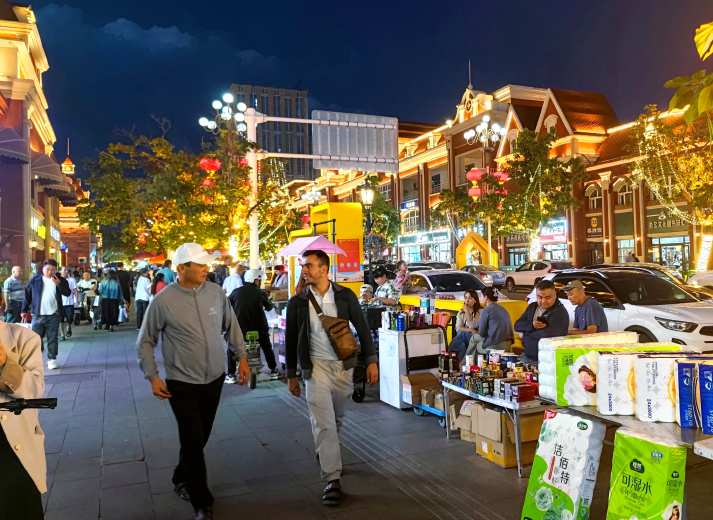 A night market street in Ili Kazak Autonomous Prefecture, Xinjiang Uygur Autonomous Region, on September 9, 2025 (XINHUA)
At the international departures hall of Beijing Capital Airport, Marc Lambert from Belgium stood at the check-in counter, frowning. It was the tail end of China's National Day holiday, which fell on October 1-7 this year. Like thousands of other international tourists, he was trying to figure out how he was going to get everything home. He had arrived in China with just one suitcase, but now he had to check in two. The second was packed with items he had purchased in China, including AI translation glasses from Shenzhen in Guangdong Province, a China Chic jacket blending traditional Chinese cultural elements with modern, streetwear-style design from Chengdu in Sichuan Province, herbal skincare products and three boxes of black sesame balls—his latest find, recommended by a local woman at an old Shanghai pharmacy. "My original suitcase was full a long time ago," he told Beijing Review. "Next time, I'm bringing three empty ones." Lambert is not alone. Recently, waves of foreign tourists have landed in China with empty suitcases and left with them bursting at the seams. On social media platforms like TikTok, YouTube and Instagram, they've fueled an unboxing trend called "China Haul," and three suitcases per person have become the standard loadout for the trip. Hashtagged "China Haul" videos are gaining traction as travelers unbox beauty products, collectible toys and smart gadgets. One Instagram comment summed it up perfectly: "I highly recommend that anyone traveling to China pack as light as possible—because you will absolutely shop yourself into exhaustion." The must-buy list Open one of these China Haul videos, and the product list tells its own story. Once, the "old three" that foreign visitors carried home from China were tea, silk and panda plushies. These days, the items that show up most often are Chinese-made smart devices—pocket gimbals, AI glasses, foldable phones and action cameras—along with collectibles from Chinese designer toy brand Pop Mart, designer handbags, China Chic apparel, herbal soaps and moxibustion products. Moxibustion therapy is a traditional Chinese medicine practice that involves burning moxa (made from dried mugwort leaves) to apply heat to specific points on the body. A Ghanaian content creator filmed himself testing a robot dog in Shenzhen's Huaqiangbei, one of the world's largest wholesale electronic products markets. The video had drawn more than 740,000 views on YouTube as of mid-October. A British sneaker vlogger tried on a pair of Chinese running shoes in Dongshankou in Guangzhou, Guangdong, a historic neighborhood known for its trendy hangouts, and was amazed by their design. A Portuguese vlogger showed traditional Chinese medicine products brought back from China, including loquat syrup for coughs and throat discomfort. The comment section quickly filled up with "drop the link" requests. Others commented and shared their own firsthand experiences. Some China tourists have even taken to social media to show off their foot-soaking packs (herbal blends for warm foot baths, said to aid sleep and circulation) and insulated thermoses (for sipping warm water all day, a distinctly Chinese habit). In one unboxing video, an American music vlogger lined up a drone, a handheld gimbal and a wireless microphone side by side. "It's easy to see why so many tourists from around the world buy so much while traveling in China. Chinese products aren't exactly cheap, but there are a lot of choices and everything is made to appeal—they're built to sell," Lambert said. "The China Haul popularity stems from a shift in the consumption logic of overseas tourists, who are moving from purchasing cultural symbols to buying Chinese technologies, designs and consumption experiences," He Yun, an associate professor at the School of Public Administration of Hunan University in Hunan Province, told Xinhua News Agency. The trend, she noted, is underpinned by the upgrading of China's manufacturing and cultural and creative industries, a substantial transition from exporting production capacity to exporting brands and lifestyles. Easier to visit, easier to buy  Tourists at an INNO100 shop, a tech retail and experience space, in Shenzhen, Guangdong Province, on August 3 (XINHUA)
China has seen rapid growth in foreign arrivals in 2026, as expanding visa-free policies continued to boost inbound travel. Official data showed that foreign nationals made 61.29 million border crossings in the first eight months of 2026, up 19.5 percent from a year earlier. Visa-free entries accounted for 23.72 million of the total, an increase of 26.8 percent year on year. According to the Ministry of Foreign Affairs, China currently grants unilateral visa-free entry to citizens of 50 countries and offers 240-hour visa-free transit to travelers from 55 countries. The policies have helped fuel the popularity of the China Travel trend on overseas social media, attracting more international visitors. The top 10 source countries for inbound foreign travelers were the Republic of Korea (ROK), Russia, Malaysia, Viet Nam, Thailand, Singapore, the United States, Japan, Mongolia and Australia, accounting for 62 percent of all inbound foreign arrivals. The boom in inbound tourism has also boosted consumption, and tax refund measures have made buying even easier. "The tax refund policy has boosted our sales. Foreign tourists now account for 30 percent of our daily customer flow," Zhou Man, manager of a consumer electronics store in Chengdu, told Xinhua. Data from the Ministry of Commerce (MOFCOM) showed that the number of overseas visitors applying for departure tax refunds had increased by more than threefold year on year during the first seven months of 2026. In May, MOFCOM and other authorities issued a notice on further optimizing departure tax refund measures and expanding inbound consumption. The new policy package includes measures such as wider coverage of tax refund stores, random inspections for small-value refund applications, paperless processing and improved refund-upon-purchase services. Under the new measures, China will encourage more eligible stores to register as departure tax refund stores and support localities in expanding related services in key business districts, tourist attractions, markets and ports with large numbers of overseas travelers. Beyond tax refunds, efforts to improve the overall shopping experience are also making it easier for international visitors to spend in China. Shanghai, for example, has introduced seven measures to make mobile payments more convenient for international visitors, tackling issues such as linking overseas bank cards to WeChat Pay and Alipay, China's two dominant mobile payment platforms, and using QR codes at small merchants. The city has also streamlined tax refund services for departing travelers and improved multilingual signs and visitor information in public spaces. Beijing launched a travel wallet service—Alipay's prepaid digital wallet designed specifically for foreign visitors' small, frequent purchases in China, that allows overseas visitors to order food, buy coffee and take the subway without linking a bank card. It became the world's first city to support tap-to-ride on the metro with five major international card networks. Shenzhen has extended its tap-to-ride system to all of the city's 432 metro stations and introduced "tap-to-refund" at its airport, allowing visitors to complete both payment and tax refund with a single card tap on the POS terminal. "Cash has become almost unnecessary for me here. With WeChat or Alipay on my phone, I can pay for nearly everything," Kim Seo-yeon, an ROK university student studying in Beijing, told Beijing Review. Copyedited by Elsbeth van Paridon Comments to luyan@cicgamericas.com |
|
||||||||||||||||||||||||||||||
|