
|
| China |
| How Jiayu County embedded technology into the vegetable supply chain, and reshaped farming in central China | |
|
|
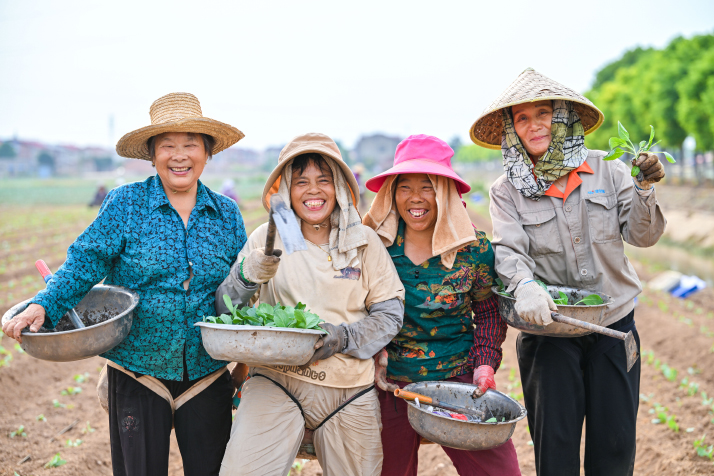 Tan Hongmei (second left) and other villagers transplant cabbage seedlings at the Red Garden base in Jiayu County, Hubei Province, on September 15 (WEI YAO)
Standing in front of a digital screen in the heart of central China's Jianghan Plain, Qiu Zhengming, chief scientist at the Hubei Academy of Agricultural Sciences, asked an AI assistant to give him a status report on a plot. Within a millisecond, the system responded: "Temperature: 31.3 degrees Celsius. Humidity: 44.5 percent." In Jiayu County, Hubei Province, traditional farming is getting a hi-tech makeover. Here, if the soil gets too dry or the greenhouse too hot, it isn't a farmer's intuition that raises the alarm; it's an instant alert sent directly to a smartphone. Behind the AI assistant is a whole-process digital hub. The Vegetable Science and Technology Demonstration Park in the county's Panjiawan Town monitors microclimates, soil and pests around the clock, using AI to automate fertilizer application, pest control and full-lifecycle tracking. All 414 local vegetable cooperatives are now registered on China's national traceability management platform for agricultural products, with every product assigned a unique QR-code ID. An agricultural cooperative in China is an organization of farmers that pools members' land, labor and capital to produce and sell at scale. Jiayu has embedded technology into every link of the agricultural supply chain, from seedling cultivation and transplanting to harvesting, cold-chain storage and retail. "Leveraging technology to boost production is essential; it's what guarantees stable incomes for our local farmers," Qiu told Beijing Review. Breaking the bottleneck Jiayu first began scaling up vegetable production in the 1980s. The county built its reputation on a quartet: pumpkins, winter melons, cabbages and Chinese cabbages (known for having a milder, sweeter taste and a tenderer crunch). Above all, it was cabbage that defined the region, earning Jiayu the moniker "China's Cabbage Capital." Yet for decades, that pride rested on fragile ground. The high-quality cabbage seeds local farmers relied on had to be imported from Japan and the Netherlands. Hence, the supply was marked by exorbitant prices and unpredictable availability. Determined to break this vulnerability, Jiayu in 2008 forged a partnership with a team led by the late Chinese Academy of Agricultural Sciences academician Fang Zhiyuan. Their target was to breed a homegrown cabbage that could stand toe-to-toe with overseas varieties. It took a decade of painstaking research. The breakthrough arrived in the form of Zhonggan 1305 (or Sitedan), a proprietary overwintering cabbage variety boasting a crisp taste and superior cold resistance. Perfectly suited for winter cultivation in the Yangtze River Basin, the new seed was a game-changer. Today, domestic seeds account for 70 percent of Jiayu's winter cabbage production, as opposed to 10 percent before 2018, slashing seed costs for local farmers by over half from 6,000 yuan ($892) per hectare. Building on that success, Jiayu continues to push the boundaries of crop science. Across the core zone of the demonstration park, Qiu and his team test more than 2,000 new breeding combinations each year to select varieties best adapted to local soil. A short drive from the demonstration park sits the Jinrun Agricultural Vegetable Seedling Center, the largest in Panjiawan. Inside its 99 sprawling greenhouses, rows of cabbage, Chinese cabbage and pumpkin seedlings grow in trays floating on shallow pools of water. Overhead, specialized grow lights simulate optimal sunlight, while workers meticulously thin out dense clusters to ensure exactly one healthy shoot remains in each cell of the seedling trays. "This hydroponic method (a method of growing plants without soil) shields seedlings from local weather, especially summer heat," said Zhang Jianjian, Jinrun's Deputy General Manager. The facility now produces 160 million seedlings annually for over 9,000 local households. "In the past, open-air germination left farmers at the mercy of the elements; one storm could wipe out an entire season," Zhang added. "Now, they just bring us their seeds, and we hand back resilient cabbage seedlings. It saves them time, labor and heartbreak." A vast majority of these nursery-reared seedlings find their home in Panjiawan's famous Vegetable Corridor. Across this 10-km stretch of soil that contains a high concentration of micronutrient selenium, farmers bend over freshly plowed ridges to transplant the delicate green shoots. This lush corridor yields 210,000 tons of eco-friendly vegetables every year, boasting eight certified green products and 25 pollution-free-crop accreditations. In October 2025, "Jiayu Cabbage" was officially registered as a regional brand, quickly gaining traction across traditional wholesale markets, supermarkets and e-commerce platforms. To lock in freshness and boost value, Jiayu invested heavily in cold-chain logistics. With 53,000 cubic meters of cold storage and 100 electric refrigerated trucks, produce reaches Changsha, capital of neighboring Hunan Province, in three hours, and the Guangdong-Hong Kong-Macao Greater Bay Area, one of China's wealthiest and most demanding consumer markets, within 24 hours. The county is also venturing into deep processing. A new facility by Jiali Ecological Agriculture uses cutting, blanching and freeze-drying to turn leafy greens into shelf-stable goods. Once fully operational, it will process 80,000 tons of vegetables annually, generating over 100 million yuan ($15 million) in output and employing 100 locals. Today, Jiayu's exports reach Japan, Russia and Southeast Asia. In the first half of 2026, vegetable output hit 864,300 tons across 15,200 hectares, or a 3.27-percent year-on-year increase, pushing the cluster's value to 4.13 billion yuan ($616.6 million) and turning this humble wetland into a powerhouse of modern agriculture. Rooted prosperity By directly linking corporate enterprises and agricultural cooperatives with individual households, local authorities have championed a hybrid economic model that gives farmers three sources of income: land lease fees, daily wages and equity dividends. When the land flourishes, those who tend it thrive as well. Tan Hongmei, a resident of Xiaojiazhou Village in Panjiawan, used to farm her family's modest plot all by herself. Today, she leases one hectare to Red Garden, an enterprise-run agricultural base, collecting 7,500 yuan ($1,050) per hectare in annual rent. By the end of each year, she receives an additional performance dividend, typically another 7,500 yuan per hectare. During the busy September transplanting season, Tan joins fellow villagers at the base as a seasonal worker, earning 220 yuan ($33) a day. "This way, I earn more than I ever did farming my own small plot," Tan said. "And best of all, I don't have to worry about market risks anymore." Tan's experience is part of a broader, structural overhaul across Jiayu. At the 53-hectare Red Garden base, manager Zhu Wenjing sees the clear advantages of centralized management: higher yields, better market value and greater flexibility for local farmers. "They can work here during peak seasons and pursue other jobs when things slow down," Zhu said. "Our neighbors don't have to leave home to find work because they can earn a steady income right here, on their doorsteps." Wang Guoxiong, dubbed the local "Vegetable King," leads the Fude Vegetable Cooperative. Guiding over 2,000 households, his organization ships 20 tons of fresh produce daily to the Greater Bay Area. By providing unified seeds, technical support and distribution, the cooperative raises each farmer's annual income by over 20,000 yuan ($2,800), roughly the equivalent of an entire year's average rural disposable income in China (according to the National Bureau of Statistics). Beyond higher incomes, corporate oversight ensures strict field management and eco-friendly pest control from the soil up. "It secures quality at the source," said Panjiawan agricultural technician Liu Zhaohui. "When farmers can grow their crops with peace of mind and buyers can purchase them with confidence, that's what builds a lasting brand." Copyedited by Elsbeth van Paridon Comments to weiyao@cicgamericas.com |
|
||||||||||||||||||||||||||||||
|