|
| China |
| A Stabilizer, Not a Shock | |
|
|
|
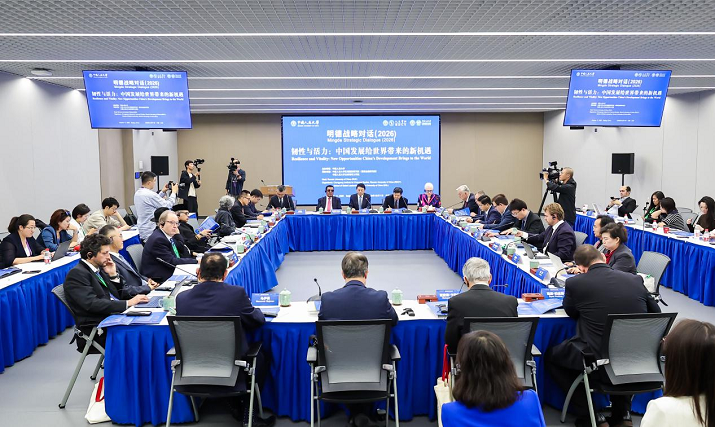
The Mingde Strategic Dialogue 2026 underway in Beijing on October 11 (COURTESY PHOTO) A recent four-day tour exploring China’s economic development has given former Ethiopian President Mulatu Teshome deeper insight into the country’s resilient growth and the opportunities it offers to the world. “The global economy is searching for silver linings and today, China’s high-quality development is providing exactly that, helping serve as a stabilizer for the world economy,” Teshome said. He made the remarks at the Mingde Strategic Dialogue 2026, held in Beijing on October 11. The gathering, hosted by the Chongyang Institute for Financial Studies at Renmin University of China (RUC), brought together former international political leaders and scholars. The discussions centered on the theme Resilience and Vitality: New Opportunities China’s Development Brings to the World. Joining hands The attendees underscored the importance of global cooperation in addressing common challenges. Zlatko Lagumdzija, former Chairman of the Council of Ministers of Bosnia and Herzegovina, called for renewed cooperation on a more practical, results-focused basis at a time of growing geopolitical and economic pressures and an international order under considerable strain. “Conflicts, economic instability, humanitarian crisis, climate change, pandemics, organized crime and the profound implications of emerging technologies make international cooperation as essential as ever,” he said. Lagumdzija stressed that the defining threats of the present age require a globally coordinated response. To address issues like cross-border implications of transformative technologies, it is essential to develop collective solutions that create tangible benefits for all, especially communities and regions that have too often been left behind, he added. Former New Zealand Prime Minister Jennifer Shipley told Beijing Review that challenges emerging from the current geopolitical climate are complex and not limited to one issue, and said countries should focus on regional economic momentum and social inclusion. Within Asia-Pacific Economic Cooperation (APEC), a regional forum for boosting trade, investment and economic growth around the Pacific Rim, the 21 member economies should strengthen cooperation on trade transparency to jointly counter protectionism, Shipley noted. She said she expected this year’s APEC Economic Leaders’ Meeting, scheduled for November in Shenzhen, China, to focus on sustaining growth across the Asia-Pacific region and ensure that both major and smaller economies are represented at the table. Bringing opportunities During the forum, many attendees highlighted the benefits being brought to the world by China’s development. According to Teshome, Ethiopia is looking to deepen cooperation with Chinese enterprises in mining, agriculture, manufacturing and infrastructure. He said China’s zero-tariff treatment for the 53 African countries with which it has diplomatic relations also helps them expand exports. In a speech delivered at the forum, Shipley highlighted the role of China in anchoring global growth, noting that the country’s development is helping build a world that is more connected, sustainable and resilient, even as geopolitical tensions and protectionism test the multilateral system. “Most nations are indebted to the fact that China’s appetite for reform, for progress, for intentional leadership, has actually had a ripple effect from which most nations have benefited,” Shipley said. China’s shift toward innovation-driven and high-quality production processes, its commitment to opening up and its green and digital transition are generating broad benefits for both the country and the world, according to Shipley. The implementation of the 15th Five-Year Plan (2026-30), characterized by major national projects and coordinated policy measures, is boosting domestic demand, raising household incomes and expanding investments, Shipley noted “These long-term orientations provide predictability, a rare commodity in this world, and help stabilize global expectations,” she added. Radhika Desai, a professor of political studies at the University of Manitoba in Canada, spoke highly of China’s approach to overall planning, saying it provides an exemplary development path for the rest of the world, even in economies with a large private sector. John Ross, former Director of Economic and Business Policy for the Mayor of London in the United Kingdom, and a senior researcher at the Chongyang Institute, praised China’s role in narrowing the digital divide between countries. China’s open-source AI models could help make the transformative technology more accessible across the Global South, he told Beijing Review. In a speech delivered at the event, former Chinese Vice Minister of Finance Zhu Guangyao expressed confidence in China’s growth momentum, projecting that China’s economy could expand by roughly $6 trillion over the next five years. That incremental growth alone exceeds the total annual GDP of Germany, the largest economy in Europe, which stood at a little over $5 trillion in 2025, Zhu said. Unfounded ‘China Shock’ narrative George Galloway, a former member of the UK Parliament, pointed to a growing wave of trade barriers against Chinese exports and denounced attempts to justify trade restrictions. “The belief in free trade, and the belief that the market is king, and that the consumer is king--all of these things are abandoned in the interests of protectionism and the protest against overproduction,” he said. Glenn Diesen, a professor of political science at the University of South-Eastern Norway, told Beijing Review that China’s rapid technological and economic development has indeed brought a shock to some in Western countries who have failed to keep pace with its development trajectory. “The shock from China’s growth can be justified, but it does not have to be terrifying,” he said. According to Diesen, introducing the “overcapacity” narrative is a way of vilifying normal export activities. “China excels in the hi-tech industry and has good export capabilities for it is able to deliver superior products at a lower price,” he said. He warned that the shock might be exploited by people who come with simple and destructive solutions to cut off trade ties from China, which could bring negative impacts. “The spectacular rise of China does create some shockwaves in the West, but I think it just gives more reason to cooperate. Even if countries are unable to cooperate, we can still manage the competition in a friendly way,” Diesen said, noting that Chinese and European companies could explore building joint ventures for mutual benefit. Huang Hanquan, head of the Chinese Academy of Macroeconomic Research, stressed that China has been contributing to global growth through its ultra-large domestic market, its industrial upgrades that power global industrialization and green transformation, and its expanding outbound direct investment that helps global rebalancing. “A resilient and dynamic China brings opportunities instead of a shock to the world,” Huang said. Tu Xinquan, Dean of the China Institute for WTO Studies at University of International Business and Economics in Beijing, said some anxieties stem from Chinese enterprises breaking long-held monopolies through technological breakthroughs. Rather than shutting doors, global economies are expected to embrace Chinese firms going global for resolving global imbalances and stabilizing supply chains, Tu noted. Copyedited by G.P. Wilson Comments to lixiaoyang@cicgamericas.com |
|
||||||||||||||||||||||||||||||
|