
|
| China |
| Where drones take off | |
|
|
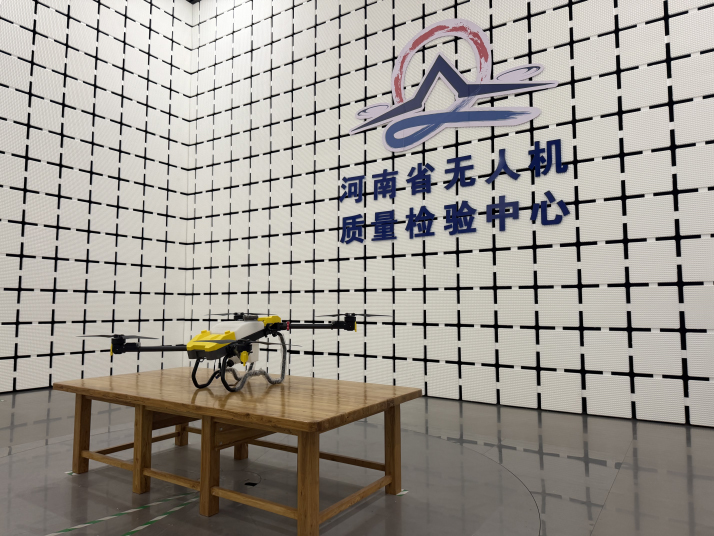 The Henan Provincial Drone Quality Inspection Center in Anyang Drone Industrial Park on September 12. The white foam panels on the walls help shield the facility from signal interference during testing (KANG CAIQI)
Anyang, a city in central China's Henan Province known for its rich archaeological heritage and ancient history, is making its mark in one of China's newest economic frontiers: the low-altitude economy, which refers to airborne economic activities below 1,000 meters. A new layer of the economy China's low-altitude economy is moving rapidly from experimentation to wider application. As of late 2025, China had 3.287 million registered drones, according to the country's Civil Aviation Administration. Drones logged more than 45.3 million flight hours that year, an increase of nearly 70 percent from 2024. In China, drones are already being deployed for agricultural operations, infrastructure inspections, logistics, environmental monitoring and emergency response. Today, their value increasingly lies not in the aircraft themselves, but in what they can do when connected with sensors, communications networks, data platforms and specialized equipment. That is where Anyang is seeking to create an advantage. The city has been developing its drone industry since 2016 and was among China's first batch of national civil unmanned aviation pilot zones approved in 2020. Today, Anyang has formed an industrial ecosystem covering research and development (R&D), manufacturing, flight testing, platform management, application scenarios, data analysis and training. At the heart of that ecosystem is the drone industrial park in the city's Beiguan District. An industrial cluster in the making The park brings together companies across the drone value chain, covering aircraft manufacturing, core components, testing, inspection, pilot training and application development. One example has become something of a local story: In the park, an idea can become a finished drone without leaving the industrial cluster. When unmanned aerial vehicle (UAV) manufacturer Yunhuan UAV was developing an airborne relay communications system for emergency situations, it needed an aircraft capable of carrying the equipment. Instead of sourcing everything from outside, the company worked with other businesses in the park. Honeycomb Aerospace helped with the aircraft design. Industrial drone producer Xinhuazhifei worked on the airframe, Hong'an Aviation supplied batteries, while another local company provided the engine. The result was a medium-sized, long-endurance communications drone designed to restore communications in disaster-affected areas, where electricity, roads and conventional communications networks may have been disrupted. The park has also continued to expand its testing and service capabilities. As of this September, it had brought together 65 related companies, with a professional flight-testing area covering about 7.38 hectares and nine standardized runways. The facilities can support flight testing, emergency drills and pilot training in one place. The park also houses a provincial-level drone quality inspection center, where aircraft can undergo testing in areas including wind resistance, vibration resistance, environmental adaptability and flight control. The center has provided testing services for companies from 19 provinces. In other words, the park is being built not merely as a place to manufacture drones, but as a place where drones can be developed, tested, trained, verified and prepared for real-world use. 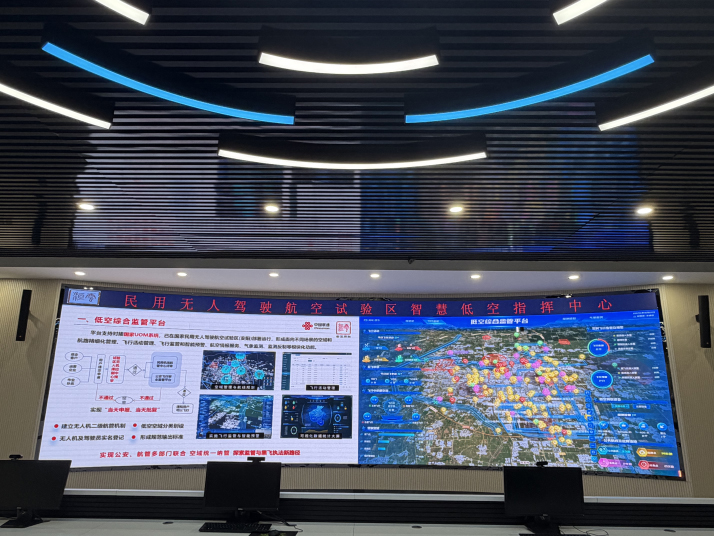 The drone command and control center at Anyang Drone Industrial Park, where a large screen displays real-time flight paths, communication signals, navigation status and other operational data in Anyang, Henan Province, on September 12 (KANG CAIQI)
When the sky becomes a lifeline Emergency response provides perhaps the clearest illustration of how such an ecosystem can translate technology into practical use. When disaster strikes, a drone's value is measured not simply by how far it can fly, but by what it can deliver to places that conventional infrastructure can no longer reach. That was demonstrated in the summer of 2023, when severe flooding hit parts of north China. After heavy rainfall triggered major floods in Beijing's surrounding mountainous areas, an emergency team from Anyang deployed the YH-630 aircraft developed by Yunhuan UAV. Equipped to serve as an airborne communications relay, the drone helped restore connectivity in three severely affected areas of the capital's Mentougou District, providing emergency communications for more than 5,000 people and helping connect more than 4,000 calls, according to local reports. "The aircraft's role was therefore not simply to fly over a disaster zone. It became part of the communications infrastructure," Wang Yueran, office director of Yunhuan UAV, told Beijing Review. The experience also represented a broader shift in the role of drones in emergency responses. Rather than functioning solely as aerial observation tools, they can carry communications equipment, transmit information and help reconnect areas cut off from conventional networks. That is why real-time monitoring and command systems have become an increasingly essential part of Anyang's low-altitude ecosystem. The city's drone command center adds a digital layer to these operations, tracking flight paths, communication signals and navigation status in real time. Its AI-enabled system can identify more than 70 types of events, with detected incidents automatically photographed, uploaded and assigned to the related authorities for follow-up. The concept is straightforward: The more drones take to the sky, the more important it becomes to know what is flying, where it is flying and what it is doing. Extending the reach Another company in Anyang is approaching emergency response from a different angle. Predator Firefighting Technology has developed unmanned firefighting and emergency response equipment designed for situations in which conventional firefighting methods face physical limitations. One major challenge is that of high-rise fires. Firefighters on the ground may have difficulty reaching fire at significant heights from outside a building. The company's equipment uses large-payload drones equipped with specialized firefighting systems to extend the reach of emergency crews. The system can support several firefighting modes and can also be adapted for disaster rescue and forest-fire response. That same model can be seen across the city's growing range of drone applications, from river inspections and environmental monitoring to infrastructure patrols, cultural heritage protection and logistics. Rather than treating drones as standalone products, the city is building an ecosystem in which hardware, software, communications and real-world applications develop alongside one another. Anyang's development plans call for the further integration of flight routes, low-altitude communications, takeoff and landing facilities, flight information services and application platforms, as well as dedicated bases for low-altitude industry, flight operations and emergency rescue. The next stage, therefore, may not be about simply putting more drones into the sky, but about making them part of everyday infrastructure. As China's low-altitude economy moves toward broader commercial and public-service applications, Anyang's experience suggests that the future of drones may depend not only on how high they can fly, but on how deeply they can connect with the world below. BR (Reporting from Anyang, Henan Province) Copyedited by Elsbeth van Paridon Comments to kangcaiqi@cicgamericas.com |
|
||||||||||||||||||||||||||||||
|