|
| China |
| Retracing the Long March at 90 | |
|
|
|
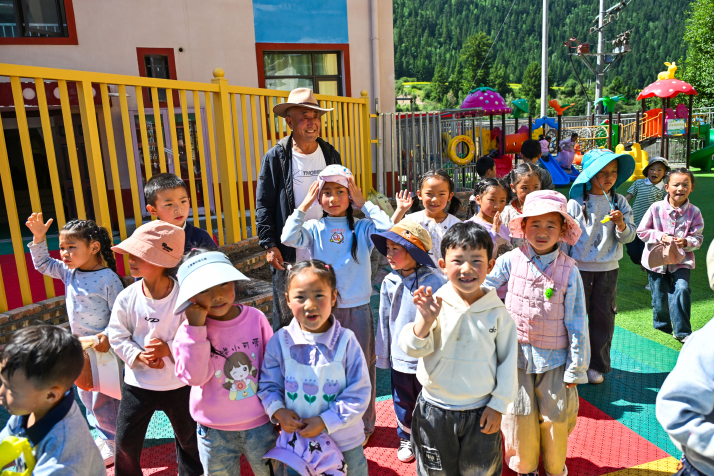
Before sunrise each morning, Gongchan, 62, unlocks the gate of Qiuji Edgar Snow Hope Primary School in Zoige County on the northeastern edge of the Qinghai-Xizang Plateau in Sichuan Province. Next to the school gate, a narrow road leads toward the site of the Qiuji Temple battlefield, where the Communist Party of China (CPC)-led Red Army soldiers fought Kuomintang forces during the Long March in 1935. The school itself is named after Edgar Snow, the American journalist whose 1937 work Red Star Over China first introduced the epic military maneuver that took place between 1934 and 1936 to readers around the world. Gongchan walks between the school and the old battlefield almost every day. For local children, he is the school guard and the kindly "story grandfather" who tells stories about the Long March. But for him, the history is personal.
Gongchan, son of a Red Army soldier who was injured on the Long March, poses with children from the kindergarten section of Qiuji Edgar Snow Hope Primary School in Zoige County, Aba, on July 9 (WEI YAO) A seed left behind Starting in October 1934, the Red Army implemented a series of strategic relocations from its bases in order to break through the encirclement by the repressive Kuomintang party regime. In October 1936, the multiple units of the Red Army joined forces in Gansu Province in northwest China, successfully completing this grueling trek. Over the course of this great journey, Red Army soldiers crossed more than 10 provinces, with some marching as far as 12,500 km. The main route passed directly through today's Zoige, where memories of the march still remain with local families. Gongchan's father, Xie Jingzhong, was among the Red Army soldiers wounded during the Battle of Baozuo in Zoige in August 1935. After ammunition ran out, soldiers began fighting hand to hand, Xie was stabbed in the head with a bayonet and left gravely injured beside the Baozuo River. Weeks later, as the Red Army marched on, hundreds of severely wounded soldiers were left behind to recuperate, with the hope of eventually rejoining their units. Yet scattered across the vast grasslands, many never made it back, including Xie, who was sheltered by a Tibetan herdsman named Naqia until he recovered. Xie stayed on the plateau, married a local Tibetan woman and settled in Xiahuangzhai Village. But he never forgot the family that had saved his life. In the 1950s and 1960s, he and several other former Red Army soldiers began experimenting with growing vegetables in the harsh alpine climate, where most residents traditionally relied on herding and growing highland barley. Under their guidance, families that had rarely grown fresh produce before gradually began planting cabbages, radishes and potatoes beside their homes. What started as an act of gratitude slowly reshaped local livelihoods. After Xie passed away in 1985, Gongchan carried on his father's mission, helping expand vegetable cultivation into a larger local industry. Thanks to his efforts, in the early 2000s, Xiahuangzhai became one of Zoige's first pilot villages for plateau vegetable farming. The new business helped farmers earn nearly 10 times more income than they did growing traditional highland barley. Today, Xiahuangzhai is home to both vegetable greenhouses and yak pastures. Locally grown vegetables are sold in many cities in and outside Sichuan. "The seed my father planted was not only for vegetables," Gongchan said. "It was also a seed of friendship, gratitude and hope."
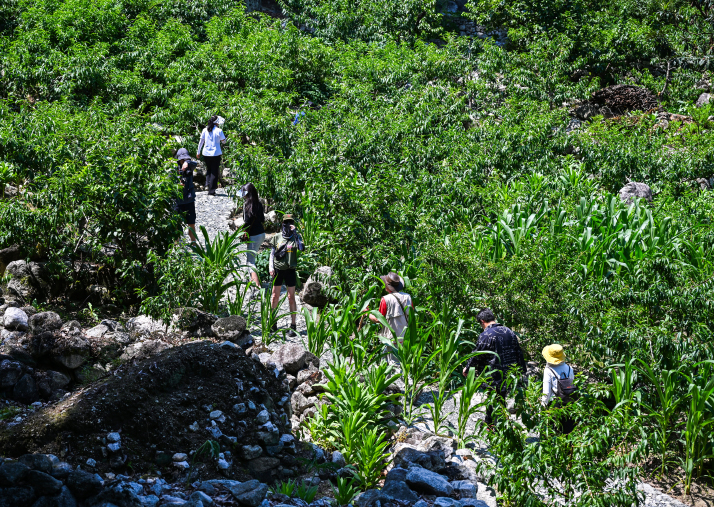
Participants in the Sichuan section of the Together on the Long March international outreach initiative organized by China International Communications Group retrace a path taken by the Red Army 91 years ago on July 5 (WEI YAO) A debt repaid in another currency Hundreds of kilometers south of Zoige, another legacy of the Long March can be seen in the flourishing Red tourism economy in Aba Tibetan and Qiang Autonomous Prefecture, Sichuan. In Xisuo Village, across from the Choktse Tusi Manor where CPC leader Mao Zedong once stayed during the Long March, tourists now move through restored Tibetan buildings beneath steep mountain slopes. Outside cafés and guesthouses, souvenir stands sell butter tea, prayer bracelets and postcards printed with old Red Army photographs. "For local people, these stories were never just history from textbooks," said Drolkar Lhamo, a Tibetan television host with Kham TV under Sichuan Media Group. Growing up in Garze Tibetan Autonomous Prefecture, which neighbors Aba, she often heard elders recount encounters with Red Army soldiers. "Older people said whenever the Red Army took something, they would leave an IOU or silver dollars behind," she told Beijing Review. "They never took anything from ordinary people for free." Mao once joked to Edgar Snow that grain and supplies borrowed from Tibetan villagers during the Long March were the Red Army's only "debt," one that had to be repaid someday. Drolkar Lhamo said she believes that the debt has been repaid many times over through development and transformation. The changes are especially visible in villages like Xisuo. For generations, families survived by farming barley and herding yaks, while many young people left for work elsewhere. Over the past two decades, tourism programs themed on Long March history and Tibetan culture have created a new local economy. One beneficiary is Zelang Sima, whose family has expanded a small restaurant into a three-story guesthouse. "Before, income was very low," she told Beijing Review. "Now people can earn money without leaving home." In many villages along the Long March route, its legacy now survives not only in museums and memorials, but also in everyday life. In Yudu County, Jiangxi Province, where the Central Red Army, or the First Front Army, began its Long March in 1934, visitors crowd riverfront memorials and immersive theater productions retelling the departure. The county received more than 770,000 tourist visits during this year's May Day holiday (May 1-5) alone. In Wuqi County, Shaanxi Province, where the Central Red Army concluded its trek in 1935, ecological restoration has transformed one of the most erosion-prone areas of the Loess Plateau. Over the past decades, the county has reforested barren hillsides, increasing forest coverage to more than triple its level in the late 1990s. Farmers' disposable incomes have risen more than 20-fold. This year, China commemorates the 90th anniversary of the victory of the Long March. From June to July, China International Communications Group (CICG) organized the Together on the Long March international outreach initiative, taking journalists, scholars and other participants from China and abroad to sites along the historic route. David Ferguson, honorary Chief English Editor of the Foreign Languages Press and a participant in the entire six-week journey, said the changes reflect a broader process of rural revitalization taking place across China. Having written a book on poverty alleviation and rural revitalization in Gansu Province, Ferguson said traveling along the Long March route gave him a closer look at how local communities are transforming historical and cultural resources into new opportunities for development. China's rural revitalization strategy, first put forward in 2017, aims to consolidate the gains made in poverty alleviation through rural development and to narrow the existing urban-rural gap. "I'm very conscious of the work that's been done in every small community in China to identify what its strengths are and to build on these strengths and to turn these into economic opportunities," Ferguson said. "All the villages that we have visited along the way, those villages that played a part in the Long March, they all have qualities to offer, they all have strengths, and they all have something to show the world."
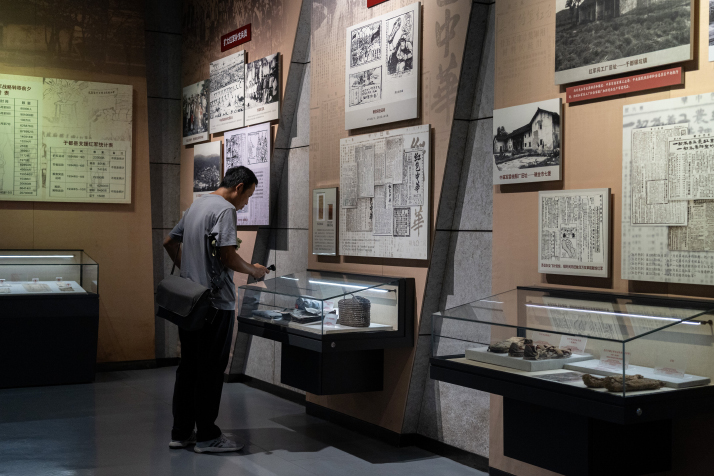
A visitor at the memorial museum of the Central Red Army's departure for the Long March in Yudu County, Jiangxi Province, on September 8 (XINHUA)
Still alive
For international participants in the CICG initiative, the journey became both a historical exploration and a way of understanding contemporary China. Having lived in China for nearly two decades, Ferguson said the spirit of the Long March is not only preserved in museums or memorials, but also lives on in living memory. He recalled first encountering it in 2008, two years after arriving in China as a journalist. Days after the 8.0-magnitude Wenchuan earthquake struck Sichuan in 2008, Ferguson traveled to Dujiangyan, one of the hardest hit areas, to report on relief efforts. What he expected to see was scenes of chaos. Instead, less than a week after the earthquake, he found an entire temporary settlement already taking shape. More than 200 prefabricated homes had been erected alongside a school, a shop and a community center. "As workers were literally nailing the final pieces onto the roof of one house, police officers and volunteers were already moving a family inside," Ferguson told Beijing Review. For him, the scene reflected the same qualities that sustained the Red Army during the Long March: organization, endurance and a shared sense of purpose. "I saw that same Long March spirit and its continuation in contemporary China," Ferguson said. "Whether in fighting natural disasters, responding to economic challenges, advancing reform and opening up, or continuing targeted poverty alleviation, you can still feel the same determination that carried the Red Army through the Long March." 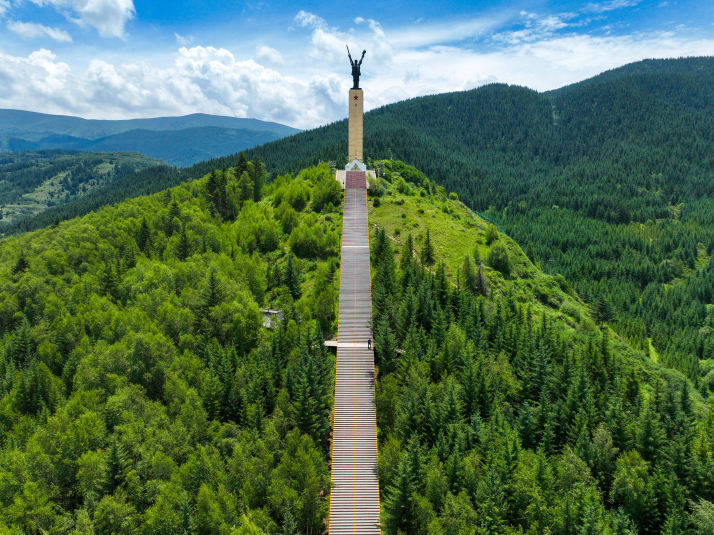 The Red Army Long March Monument in Songpan County, Aba Tibetan and Qiang Autonomous Prefecture, Sichuan Province, on July 8 (XINHUA)
Zhavier Harris, Marketing and Communications Manager of the Springfield Urban League, a community outreach non-profit in Springfield, Illinois in the U.S., has retraced part of the Long March route twice in a decade. Traveling through mountains and grasslands once crossed by the Red Army left a strong impression on him. He drew parallels between the Long March and struggles in other societies. "Every community has its own Long March," Harris told Beijing Review. "The details are different, but perseverance, sacrifice and hope for a better future are universal." For 21-year-old American-born Chinese videographer Skyler Gommeren, the trip also became a personal exploration of identity. "Seeing the actual battlefields and villages made it feel real in a way documentaries never could," he said. "You realize how much sacrifice was involved." Nearly 90 years after Snow took the Long March into living rooms around the world, the route still serves as a lens through which the world tries to understand both China's revolutionary past and its present transformation. Today, tourists and students move through places that were once battlefields. Yet along the route, memories of the Long March remain embedded in the fabric of local society, in family histories, local industries and the stories passed from one generation to the next. Copyedited by G.P. Wilson Comments to linan@cicgamericas.com Timeline of an Epic Military Maneuver October 1934: The First Front Army of the Chinese Workers' and Peasants' Red Army, or the Central Red Army, embarked on the Long March from Jiangxi and Fujian provinces. Later, other Red Army units started relocations from their own bases in Sichuan, Hunan and Henan provinces. November 25-December 1, 1934: The Battle of Xiangjiang River in present-day Guangxi Zhuang Autonomous Region was the fiercest and most brutal engagement fought against the Kuomintang troops during the Long March. In its aftermath, Central Red Army numbers were halved to roughly 30,000 soldiers. Despite the staggering amount of casualties, the Central Red Army succeeded in breaking through the Kuomintang troops' heavy defensive lines. January 1-6, 1935: The Central Red Army crossed the difficult Wujiang River, flanked by steep cliffs, in Guizhou Province. January 15-17, 1935: The Political Bureau of the Communist Party of China (CPC) Central Committee held an enlarged meeting in Zunyi, Guizhou. The pivotal gathering corrected previous military errors and mapped out new strategies. At the meeting, a new CPC central leadership with Mao Zedong at the helm was established. January 19-March 22, 1935: Mao applied a highly flexible strategy, which banked on unconventionality and unpredictability, to throw off the pursuing enemy by making the Central Red Army cross the Chishui River in Guizhou four times back and forth. May 3-9, 1935: By crossing the Jinsha River, the name given to the upper course of the Yangtze, in Yunnan Province, the Central Red Army successfully shook off the Kuomintang soldiers still pursuing it. May 24-June 2, 1935: The Central Red Army engaged in battle while crossing the Dadu River at the Anshunchang ferry point in Sichuan. Under a hail of bullets, a team of 18 commandos crossed the river by boat and took control of the ferry. A second team of 22 commandos then climbed on the iron chains of the Luding Bridge to take control, prevailing over the Kuomintang troops who had removed the planks of the bridge. This takeover opened a vital route for the Central Red Army to cross the river and continue northward. June 1935: Red Army soldiers succeeded in climbing Jiajin Mountain, literally meaning zigzag in Tibetan, a snow-capped mountain with an altitude of over 4,000 meters in Sichuan. August 1935: The Central Red Army crossed the desolate, marshy Songpan Grassland, or Zoige Marshland, in Sichuan, braving food shortages and countless other hardships. September 16-17, 1935: The Red Army started to cross the 30-meter-wide Lazikou Pass along the Minshan Mountain Range, a gateway to northwest Sichuan and south Gansu where Kuomintang troops were trying to trap them by taking advantage of the surrounding sheer cliffs. The Red Army then split into two divisions, launching attacks from both the front and back. The victory marked the army's departure from mountainous and marshy areas and the beginning of their journey north. October 19, 1935: The main force of the First Front Army of the Red Army arrived in Wuqi Town in Shaanxi Province, joining local Red Army troops who had set up a base area. Three days later, the Political Bureau of the CPC Central Committee held a meeting, reviewing performances and planning strategies. October 1936: The first, second and fourth front armies of the Red Army converged in Gansu, marking the end of the Long March. (Source: Compiled by Beijing Review) |
|
||||||||||||||||||||||||||||
|